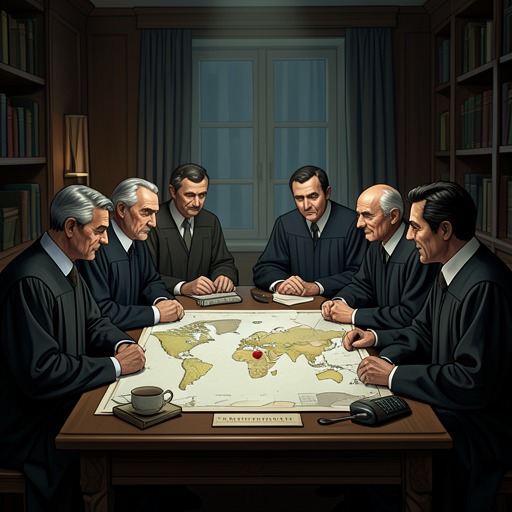
Bohr's Open World vision
American PrometheusNiels Bohr’s Open World vision was a proposal for making the conditions of scientific inquiry the basis of postwar security: atomic knowledge could not safely remain the guarded possession of rival states, and international control required transparency, inspection, and the Soviet Union’s participation before the war ended. Its importance in the book lies both in the reach of the proposal and in the difficulty of acting on it. J. Robert Oppenheimer heard in Bohr’s argument a way to turn the bomb from a military secret into a reason for international cooperation, but he did so inside a project organized around secrecy and surveillance.
From scientific openness to political security
For Bohr, the bomb’s arrival was not a distant possibility but an impending change in the conditions of warfare. In a memorandum drafted and revised in the spring of 1944, he treated the weapon as both a major achievement of science and a danger that could outlast any temporary national advantage. Unless governments agreed in time on control of the new active materials, he warned, the weapon’s power could become a continuing threat to human security. The problem, in this account, was not simply how to manage a new device. Atomic power demanded a new approach to international relations.
Bohr’s answer was an open world in which secrecy would give way to knowledge shared across national boundaries. He saw a practical precedent in the multinational communities of science: laboratories in Copenhagen and at Cavendish, among others, demonstrated forms of inquiry in which people from different countries could cooperate. Scientific exchange, in his reasoning, was not merely a useful professional habit. Shared investigation fostered knowledge and rationality, and imposed a corresponding responsibility on the people and nations able to shape human life through what they learned.
That responsibility led to a concrete test of confidence. No nation, Bohr argued, could feel secure if a potential enemy might be stockpiling atomic weapons beyond its view. International inspectors therefore needed access to military and industrial facilities, along with information about new scientific discoveries. Openness was not a decorative promise of goodwill: it was the means by which states might verify that atomic power was not being accumulated in secret. The vision joined a scientific norm of exchange to a political system of inspection and control.
The Soviet question and the timing of disclosure
Bohr’s proposal depended on involving the Soviet Union early, rather than presenting it with a completed atomic project after the war. He believed that a postwar control regime could be established only if Soviet participation were invited while the war was still underway and before the bomb became a fact. Informing Stalin that the Manhattan Project existed, and assuring him that it was not directed against the Soviet Union, might prevent secrecy from breeding suspicion. In Bohr’s view, an agreement among the wartime allies offered the alternative to a future in which several states possessed nuclear weapons and distrusted one another.
Peter Kapitza’s invitation to Bohr to come to Moscow sharpened the issue. Bohr hoped Franklin D. Roosevelt and Winston Churchill would allow him to accept it, and J. Robert Oppenheimer later explained the political possibility he saw in the invitation: the United States and Britain might exchange atomic knowledge for Soviet openness. Bohr suspected that Soviet physicists already knew something about the British-American program; concealing it could therefore intensify, rather than prevent, dangerous assumptions. Robert Wilson similarly worried that including British scientists at Los Alamos while excluding Russian scientists would create lasting resentment.
The proposal met a fundamentally different view among those directing the project. Leslie Groves regarded the Soviet Union as an enemy, not a partner in wartime planning, and Winston Churchill reacted angrily when British intelligence brought him news of the Kapitza-Bohr correspondence. The disagreement was not a minor dispute about communication. It exposed competing premises: Bohr treated shared knowledge and inspection as the conditions for security, while military leaders treated secrecy and strategic advantage as necessities. The book presents the open world as a serious political alternative, not as a policy already adopted by the governments involved.
Oppenheimer’s reception and the limits of action
J. Robert Oppenheimer was particularly receptive to Bohr’s political and ethical argument. After nearly two years of administrative work, he found Bohr’s attention to the project’s implications for humanity intellectually renewing. Bohr’s presence also changed how some scientists experienced their work: an undertaking that had seemed macabre could, through the prospect of international cooperation, appear to carry a hopeful purpose. Oppenheimer trusted Bohr as a thinker and later tried to translate his difficult ideas for others.
Yet receptiveness did not make Oppenheimer free to promote the proposal openly. He was under constant surveillance, and when colleagues asked why British scientists worked at Los Alamos but Soviet scientists did not, he generally declined to engage. He either stayed silent or said that decisions of that kind were not the scientists’ responsibility. His caution shows the distance between accepting the logic of openness and possessing the authority to put it into practice. The laboratory’s everyday structure made that distance visible: security rules restricted communication even among the American scientists working on the same project.
Oppenheimer’s response to Bohr thus developed within a real institutional contradiction. The scientific work required increasingly broad exchanges among researchers, while the military system tried to divide information into compartments. Oppenheimer supported open-ended discussion among the cleared scientists because their work was too complicated to proceed well without it. But such internal scientific exchange was not the same as opening the project to an international system of knowledge and inspection. Bohr’s vision asked for a transformation much larger than a more efficient laboratory.
From the laboratory to the postwar world
In March 1945, Oppenheimer used the logic of openness to argue that the war should not end with the bomb remaining a military secret. Addressing scientists who were troubled by the prospect of the weapon’s use, he argued that the world needed to know about it and that the project should proceed to a test. The approaching inaugural meeting of the United Nations made disclosure urgent: its delegates, he believed, should begin deliberating about the postwar order with knowledge of the weapon capable of changing it.
The reasoning connected the bomb’s existence to a challenge to national sovereignty. Oppenheimer and the scientists around him believed that some powers would have to be exercised through the United Nations rather than reserved to individual states. Robert Wilson recalled that this prospect helped him continue with the project. Oppenheimer’s argument did not make the weapon harmless or resolve the future of international control; it made public knowledge a necessary starting point for addressing the danger. In that sense, the open world was both a proposed safeguard and a demand that political institutions confront what science had made possible.
The vision’s force rests on the contrast between the scale of its ambition and the constraints around its advocates. It imagined inspection across military and industrial sites, shared scientific knowledge, and Soviet participation before the war ended. Meanwhile, the bomb project operated through restricted access, suspicion, and military authority. Oppenheimer could carry Bohr’s argument into discussions among scientists and use it to explain why the world had to know, but neither man controlled the governments whose agreement the proposal required. The open world therefore remains in the narrative a demanding alternative to the secrecy surrounding the bomb: specific enough to describe how cooperation might work, yet unresolved at the moment when its advocates most urgently called for it.