Dean Acheson
American PrometheusDean Acheson’s importance in the atomic-policy story rests on a consequential attempt to turn the bomb from a national secret into an internationally governed technology. As chair of a committee appointed by Harry S. Truman, he brought J. Robert Oppenheimer and other advisers into the work of designing a system for atomic energy; as the effort failed, he came to regard Bernard Baruch’s handling of the proposal as a lost opportunity to avert an uncontrolled arms race.
Government office and the atomic-policy problem
In late September 1945, while serving as Under Secretary of State, Acheson heard Oppenheimer describe the reluctance of many Manhattan Project scientists to continue weapons work after Hiroshima and the end of the war. Oppenheimer told him that colleagues felt such work was against the dictates of their hearts and spirits. The exchange placed Acheson in contact with a question that would soon define his work on atomic policy: whether the new technology could be governed in a way that addressed both its military danger and its potential civilian uses.
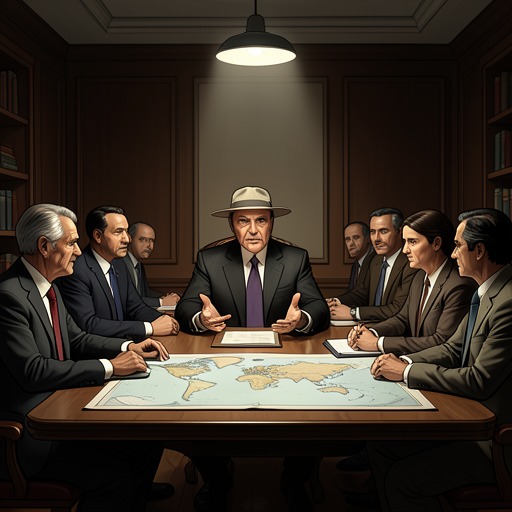
In late January 1946, negotiations among the Soviet Union, the United States, and other countries resulted in agreement to establish the United Nations Atomic Energy Commission. Truman then appointed a special committee to develop a concrete proposal for international control, with Acheson as chair. Its membership brought together prominent figures from government and public life, including John J. McCloy, Vannevar Bush, James B. Conant, and General Leslie Groves. When Acheson told his assistant Herbert Marks that he knew little about atomic energy, Marks proposed a Board of Consultants chaired by David Lilienthal. Acheson’s committee and Lilienthal’s board thus joined political authority and administrative experience to the technical knowledge the plan required.
Working with Oppenheimer and shaping a proposal
Oppenheimer was the only physicist on the Board of Consultants and, in the account of its deliberations, its central intellectual force. Acheson later recalled that the participants considered Oppenheimer the most stimulating and creative mind among them, and that he was especially constructive and accommodating on this task. That judgment matters because Oppenheimer could be argumentative and sharp in other settings; here, Acheson saw those qualities give way to collaboration around a shared problem.
Acheson also encountered Oppenheimer’s talent for making difficult science vivid. At a dinner at Acheson’s Georgetown home, Oppenheimer took chalk to a small blackboard and used stick figures to illustrate electrons, neutrons, and protons. When Acheson and McCloy’s questions seemed to rest on treating these particles as little people, Oppenheimer put down the chalk in gentle despair and told them, “It’s hopeless! I really think you two believe neutrons and electrons are little men!” The scene captures the comic friction between a physicist’s conceptual world and the officials who would have to make policy from it, but also Acheson’s willingness to be taught rather than pretend expertise.
By early March 1946, the Board had a draft report of about 34,000 words, written by Oppenheimer and reworked by Marks and Lilienthal. In mid-March, the group met for four full days in Washington at Dumbarton Oaks. The members read sections aloud; when they finished, Acheson removed his reading glasses and pronounced the document brilliant and profound. His response signaled more than approval of its technical reasoning: he was prepared to sponsor a sweeping political answer to the risks the report had identified.
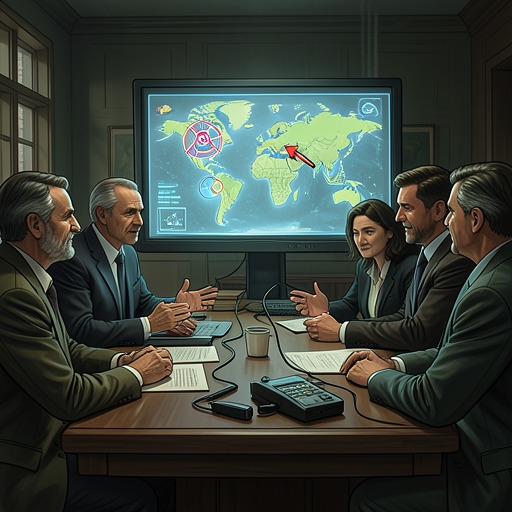
The proposal rejected the idea that a simple ban on atomic weapons, or international inspection alone, could reliably prevent diversion from civilian programs. More than 300 inspectors would be needed merely to monitor one uranium diffusion plant at Oak Ridge, while inspectors could struggle to detect the diversion of enriched uranium or plutonium from civilian facilities. The report treated peaceful atomic energy and the technical capacity to make weapons as inseparable. Its proposed Atomic Development Authority would monopolize the field internationally, control the technology, and distribute its benefits for civilian purposes. Because world government was not an immediate prospect, Oppenheimer argued for a partial surrender of national sovereignty in this domain. Acheson’s role was to lead a committee capable of considering that radical design as a serious policy proposal.
Baruch, diplomacy, and the plan’s defeat
Acheson and Lilienthal tried to keep the proposal alive through bureaucratic and public advocacy. Their effort brought them into conflict with Baruch, who complained that he was being undercut. Acheson nevertheless sought a meeting that might reconcile the competing approaches, arranging for the principals to gather at Blair House on May 17, 1946. The maneuver reflects his position as both sponsor of the international-control effort and intermediary among powerful officials whose aims were diverging.
The dispute was not only institutional. Oppenheimer had declined Baruch’s offer to serve as scientific adviser, then regretted the decision and asked James B. Conant whether he should reverse course. Conant told him that it was too late and Baruch had lost confidence in him. Acheson, Lilienthal, and Oppenheimer continued lobbying, but their influence could not control the plan’s presentation at the United Nations. On June 14, Baruch offered his own proposal, framing the choice in biblical terms as one between “the quick and the dead.” The Soviet Union rejected it, objecting to its veto provisions, and instead proposed a treaty banning the production or use of atomic weapons. Oppenheimer considered that response not unreasonable; the Truman Administration rejected it outright.
The negotiations continued for months without result. Acheson later assigned Baruch a large share of the blame, saying, “It was his [Baruch’s] ball and he balled it up. . . . He pretty well ruined the thing.” The judgment conveys Acheson’s sense that the failure was not inevitable: an opening for a serious effort at international control had been mishandled. The book presents the resulting breakdown as an early missed opportunity to prevent an uncontrolled nuclear arms race, while noting that later arms-control agreements came only after the Cuban missile crisis and the construction of tens of thousands of warheads.
Acheson amid suspicion and the Cold War
Acheson’s work on international control unfolded as atomic policy became entangled with domestic anticommunism. In the spring of 1946, J. Edgar Hoover investigated senior Truman Administration officials and circulated allegations about people associated with atomic-energy policy. The targets included Acheson, along with John J. McCloy, Herbert Marks, and Edward U. Condon. The investigations did not establish that these officials were disloyal; in the narrative, they illustrate how the demand to protect atomic secrets could be used to subject policy participants to surveillance and suspicion.
Acheson’s significance therefore lies partly in the contrast between the scale of the international proposal he helped convene and the increasingly narrow political conditions surrounding atomic policy. The committee could imagine shared authority over mines, plants, laboratories, and peaceful benefits; it could not make that vision prevail over distrust between the United States and the Soviet Union, Baruch’s approach, and the Truman Administration’s rejection of the Soviet response. Acheson’s later criticism of Baruch preserves his conviction that the failure was a political choice with consequences, rather than merely a technical disagreement among experts.