Dwight D. Eisenhower
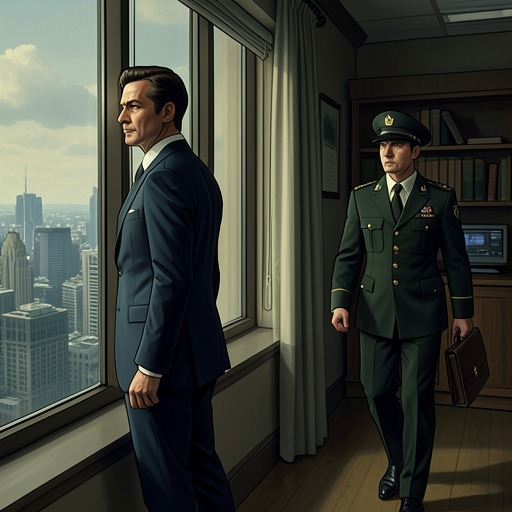
American PrometheusDwight D. Eisenhower’s relationship with J. Robert Oppenheimer turned on a stark reversal: as president, Eisenhower could appreciate Oppenheimer’s argument that nuclear policy required candor, yet he ultimately ordered him barred from classified information. The evidence presents Eisenhower neither as a simple architect of the campaign against Oppenheimer nor as a bystander. He considered the physicist’s warnings about nuclear war, absorbed suspicions advanced by Lewis Strauss and others, and chose an administrative response that helped make Oppenheimer the most prominent victim of the anticommunist campaign.
Identity and Political Setting
Eisenhower entered the White House in 1953, when advocates of massive nuclear retaliation gained influence and Strauss rose to the chairmanship of the United States Atomic Energy Commission. Oppenheimer, once a central government adviser, had become a critic of the secrecy and strategic assumptions surrounding nuclear policy. Their relationship took shape within this conflict over who could speak credibly about atomic weapons, what the public should know, and whether criticism of military policy could be treated as a security problem.
Eisenhower was not uniformly hostile to Oppenheimer’s position. After reading a speech in which Oppenheimer urged candor about nuclear dangers, the president was struck by its image of the United States and the Soviet Union as “two scorpions in a bottle.” Eisenhower himself doubted the strategic value of nuclear weapons, telling aide C. D. Jackson that atomic weapons favored a surprise attack, an approach the United States would not take, and that hysterical fear of other nations had arisen with the advent of atomic weapons. For a time, Oppenheimer’s argument seemed capable of influencing the new administration.
A Brief Opening for Nuclear Candor
In May 1953, Oppenheimer sought an urgent meeting with Eisenhower. After their initial conversation, the president invited him to brief the National Security Council. Oppenheimer spent five hours presenting arguments for candor and urging the creation of a five-member disarmament panel. Lee DuBridge accompanied him. C. D. Jackson later recalled that Oppenheimer held nearly everyone spellbound, with the president as the exception. Eisenhower thanked the physicist cordially but did not reveal his view; Jackson also reported that the president felt uneasy watching Oppenheimer’s influence over a small group.
The encounter occurred as Strauss was pressing his own case. Strauss had told Eisenhower that Oppenheimer could not be trusted and that the Atomic Energy Commission could not function with him connected to its program. Eisenhower’s uncertainty mattered: he had heard Oppenheimer’s case directly, but Strauss was also presenting the physicist’s past associations and policy disputes as grounds for suspicion. The possibility that Eisenhower might support a more candid nuclear discussion narrowed as Strauss gained power and repeatedly raised the Oppenheimer matter with him.
The “Blank Wall” Decision
On December 2, 1953, Secretary of Defense Charles E. Wilson told Eisenhower that a new Federal Bureau of Investigation report on Oppenheimer was the worst yet and warned that Senator Joseph McCarthy might use it. Eisenhower said he would not allow Oppenheimer’s character to be assassinated without substantiating evidence, and he doubted the government possessed that kind of proof. Yet he also decided to cut Oppenheimer off from government contacts. Before reading the report, Eisenhower wrote that its charges were grave; the following morning, after speaking with national security adviser Robert Cutler, he called Strauss to the Oval Office.
Eisenhower directed that a “complete bar” be erected between Oppenheimer and sensitive or classified information. After reviewing the charges, however, he recorded that they consisted of little more than a letter from William L. Borden and presented little new evidence. He also noted that the underlying information had been reviewed repeatedly and that the overall conclusion had been that there was no evidence implying Oppenheimer’s disloyalty. His distinction was consequential: he acknowledged the weakness of the case for disloyalty but still accepted that Oppenheimer might be a security risk.
Eisenhower formalized the exclusion by instructing the attorney general to place a “blank wall” between Oppenheimer and classified material. He understood that the physicist might be the target of scurrilous charges, but, having ordered an investigation, he was unwilling to halt the process and risk appearing to shield a possible security threat. The order therefore reflected both his doubts about the evidence and his decision to protect the administration from the political consequences of stopping the inquiry. The wall converted unresolved suspicion into immediate professional isolation.
Hearing, Verdict, and Consequences
The security hearing ended with Oppenheimer designated a security risk and his clearance revoked. The result made him the most prominent victim of the anticommunist campaign, while exposing scientists more broadly to the consequences of publicly challenging government policy. Eisenhower appeared satisfied with the outcome, though the account describes him as unaware of the tactics Strauss had used to obtain it. The hearing’s significance thus extended beyond what Eisenhower may have intended: a president who had once entertained Oppenheimer’s arguments presided over an administration in which the critic was formally excluded from the secrets and influence he had once possessed.
In mid-June 1954, Eisenhower suggested that Oppenheimer be put to work solving the problem of seawater desalination, writing that no scientific success could equal such a boon to humanity. Strauss quietly ignored the suggestion. The episode reveals a striking gap between the president’s apparent willingness to imagine a useful role for the physicist and the institutional reality created by the clearance decision. The proposal did not restore Oppenheimer’s access or reverse the hearing’s verdict.
Aftermath and the Limits of Dissent
The hearing altered Oppenheimer’s public conduct. In 1955, at a meeting of the Twentieth Century Fund, other participants discussed a possible public statement against precipitate military action during the crisis over the Formosa Strait. Oppenheimer agreed with the statement’s general position but said he should not sign because of the trouble it would cause. He also argued that a conflict did not necessarily lead from limited use of tactical atomic bombs to the wholesale bombing of cities, and cautioned against implying that Washington was not already considering the issues carefully. The group ultimately decided that a public statement might not be appropriate. His restraint stood in sharp contrast to his earlier advocacy of candid debate and reflected how the security case had changed the conditions under which he could speak.
By the 1960s, Oppenheimer said there was nothing he could do about the construction of backyard bomb shelters and that he would be the worst person to speak out against it. He also remained publicly silent as the Vietnam War escalated, although his private discussions with his son indicated skepticism about the administration’s growing commitment. These later silences do not establish Eisenhower’s personal responsibility for every subsequent choice, but they mark the wider consequence of the period in which Oppenheimer was removed from public influence. The prologue’s account of his 1967 memorial recalls the bitterness with which friends remembered his designation as a security risk. Eisenhower’s role in that history remains defined by the contradiction at its center: he could recognize that the evidence did not demonstrate disloyalty, yet still impose the barrier that helped silence one of the country’s most consequential advocates of nuclear candor.