Francis Fergusson
American PrometheusFrancis Fergusson was J. Robert Oppenheimer’s close friend from adolescence, an intimate witness to the young man’s awkwardness and brilliance, and later one of the principal sources for the story of his 1925–1926 crisis. Their friendship linked Oppenheimer’s sheltered schooldays to the upheaval of his first months in Europe and endured into old age. Fergusson’s testimony gives the biography some of its most vivid scenes, but also carries an important qualification: parts of what he recounted came from Oppenheimer himself, and the truth of those stories could remain uncertain.
A friend from school
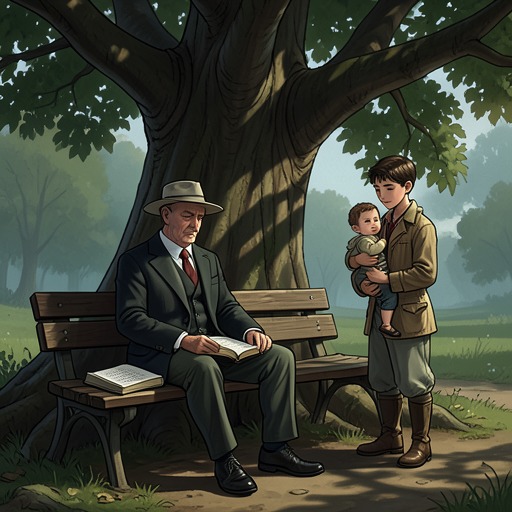
Fergusson, a scholarship student from New Mexico, became Oppenheimer’s classmate during their senior year at the Ethical Culture School. By the time they met in the fall of 1919, Oppenheimer was intellectually accomplished but socially adrift. He took courses across the humanities and sciences, added Greek, Latin, French, and German, and earned straight A’s; Fergusson remembered him as coasting, “trying to find something to keep himself occupied.” Oppenheimer graduated as valedictorian. At sixteen or seventeen, Fergusson was his one real friend.
The difference between them became more pronounced as they grew older. Fergusson was already more socially mature, and his ease with people could make Oppenheimer feel painfully behind. After two years apart, the friends arranged to meet in England in September 1925. Fergusson had spent two years as a Rhodes Scholar at Oxford, had changed his studies from biology to literature and poetry, and moved among upper-class English families. He had also had a girlfriend for several years. Oppenheimer, by contrast, remained uncertain about sex and intimacy. In a later account, Fergusson judged him “completely at a loss about his sex life.”
New Mexico and a shared world
Before their European reunion, the friends had traveled together in New Mexico. In Albuquerque, Fergusson introduced Oppenheimer to Paul Horgan, another precocious boy bound for Harvard. Horgan remembered Oppenheimer’s wit, gaiety, and ability to enter fully into the moment. He called the three young men “this great troika” of “polymaths.” The friendships and encounters in New Mexico drew Oppenheimer into a social world that was livelier and less protected than the one he had known at school.
Fergusson also accompanied Oppenheimer, Horgan, and Herbert Winslow Smith to Los Pinos, a dude ranch northeast of Santa Fe run by Katherine Chaves Page. Oppenheimer was intensely attracted to Page, who was newly married, and Fergusson recalled him bringing her flowers and flattering her. The visit was part of a lasting connection between Oppenheimer and New Mexico, but Fergusson’s importance to the biography is more than that of a companion on an early journey: he saw Oppenheimer’s sociability and romantic intensity before the Cambridge crisis made those qualities seem more precarious.
The 1925–1926 crisis
In September 1925, Oppenheimer and Fergusson met in Swanage, Dorset, and spent ten days walking the coastal cliffs and confiding in each other after two years apart. Fergusson later recalled that Oppenheimer seemed more self-confident, yet remained deeply inexperienced in his emotional life. Fergusson, by then more socially assured, spoke at length about his own experiences. In retrospect, he thought he had burdened Oppenheimer with too much, describing the episode as a “first-class mental rape.” The recollection presents their friendship as a source of trust, but also shows how easily Fergusson’s greater maturity could intensify Oppenheimer’s sense of inadequacy.
As Oppenheimer’s distress deepened that autumn, Fergusson learned of events that he later recorded in an account dated February 1926. One story concerned a train compartment: according to Fergusson’s account of what Oppenheimer told him, Oppenheimer kissed a woman, was overcome with remorse, and then imagined—or claimed—that he had dropped a suitcase on her head while leaving the station. The biographical narrative treats the reported attempt with caution: what happened in the compartment is uncertain, and the suitcase incident did not occur as described. The tale nonetheless conveys Oppenheimer’s distress and the fantastic, self-accusing stories through which he expressed it.
In Paris, during the winter break, Fergusson met Oppenheimer again. Oppenheimer had been seeing a London psychiatrist and feared that the Cambridge authorities might not let him return. His parents, Ella and Julius Oppenheimer, were trying to help, but Fergusson understood that their efforts were not succeeding. Oppenheimer was sleeping little and behaving erratically. In one episode, he locked his mother in a hotel room and left; afterward, she insisted that he see a French psychoanalyst.
Another Paris encounter became one of Fergusson’s most alarming recollections. When Fergusson told Oppenheimer that he had proposed to Frances Keeley and she had accepted, Oppenheimer attacked him from behind with a trunk strap, winding it around his neck. Fergusson was frightened, but managed to pull away; Oppenheimer fell to the ground weeping. Fergusson later considered jealousy a possible explanation, particularly since Oppenheimer had already felt the loss of a friend to marriage. But the biographical account also raises a question about the limits of Fergusson’s memory and narration: Herbert Winslow Smith had warned him to handle Oppenheimer tactfully, while also recalling that Fergusson himself had once reacted violently when socially intimidated. The account does not erase Fergusson’s testimony; it places it within the uncertainty surrounding a crisis that Oppenheimer partly disclosed and partly obscured.
A witness to uncertain stories
Fergusson’s recollections were especially important in clarifying the poisoned-apple episode involving Oppenheimer’s Cambridge mentor, Patrick Blackett. Decades later, other acquaintances remembered Oppenheimer saying in Corsica that he had poisoned an apple and needed to return to see what had happened; they could not tell whether this was real or imagined. Fergusson, interviewed by Martin Sherwin in 1979, placed the incident in Oppenheimer’s first Cambridge term, in late 1925, before his visits to the psychiatrist. He told Alice Kimball Smith in 1976 that he had assumed the poisoning attempt was probably true, while acknowledging that Oppenheimer had been doing “all sorts of crazy things then.” Smith regarded Fergusson as a careful witness who did not pretend to remember what he could not.
Fergusson’s account of the crisis was not based solely on scenes he had observed. He acknowledged that he witnessed only some of the events and that details in his written account could only have come from Oppenheimer. The friend’s confidences remained private for many years; Fergusson did not reveal them until after Oppenheimer’s death. That delay, together with his explicit uncertainty about some incidents, makes his testimony both unusually intimate and necessarily qualified. It allows the biography to follow a private crisis without presenting every remembered or retold episode as established fact.
Friendship through the final years
Fergusson remained close to Oppenheimer long after their youth. In the aftermath of the 1954 security hearing, he was startled by Oppenheimer’s altered appearance: at fifty, his short, speckled-gray hair had turned silver white, and he looked older than his age. Oppenheimer told him he had been a “damn fool” and probably deserved what had happened—not because he believed himself guilty, but because he had made real mistakes, including claiming knowledge he did not have. Fergusson thought vanity had contributed to some of those errors. He remembered his friend as “like a wounded animal,” retreating and returning to a simpler life.
The friendship also remained part of Oppenheimer’s later private world. When Oppenheimer and Katherine (Kitty) Oppenheimer invited Fergusson to spend Easter week on St. John, Oppenheimer caught a bad cold and spent most of the visit in bed. Kitty took Fergusson on long beach walks and pointed out the island’s flora. The visit offered a quieter, domestic counterpoint to the public ordeal that had marked Oppenheimer’s later life.
On February 17, 1967, Fergusson visited Oppenheimer at home. He could see that Oppenheimer was gravely ill: though still able to walk, he weighed less than a hundred pounds. After they sat together in the dining room, Fergusson led him to his bedroom and left. The next day, he learned that Oppenheimer had died in his sleep. Their friendship thus closes not with a dramatic reconciliation or final disclosure, but with the ordinary gesture of a friend walking a dying man to bed. Across decades, Fergusson had been companion, witness, and keeper of difficult confidences; his recollections preserve both the intimacy of that role and the limits of what even a close friend could know.