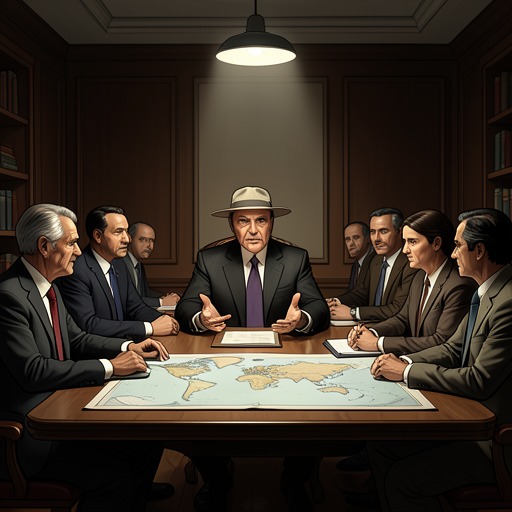
Henry L. Stimson
American PrometheusHenry L. Stimson was secretary of war during the final months of the Second World War and a central official in the first debates over atomic weapons. His role was marked by a consequential tension: he recognized that the bomb could transform international relations and raised the possibility of restraint and cooperation, even as the government moved toward using it against Japan without warning. His trust in J. Robert Oppenheimer gave that debate a personal dimension, culminating in a parting gesture that placed the postwar atomic question, symbolically, in Oppenheimer’s hands.
Secretary of War and the moral question of bombing
As the Pacific war approached its climax, the firebombing of Japanese cities made the scale of civilian destruction impossible to treat as an abstraction. The raids were public knowledge, and Stimson later told Oppenheimer that he considered it appalling that they had provoked no protest. He did not say the air strikes should stop; what troubled him was the absence of public questioning in a country carrying them out. His concern was therefore not a recorded repudiation of strategic bombing, but an insistence that the ethical question itself mattered.
That distinction became important as the atomic bomb neared completion. Stimson chaired the Interim Committee, an ad hoc group advising him on atomic policy, and controlled the agenda at its May 31 meeting. The committee did not decide whether the bomb should be used against Japan; that decision was treated as effectively settled and reserved to the White House. Stimson nevertheless presented the weapon as more than a new instrument of war. He described it as a revolutionary change in humanity’s relation to the universe, one that might become a Frankenstein or, alternatively, help secure global peace. Its consequences, he emphasized, reached beyond the immediate war.
Atomic policy: use, restraint, and openness
The meeting joined the question of immediate military use to the broader problem of what kind of world would follow. Stimson turned discussion toward future weapons development, while Oppenheimer urged that wartime work not permanently consume scientific life. Stimson heard Oppenheimer argue that most scientists should return to universities and research laboratories after the war, rather than have the Manhattan Project continue to dominate inquiry. The issue was not simply staffing: it was whether the enormous wartime mobilization would become the lasting model for science.
On peacetime uses of atomic energy, Oppenheimer proposed an exchange of fundamental information, arguing that an offer made before the bomb was used would strengthen the United States’ moral position. Stimson took up the possibility of self-restraint and an international organization with inspection powers. General George C. Marshall cautioned that inspection might not work and identified Russia as the paramount concern. Oppenheimer answered that a tentative opening of discussions could be attempted without disclosing production details, appealing to the common interests of scientists. The resulting discussion did not settle the issue, but it brought international control and scientific openness into the room alongside military planning.
The committee’s consideration of targets produced a sharper contradiction. Its members agreed that the Japanese should receive no warning and that the bomb should not be aimed at a civilian area, while also seeking a profound psychological impression on as many inhabitants as possible. Stimson summarized the proposed target as a vital war plant employing many workers and surrounded by workers’ houses. In practice, this formula placed civilians close to the center of the intended effect. J. Robert Oppenheimer did not object to the defined target; he instead raised the possibility of simultaneous strikes, which General Leslie Groves rejected. The minutes also recorded agreement that scientists considered insufficiently discreet or loyal would be separated from the program after the bomb’s use. Stimson’s committee thus entertained future restraint while participating in the immediate arrangements for atomic attack.
Confidence in Oppenheimer and the problem of dissent
Stimson’s relationship with Oppenheimer rested on a degree of trust uncommon in the official world surrounding the project. Oppenheimer was asked to consult on atomic policy, and he sought the views of colleagues such as Robert Wilson about the proposed use of the weapon. The consultation did not mean that scientists controlled the decision: Stimson’s own agenda made clear that the choice of military use belonged elsewhere. But Oppenheimer’s place in these discussions gave him a channel to present arguments about targets, international openness, and the postwar direction of science.
That channel became contested when Leo Szilard tried to prevent the bomb’s use. Oppenheimer considered a petition opposing immediate use redundant, reasoning that scientists had already had an opportunity to express their views through him. He would not expedite it to Washington; it was sent through ordinary Army channels and arrived too late. He also informed General Leslie Groves about Szilard’s efforts. Stimson’s meeting had permitted scientific advice, but the episode revealed the limits of that permission: access to deliberation did not guarantee that dissenting proposals would be transmitted promptly or given decisive weight.
A final handover
After the bombings, Oppenheimer’s assessments grew more explicitly bleak. In a report to Stimson, he and the other scientific advisers warned that no military countermeasures would adequately prevent atomic weapons from being delivered. Scientific superiority, the report argued, could not ensure the nation’s safety; security depended on making future wars impossible. Oppenheimer personally carried the letter to Washington and found little encouragement for collaboration or international control.
On Friday, September 21, 1945, Stimson’s final day as secretary of war and his seventy-eighth birthday, he was preparing to make one last appeal to Harry S. Truman. He intended to urge an approach to the Soviet Union that would offer to share the bomb on appropriate reciprocal terms. Oppenheimer, who genuinely liked and trusted him, briefed him again on technical aspects of the weapon. Stimson then asked Oppenheimer to accompany him to the Pentagon barbershop. After his hair was trimmed, he rose, shook Oppenheimer’s hand, and said, “Now it is in your hands.” The words joined personal confidence to an unsettled public burden: Stimson was leaving office just as the struggle over atomic policy was beginning in earnest.
Significance
Stimson’s record does not resolve into either simple opposition to the bomb or unqualified faith in its power. He acknowledged the ethical wound of unprotested city bombing, recognized that atomic weapons demanded a response beyond the needs of the current war, and entertained international inspection and scientific exchange. At the same time, as chair of the Interim Committee, he presided over deliberations that accepted no warning and a target intended to create a vast psychological effect. The contrast between those positions marks the early atomic debate: moral unease and proposals for restraint coexisted with decisions that made civilian exposure part of the strategy.
His departure also frames Oppenheimer’s postwar role. Stimson’s confidence did not give the physicist authority over policy, but it affirmed him as a trusted adviser at the moment the government’s wartime structure was giving way to a new contest over secrecy, international control, and the future purpose of scientific work. The handclasp at the Pentagon was therefore both an intimate farewell and a transfer of responsibility without any assurance that the arguments Stimson and Oppenheimer had raised would prevail.