J. Robert Oppenheimer
American PrometheusJ. Robert Oppenheimer was a theoretical physicist, wartime director of the Los Alamos Laboratory, and influential adviser on nuclear policy whose career traced the possibilities and costs of scientific power. He helped build the atomic bomb, then warned that no military defense could reliably protect the United States from atomic weapons and argued for international control. In 1954, the government judged him a security risk and revoked his clearance. His ascent and exclusion were not separate stories: both turned on his ability to persuade, his political past, and the question of whether scientific expertise could shape decisions made in the name of national security.
Identity and formation
Oppenheimer’s early life presented a sharp contrast to the public figure he became. He later described himself as an “unctuous, repulsively good little boy” and said that childhood had not prepared him for a world full of cruelty. His sheltered upbringing offered few ordinary ways to express anger, but the biography connects it with an inner toughness and physical stoicism that he may not have recognized in himself. That reserve would accompany a personality remembered as brilliant and charismatic, but also enigmatic and difficult to read.
A severe emotional crisis threatened him in 1925–26. In Göttingen, achievement helped alter the course of that crisis: during nine months he found academic success, renewed confidence, and a new sense of his own worth. His later image of scientific work as climbing through a mountain tunnel captured the uncertainty of research on the edge of the quantum revolution. He was not a leading participant in its first flowering, but possessed the intellect and drive to make physics his life’s work.
By the spring of 1928, ten American universities, including Harvard, and two institutions abroad had offered him positions. He accepted appointments at the University of California, Berkeley, and the California Institute of Technology, planning to teach a semester at each. Berkeley appealed because its physics program lacked a theoretical component; he saw an opportunity to create one. When he left Zurich for the United States in June 1929, his work had already given him an international reputation. Between 1926 and 1929 he published sixteen papers, an unusually large output for a young physicist.
Scientific work and teaching
Under Wolfgang Pauli’s supervision, Oppenheimer mastered continuum wave functions and made important contributions to calculations involving X-ray absorption and the elastic and inelastic scattering of electrons. Robert Serber later regarded Oppenheimer’s theory of field emission as his most original early contribution: it made it possible to study electrons emitted from metals under a very strong electric field. His work combined wide-ranging command of new theoretical problems with a readiness to make a difficult calculation or unfamiliar idea accessible to others.
On February 14, 1930, he completed a paper arguing that the electron must have a positively charged counterpart with the same mass. Against the suggestion that this counterpart was a proton, he proposed an anti-electron, later identified as the positron. The implication was that a form of matter with the electron’s mass and opposite charge could exist. Paul Dirac had not drawn that conclusion from his own equation; he credited Oppenheimer’s insight and then proposed the possibility of a new particle. The episode shows Oppenheimer working not in isolation from his scientific peers but within a fast-moving exchange in which a theoretical implication could redirect another physicist’s thinking.
His late-1930s research on neutron stars became, in retrospect, some of his most consequential scientific work. Friendship with Richard Tolman brought him into contact with astronomers at the Mt. Wilson Observatory and helped spark his interest in astrophysics. In 1938, he and Serber examined the properties of compressed stars in “The Stability of Stellar Neutron Cores.” He then collaborated with George Volkoff on calculations suggesting an upper mass limit for neutron stars, now known as the Oppenheimer-Volkoff limit. Their work was done laboriously with slide rules; the astronomical object it described would not be observed until 1967.
On September 1, 1939, Oppenheimer and Hartland Snyder published “On Continued Gravitational Contraction.” The date became known for the invasion of Poland and the beginning of the Second World War, while the paper attracted little notice at the time. Later physicists recognized it as a major contribution that opened a path toward modern work on gravitational collapse. The difference between the paper’s quiet reception and its later importance mirrors a recurring feature of Oppenheimer’s career: the significance of his work was not always apparent when it was done.
At Berkeley, his role extended beyond research. Students called him Opje, a Dutch nickname he had acquired in Leiden; he began using it in his letters, and his students gradually Anglicized it to Oppie. A colleague described his habit of helping people with their problems and then giving them the credit. That generous, persuasive teacher became a leader whose influence was not limited to his own papers: he helped shape a major center for theoretical physics and developed the interpersonal authority that wartime scientific organization would demand.
Political commitments and unresolved affiliations
In the 1930s, the Depression and the rise of fascism drew Oppenheimer toward struggles for economic and racial justice. Jean Tatlock’s activism and social conscience helped awaken in him a sense of responsibility that had been discussed at the Ethical Culture School. He became active in Popular Front causes, working with friends whose political circles included fellow travelers and communists. The biography presents this activism as part of a wider change in his life, not simply as a label imposed later by investigators.
The exact nature of his relationship with the Communist Party remained uncertain. Friends generally knew where his sympathies lay, but the evidence did not settle whether he had belonged to the Party. Oppenheimer described Haakon Chevalier as a left-wing intellectual with broad connections to front organizations, a description that could also have fit Oppenheimer himself. Chevalier’s later fiction sharpened the dispute: in a novel begun before the security hearing and published in 1959, a brilliant physicist who builds an atomic bomb leads a Communist closed unit. Oppenheimer objected directly to that portrayal, writing that he had never been a Party member and therefore had never belonged to a Party unit. The tension between political association and formal membership would become central to assessments of his trustworthiness.
The Chevalier affair began with a brief conversation in the winter of 1942–43 at Oppenheimer’s home. Its importance grew from the way he later handled it; different accounts made it resemble a story whose meaning shifted with the perspective of each participant. In 1943, an Army counterintelligence officer recommended that Oppenheimer be denied clearance and dismissed, citing circumstantial evidence of continuing Communist connections, including a visit to Tatlock and a telephone call to David Hawkins. Oppenheimer assured Boris Pash that matters at Los Alamos were in order and said he would be willing to be shot if he had done anything wrong. Later that year, when Leslie Groves ordered him to identify the intermediary connected to a request from George C. Eltenton, Oppenheimer reluctantly named Chevalier while insisting that his friend was harmless and had not engaged in espionage. The affair remained a lasting source of suspicion because his disclosures changed under questioning and because the stakes of candor and loyalty were inseparable.
Wartime leadership at Los Alamos
By the time Oppenheimer was invited to uranium-problem meetings, he had become an increasingly indispensable scientific organizer. Colleagues valued his deep understanding of theory, practical judgment, interpersonal skill, and infectious enthusiasm. In May 1942, he became director of fast-neutron research for the S-1 program, with the unusual title Coordinator of Rapid Rupture. He soon organized a secret summer seminar of leading theoretical physicists to outline a basic atomic-bomb design.
His next role required more than scientific command. As director of a weapons laboratory meant to bring together the far-flung work of the Manhattan Project and rapidly produce a usable weapon, he had to acquire administrative skills, establish new work habits, and adapt to security practices that felt alien to his earlier life. He did so at speed, but the transformation was costly. He carefully pinned classified memoranda inside his pocket and complied with almost all Army security requests, even as investigations into his past, the pressure of the work, and the feeling of constant surveillance wore him down. In the summer of 1943 he told Robert Bacher he was thinking of quitting. Bacher’s answer was that nobody else could do the job.
The appointment thus depended on a paradox: the government relied on a man whose past it continued to investigate. Oppenheimer’s reassurance to Pash, his subsequent naming of Chevalier, and Groves’s confidence in his integrity formed a sequence in which cooperation did not end suspicion. Groves considered himself a good judge of character and believed Oppenheimer trustworthy, but the investigation continued to gather and reinterpret details about the physicist’s political circle.
Oppenheimer’s scientific leadership also meant choosing among technically uncertain paths. Although initially skeptical of implosion, he later argued that the project should stake its effort on an implosion-design plutonium bomb. Progress had been slow after Seth Neddermeyer began experimenting with the idea, but John von Neumann’s theoretical calculations persuaded Oppenheimer that implosion was possible. He accepted the risk rather than allow the project to lose time pursuing alternatives he considered inadequate.
Niels Bohr’s arrival at Los Alamos in December 1943 redirected Oppenheimer’s attention from the immediate problems of running the laboratory toward the consequences of the weapon. Bohr asked whether the bomb would be powerful enough to make future wars inconceivable. Oppenheimer understood the larger question, after more than a year spent concentrating on the practical and administrative demands of the laboratory. The exchange helped place postwar consequences alongside the work of construction, even though Oppenheimer would later support direct military use of the bomb.
The bomb and the politics of responsibility
In June 1945, Oppenheimer met with the Scientific Panel to consider its recommendations to the Interim Committee. The discussion included the proposal for a dramatic but non-lethal demonstration of the bomb. Oppenheimer set out anxieties and arguments against dropping it but did not endorse those objections. He and the other scientists concluded that they could propose no technical demonstration likely to end the war and saw no acceptable alternative to direct military use. Their reasoning rested partly on the hope that using the bomb might prevent future wars, even as they recognized the distinction between ending a war and eliminating the weapon itself.
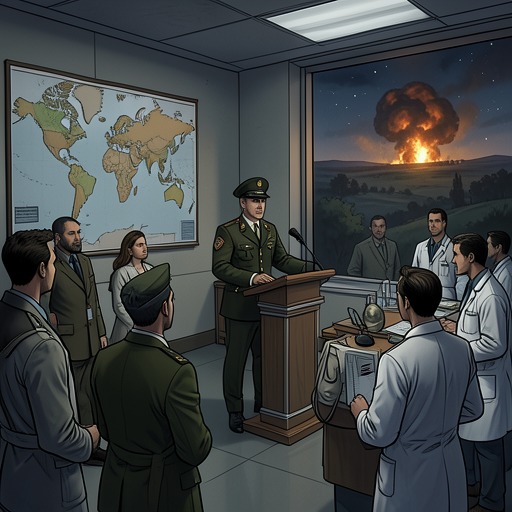
He also pressed for a full-scale test of the implosion device. Leslie Groves initially resisted, concerned that plutonium was too scarce to waste. Oppenheimer argued that the project’s incomplete knowledge made a test essential; without one, planning to use the weapon over enemy territory would be substantially blind. The target date moved from July 4 to July 16 under pressure to deliver a tested weapon before the Potsdam Conference ended. At the Trinity test, Oppenheimer lay facedown outside the control bunker, 10,000 yards south of ground zero. During the final minutes he grew tense; after the flash and the roar, an observer saw his face relax in relief.
The test did not settle his concerns about what came next. In a report to Secretary of War Henry L. Stimson, Oppenheimer and the Scientific Panel concluded that no military countermeasures would adequately prevent atomic weapons from being delivered. They warned that future weapons would become larger and more lethal, and that even an American monopoly could not guarantee safety. This assessment turned his scientific authority toward a political argument: possession of the bomb could not, by itself, secure the nation against the destruction it made possible.
After the war, Oppenheimer used his new prominence to advocate for scientists and for international control. About 500 Los Alamos scientists met on August 30, 1945, and formed the Association of Los Alamos Scientists. Their statement warned of an arms race, the impossibility of effective defense against atomic weapons, and the need for international control. Oppenheimer was asked to forward the document to the War Department, and its authors expected it to be released to the press.
He later played a leading role in the Acheson-Lilienthal Board of Consultants. As its only physicist, he impressed the group with the clarity of his arguments and pressed for unanimity. His proposal was an international Atomic Development Authority that would control atomic technology while developing it for civilian purposes. The plan called for shared authority over uranium mines, power plants, and laboratories, and for countries to surrender some sovereignty in this field. Oppenheimer linked that institutional proposal to a larger conviction: permanent peace required a political order capable of preventing atomic warfare.
His opposition to an accelerated hydrogen-bomb program followed the same concern about what weapons could accomplish and what they could not. In 1949, the General Advisory Committee opposed a crash program on scientific, technical, and moral grounds. Oppenheimer considered, but did not join, a proposal by Isidor Rabi and Enrico Fermi to invite other nations to pledge not to build the weapon. The committee majority concluded that the hydrogen bomb was neither necessary as a deterrent nor beneficial to American security. Oppenheimer’s stand increased the gap between his policy judgment and the officials who favored rapid development.
Exclusion, later years, and legacy
Oppenheimer’s disagreements with Washington accumulated. By 1952 he was frustrated by the rejection of his advice and resigned from the General Advisory Committee with James B. Conant and Lee DuBridge. He told his brother that he intended to return his attention to physics. Yet he continued to speak on nuclear policy. In February 1953, while Joe Weinberg still faced the consequences of his own investigation, Oppenheimer addressed an elite meeting of the Council on Foreign Relations. With the administration’s consent, he presented an unclassified version of a disarmament report urging candor about nuclear weapons. Lewis Strauss, appointed atomic-energy adviser and then chairman of the United States Atomic Energy Commission, was an increasingly powerful opponent of Oppenheimer’s influence.
A letter delivered by Strauss four days before Christmas 1953 made that conflict personal and immediate. It declared Oppenheimer a security risk and set out thirty-four charges concerning his background and policy recommendations. As he traveled to his lawyer’s home in Georgetown, he exclaimed that he could not believe what was happening. He had to choose between resigning from his advisory positions and contesting the charges. He chose to fight. The decision initiated a formal security proceeding that tested not only his political associations but also his scientific judgments and character.
The hearing exposed the strain that had marked earlier encounters with investigators. In 1949, Oppenheimer had appeared before the House Committee on Un-American Activities without a personal lawyer, bringing the Atomic Energy Commission’s general counsel and cooperating with questions about atomic espionage. After his testimony implicated Bernard Peters, David Bohm later asked why he had spoken as he did. Bohm recalled Oppenheimer saying that his nerve had given way and that he could not understand his own conduct. The episode echoed earlier moments under pressure, including his interview with Pash and his meeting with Harry S. Truman. It complicated any simple portrait of him as either calculating or fearless.
During the 1954 hearing, Katherine Oppenheimer testified about her Communist past with controlled precision, drawing on a self-command learned in childhood. On the final day, after nearly four weeks of humiliation, Oppenheimer thanked the board for its patience and consideration, a conciliatory gesture intended to show that he remained reasonable and trustworthy. On May 23, the board ruled by two votes to one that he was loyal but nevertheless a security risk. It cited his associations, his susceptibility to influence, his conduct in the hydrogen-bomb program, and doubts about his future participation in defense work. The commission rescinded his clearance one day before it was due to expire.
The verdict removed Oppenheimer from the levers of federal policy but did not give him the freedom to return untroubled to public debate. He wanted to influence events, yet his exclusion left him frustrated and, in his brother’s view, still longing to return to official circles. Rather than renew the activism that had marked the 1930s, he increasingly censored himself. His later reflections placed ethical responsibility in the tension between choice and power: knowledge alone did not define responsibility; what a person was able to do mattered too.
Oppenheimer died in his sleep on February 18, 1967, aged sixty-two; his remains were cremated two days later. On February 25, six hundred friends and colleagues gathered in Princeton to mourn him, among them scientists, politicians, generals, writers, and artists. Some remembered a gentle teacher called Oppie, others a great physicist and public servant, and many recalled the bitter fact that the government had made him the most prominent victim of its anticommunist campaign. His reputation remained divided: to some he embodied the tragedy of the modern nuclear scientist, to others a martyr of the political purge, and to his enemies a Communist and a liar. The tensions were not resolved by his death. They were the substance of his public legacy: scientific brilliance and political vulnerability, persuasive leadership and emotional reserve, service to the state and refusal to accept that the state’s choices were beyond moral judgment.