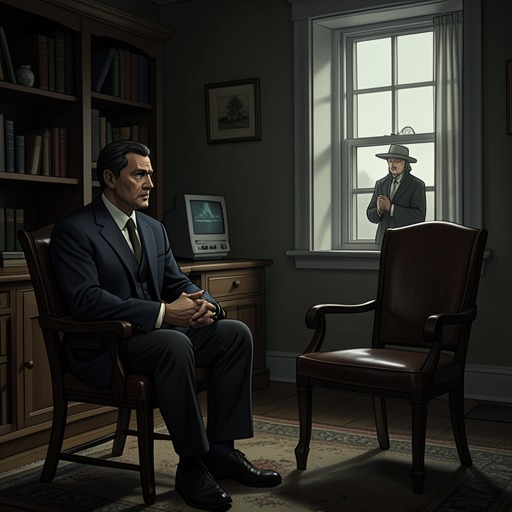
J. Robert Oppenheimer—Julius Oppenheimer relationship
American PrometheusJ. Robert Oppenheimer’s relationship with Julius Oppenheimer was neither simple rebellion nor uncomplicated filial closeness. Robert loved his father and, as an adult, went to unusual lengths to include him in his life; as a sensitive boy, however, he could be embarrassed by Julius’s exuberance and by the world of commerce he represented. Their bond held affection and discomfort together, a private tension that the biography treats as part of the background to Robert’s later public character.
Family Life and Contrasting Temperaments
Julius Oppenheimer was a prosperous businessman whose wealth gave the family a notably comfortable life. On weekends, the family rode into the countryside in a Packard, and when Robert was eleven or twelve, Julius bought a summer home at Bay Shore on Long Island. There Robert learned to sail. Julius kept a forty-foot yacht, the Lorelei, moored at the pier below the house; the property also included seven acres, a vegetable garden, and many flowers. This was a childhood of substantial material privilege, but accounts of Robert do not reduce his character to that privilege: friends remembered him as generous rather than spoiled.
The parents’ temperaments sharpened the contrast Robert experienced at home. Julius was a conversationalist and extrovert who enjoyed art, music, and argument; he might even burst into song at the dinner table, to his sons’ embarrassment. Ella Friedman Oppenheimer, by contrast, was quiet, emotionally delicate, and attentive to decorum. Their marriage was described as loving, but Robert grew up caught between his mother’s strict standards and his father’s more spontaneous, sociable manner. The tension was not evidence that he lacked affection for Julius. It was part of the difficulty of loving a parent whose way of moving through the world could also make a son self-conscious.
Embarrassment, Loyalty, and the Garment Business
Robert sensed that his mother was uncomfortable with people in Julius’s commercial world, many of whom were first-generation Jews. He therefore encountered his father’s business not only as a source of the family’s comfort but also through the social judgments surrounding it. As an adolescent, he became increasingly self-conscious about Julius’s garment trade, which he associated with a traditional Jewish occupation. Julius’s open pride in his son could irritate Robert; Robert then felt guilty for being irritated. His response was divided rather than simply rejecting: embarrassment and shame coexisted with attachment.
A small exchange years later made that division audible. During a Western trip in 1922, Herbert Winslow Smith asked Robert to fold a jacket for a suitcase. Robert answered, “Oh yes. The tailor’s son would know how to do that, wouldn’t he?” The remark carried the sting of a social identity he had not made peace with. It also condensed the pressure between his own ambitions and the family trade from which those ambitions had emerged. The anecdote does not establish that Robert repudiated his father; rather, it shows how readily the father’s occupation could become a point at which Robert’s pride and discomfort collided.
An Adult Son’s Devotion
The boy’s embarrassment did not become a lasting estrangement. Smith later recalled that as an adult Robert clearly loved and deferred to Julius. Until his father’s death, Robert made extraordinary efforts to accommodate him, introduce him to friends, and make room for him in his life. Those practical gestures matter: devotion appears not only as a declared feeling but as the repeated work of bringing a parent into one’s social world, even when earlier family tensions had made that world difficult to navigate.
The difference between Robert’s youthful reactions and his adult conduct gives the relationship its complexity. The son who could be mortified by Julius’s affability also remained attentive to his father and took pains to include him. The evidence supports neither a clean break from the family nor a story in which affection erased every discomfort. Instead, Robert’s adult loyalty existed alongside the memories of childhood shame and the guilt attached to it.
Place in the Biography
The biography follows Robert from childhood through a life of scientific prominence and public controversy, and it explicitly argues that private experience helps shape public behavior and policy decisions. The father-son relationship contributes to that approach by showing the intimate contrasts behind the public figure: a prosperous and expressive father, a shy and sensitive son, and the son’s gradual capacity to accommodate a relationship that had once exposed him to embarrassment. These details do not, by themselves, prove a direct cause for any later decision. They give the reader a grounded account of one lasting family bond within the wider life the book reconstructs.