Katherine Oppenheimer
American PrometheusKatherine Oppenheimer’s life in the biography is shaped by the distance between her own ambitions and the demands of J. Robert Oppenheimer’s career. A politically active young woman and an aspiring botanist, she entered the isolated world of Los Alamos as a wife and mother while her husband’s work took precedence. Her story there is marked by professional frustration, mounting strain at home, and, later, a conspicuous role beside him during the security proceedings that threatened his standing.
Political Background and Independent Ambitions
Katherine’s past was not incidental to the public crisis surrounding her husband. About twenty years before his security ordeal, she had stood outside factory gates in Youngstown, Ohio, distributing Communist literature. In the eyes of the legal team, that earlier political life formed part of the indictment against J. Robert Oppenheimer; Katherine herself might have to testify, making the case an ordeal for her as well as for him. The past that had once expressed her own convictions had become evidence to be managed in a proceeding centered on her husband.
Her history also included a brief connection with Joe Dallet: she met Earl Browder once when he came to Youngstown to see Dallet, and they had dinner together. The surviving account supplies little more about the encounter, but it places her in a political world that preceded her life at Los Alamos. In the later crisis, that past was not simply background. It was part of what made the scrutiny of J. Robert Oppenheimer a threat to Katherine’s own privacy and reputation.
She also had ambitions beyond politics and marriage. At Los Alamos she wanted to become a botanist, but found that the mesa offered little room for her to develop professionally. After spending a year doing blood counts for Dr. Hempelmann, she quit. The contrast is sharp: her husband’s work drew extraordinary institutional attention, while her own professional prospects narrowed to a job she ultimately left. The biography presents this frustration alongside the isolation of the place, rather than treating her unhappiness as a private temperament detached from circumstance.
Los Alamos: Work, Isolation, and Domestic Life
Los Alamos was becoming more comfortable, though never luxurious. Soldiers supplied firewood, collected garbage, and stoked coal furnaces; the Army also bused Pueblo Indian women from San Ildefonso to work as housekeepers. Residents called these workers their half-days, after their daily half-day shifts. The arrangement helped sustain household life in the isolated community, but it also shows the labor that made the scientists’ domestic world possible. Katherine’s own experience of the mesa was less accommodating: she felt socially isolated, professionally thwarted, and increasingly trapped by a place organized around her husband’s work.
At times she could be warm and charming with friends or strangers, but acquaintances also sensed a sharp edge and persistent tension. At gatherings she could manage small talk, yet, as one friend put it, she wanted to make big talk. Joseph Rotblat, who saw her at parties and at the Oppenheimer home, remembered her as aloof and haughty. These judgments are witnesses’ impressions, not a complete account of her character. Read beside her blocked ambitions and isolation, they register the difficulty of making a life in a community whose rhythms and opportunities were not hers to set.
The Army’s security measures entered even the family’s everyday routines. Armed military police were stationed outside the Oppenheimers’ Bathtub Row house and checked every visitor’s pass, including Katherine’s. She often forgot her pass when she went out and made a scene when the guards would not let her back in. She could also turn the inconvenience to practical use, occasionally relying on the MPs to watch Peter; when the sergeant realized what was happening, he withdrew the detail. The episode captures both the intrusion of security into home life and Katherine’s readiness to improvise within it.
Marriage, Children, and Strain
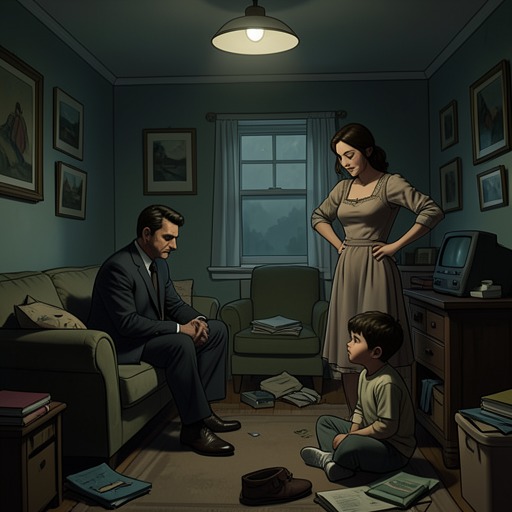
The demands of Los Alamos pressed heavily on Katherine’s family life. Four months after one period of mounting strain, she said she had to go home to see her parents. Those around her described her as drinking heavily and nearing an emotional collapse; the account leaves open whether postpartum depression, the household’s drinking, or the state of the marriage contributed. She and J. Robert Oppenheimer were also struggling with Peter, then two. Pat Sherr described Katherine as impatient with him and believed she had little intuitive understanding of children. Jackie Oppenheimer recalled that Katherine sometimes left on shopping trips lasting days, leaving the children with the maid, then returned with an enormous present for Peter. These reports portray instability and care alongside one another, not a simple absence of attachment.
In April 1945, Katherine left for Pittsburgh with Peter but left her four-month-old daughter, Toni, with her friend Pat Sherr. The Los Alamos pediatrician, Dr. Henry Barnett, thought caring for a child might help Sherr, who had recently had a miscarriage. Toni stayed in Sherr’s home for three and a half months. J. Robert Oppenheimer, working long hours, visited his baby daughter only twice a week. Katherine returned to Los Alamos in July and, characteristically, brought Sherr gifts. The separation makes visible how war work and domestic upheaval distributed care across the household and its friends; it also gives the months of absence a concrete measure.
The pressures did not end with the war. A Princeton neighbor later called being a child of the Oppenheimers a great handicap. Sherr remembered J. Robert Oppenheimer as sweet with the children and never angry, but her view of him changed over time. When Peter, aged six, seemed extremely shy, she encouraged Katherine to consider taking him to a child psychiatrist. Katherine consulted her husband, who had himself endured and detested therapy, and reported that he had no confidence in subjecting their son to it. Sherr interpreted his response as a father’s unwillingness to have a son who needed help. The disagreement exposes a consequential difference in judgment: a possible need for support met the father’s resistance, while Katherine was left between concern for her child and her husband’s conviction.
Travel, Friendship, and Unspoken Trouble
The biography also shows Katherine and J. Robert Oppenheimer together beyond the mesa, without suggesting that travel resolved their difficulties. In early summer, she and their two children boarded the SS Uruguay with him for Rio de Janeiro, where he was to lecture as a guest of the Brazilian government before returning to Princeton in mid-August. While he was there, the FBI had the American Embassy monitor his contacts. The family’s journey therefore unfolded under the surveillance that followed his public life.
In Paris, the couple visited Haakon Chevalier and his wife at Chevalier’s flat on Rue du Mont-Cenis. The evening was intimate and carefully domestic: Chevalier cooked dinner, they toasted one another with champagne, and Katherine and J. Robert Oppenheimer signed the cork. The scene sits in telling contrast to the scrutiny surrounding his associations. At home, the evening’s ordinary gestures could coexist with a history of political suspicion and surveillance.
On another evening, after drinking, J. Robert Oppenheimer went upstairs to a guest bedroom, and a few minutes later those downstairs heard a terrible crash. Anne Marks reached the top of the stairs first; he was nowhere in sight. She could not open the bathroom door or get a response from him. The account records the alarm and uncertainty of the moment but does not establish what had happened behind the door. Its restraint matters: Katherine’s later life is full of other people’s interpretations, but not every crisis is explained for the reader.
A few days before Christmas, Katherine and her husband went into his office and shut the door, an unusual act for a man who almost always left it open. They stayed for a long time; his secretary, Verna Hobson, could tell that something was wrong, though she did not know what. Hobson later gave him a used record by a Brazilian soprano, insisting it was not a Christmas present but simply something she wanted to give him. He took it and sat very still with his head down. The episode offers a small, human counterpoint to the formal proceedings: a colleague sensed distress and answered not with an explanation or a demand, but with a present.
The Security Hearing and Katherine’s Public Role
Katherine’s political history and her marriage converged when J. Robert Oppenheimer’s legal strategy became a source of disagreement. She was unhappy with the direction Lloyd K. Garrison was taking. The biography recalls her as a fighter, linking her resolve in the hearing to the younger woman who had distributed political literature outside factory gates. She too might be called to testify, and the proceeding would require her energy, tenacity, and intelligence. Her involvement was not merely that of a supportive spouse: the case reached into her own past and placed her under its pressure.
On the first morning of the hearing, J. Robert Oppenheimer and his lawyers arrived nearly an hour late. A few days earlier, Katherine had fallen down the stairs and broken her leg. On crutches, with her leg in a cast, she made her way to the leather couch and sat beside her husband as they waited for the proceedings to begin. He appeared subdued and nearly resigned; the late arrival irritated the board, and Garrison apologized. Katherine’s injured body became part of the scene in which the couple faced the board together. She was not simply an observer of the hearing: she was physically present, hurt, and implicated by a past the accusation had drawn into the room.
The biography’s broader method places private experience beside public conduct and policy, and Katherine’s story makes that approach tangible. Her professional hopes, political past, household responsibilities, and moments of distress do not explain away J. Robert Oppenheimer’s decisions; they show the family life surrounding a public career and the unequal room each partner had to pursue a life of their own. Even later recollections of tension require care: Verna Hobson saw abrasions on J. Robert Oppenheimer, increasingly over the years, but never saw Katherine throw anything at him. The distinction between what a witness observed and what a witness inferred is central to the portrait. Katherine emerges neither as a mere appendage to her husband nor as a fully documented figure whose inner life can be settled by other people’s accounts, but as a forceful and frustrated person whose actions and hardships remained entangled with his fame and vulnerability.