Katherine Puening Oppenheimer
American PrometheusKatherine Puening Oppenheimer appears in the biography less as a detached observer of J. Robert Oppenheimer’s public life than as someone living beside its pressures. Her place in the narrative is clearest in domestic moments: a coded message arranged before the Trinity test, a rare week alone after the war, her alarm at his emotional collapse, and a phone call in which both spouses recognized that the FBI might be listening. These scenes make the marriage one of the settings in which the costs of Oppenheimer’s work become personal and immediate.
Identity and place in the biography
The available episodes establish Katherine Puening Oppenheimer as Oppenheimer’s wife and intimate companion, but offer little account of her early life or independent ambitions. They do, however, show her acting and speaking within a marriage that was shaped by exceptional public pressures. Her responses are not merely background to his career: she takes part in the practical rituals surrounding it, tries to understand his political choices, and gives voice to the strain those choices placed on their household.
The biography’s broader method is to read public conduct and policy decisions alongside the private experiences of a lifetime. In that frame, Katherine’s significance lies partly in what she witnessed at close range—and partly in the limits of what any witness could know. Accounts of intimate conversations sometimes differ, and her presence does not make every disputed episode certain.
Marriage under wartime pressure
On the evening of July 11, 1945, Oppenheimer walked home and said goodbye to Katherine before leaving for the Trinity test. He told her that, if the test succeeded, he would send a message: “You can change the sheets.” The domestic phrase turned an immense and uncertain scientific undertaking into a message that could pass between spouses. Katherine gave him a four-leaf clover from their garden for good luck. The small exchange held together household intimacy and an event whose consequences would reach far beyond their home.
The test preparations left Oppenheimer visibly anxious. A recent firing of the implosion explosives, conducted without the plutonium core, had suggested that the device might fail; at the Hilton Hotel in Albuquerque, he became so emotional that George Kistiakowsky offered to bet his month’s salary against ten dollars that the implosion charge would work. Katherine was not present in that scene, but the farewell and clover show the private relationship immediately adjoining the strain of the preparations. The evidence does not record what she knew about the test’s technical risks; it does show the gesture with which she sent her husband into them.
The aftermath and shared distress
After the war, Oppenheimer and Katherine went alone to their cabin near Los Pinos for a week. It was their first substantial time alone together in three years. He used the quiet to answer friends who had only recently learned from newspapers what he had been doing during the war. To Herbert Winslow Smith, he described a future containing promise but lying “only a stone’s throw from despair”; to his former Harvard roommate, he called the ranch an “earnest but not too sanguine search for sanity” and anticipated “some great headaches ahead.” Their retreat was therefore not simply a return to ordinary domestic life. It was an attempt, in solitude, to take stock of the war’s consequences.
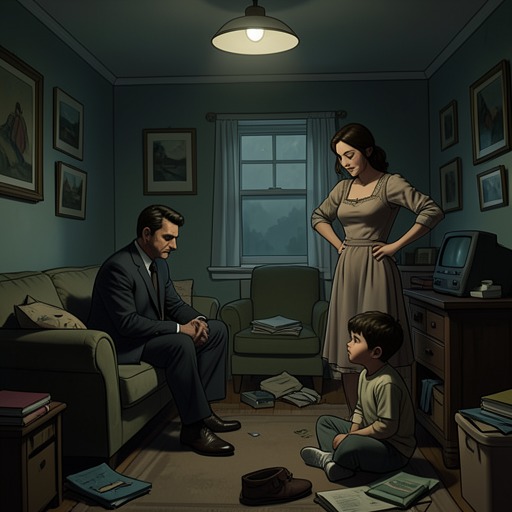
The postwar news had affected Oppenheimer profoundly, and Katherine’s own distress emerges through her conversation with Jean Bacher. She told Bacher, “You just can’t imagine how terrible it’s been for me; Robert was just definitely beside himself.” Bacher was struck by Katherine’s emotional state and by her fear about what might happen next. Katherine also said that she did not know how she would stand the enormity of Hiroshima and Nagasaki. Her account places her not outside Oppenheimer’s grief but within the household trying to endure it. The biography does not turn her reaction into a resolution of his feelings; it records the pressure as something both spouses had to live through.
Intimacy, disagreement, and competing recollections
Katherine’s account of Oppenheimer’s conversation with Haakon Chevalier became part of a larger dispute over what had been said about a proposal to pass technical information to Soviet scientists. Chevalier recalled that he and Oppenheimer spoke briefly in the kitchen, then rejoined their wives. He remembered Katherine’s recently purchased early-nineteenth-century French book on mycology, illustrated with painted orchids, as an object the couples looked through before dinner. In this recollection, the conversation ended without further incident.
After Oppenheimer’s death, Katherine gave a different account. She said she had sensed something was happening as soon as Chevalier entered the house and had made a point of not leaving the two men alone. In her version, Chevalier eventually spoke in her presence, and she exclaimed, “But that would be treason!” Oppenheimer later presented the kitchen conversation as one between the two men, which Katherine’s account suggested may have been his way of keeping her out of it. Chevalier, for his part, maintained that Katherine had not entered the kitchen. The conflicting memories do not establish precisely who was present or who first used those words. They do show Katherine as a participant in the history of the marriage and its political entanglements, not simply a recipient of Oppenheimer’s version.
Surveillance, departure, and the limits of privacy
By 1946, the FBI was monitoring Oppenheimer’s contacts and had wiretapped the couple’s Berkeley home. In a phone call with Katherine before a meeting concerning Bernard Baruch’s atomic-control plan, Oppenheimer described the meeting as “an attempt to box the old guy in” and said that appealing to Baruch’s conscience might be his best approach. Katherine urged him to clarify what Baruch wanted. When Oppenheimer heard the operator’s clicking and asked, “Are you still there? I wonder who is listening to us?” she answered, “The FBI, dear.” Her matter-of-fact reply turned surveillance into part of their shared domestic reality: the conversation continued, but neither spouse could treat the telephone as private.
Katherine welcomed Oppenheimer’s decision to move East. The FBI wiretap recorded her telling a salesman that they “would not be gone long— only 15 or 20 years.” Their new home at Olden Manor in Princeton had ten bedrooms, five bathrooms, and a garden. The move was a sharp break for Oppenheimer’s Berkeley colleagues and brought him closer to friends including Isidor Isaac Rabi, who welcomed his arrival. For Katherine, as for Oppenheimer, it meant a change of home and social world; the evidence does not specify how she experienced the transition beyond her welcome for the decision.
The biography also recalls a separate household crisis in which Oppenheimer collapsed on a bathroom floor, blocking the door, and later said he had taken one of Katherine’s prescription sleeping pills. Those present kept him awake and walked him back and forth until a doctor arrived. The episode is not evidence of Katherine’s intention or of the circumstances in which he took the pill; its relevance is the stark proximity of his public ordeal to the vulnerable life of the household. Taken together, these episodes make Katherine’s role legible through specific acts of companionship, alarm, recollection, and practical endurance, while preserving the uncertainties that surround the private life the biography reconstructs.