Nuclear Age
American PrometheusThe Nuclear Age is more than the period following the first atomic weapons. It is a new political and moral condition in which scientific knowledge could destroy cities, military plans could threaten civilian populations on an unprecedented scale, and the people who helped create nuclear weapons became advisers, critics, and sometimes targets of the state. J. Robert Oppenheimer’s career traces that transformation: he helped bring atomic power into the world, then tried to limit the dangers of a nuclear order that would outlast the war and the policies of any one government.
From scientific revolution to nuclear politics
The story’s roots reach back before the bomb. In the 1920s, Oppenheimer learned quantum physics in Germany, embraced the new science, and carried it into his work and teaching. In the 1930s, at the University of California, Berkeley, he helped build the leading center for theoretical physics in the United States. His scientific rise unfolded amid the Great Depression and the growth of fascism abroad; those pressures also drew him into political activity with friends concerned about economic and racial justice. The Nuclear Age, as this account presents it, emerged from a world already shaped by scientific change and political crisis, not from a sudden technical discovery detached from human affairs.
The Second World War made that connection immediate. Oppenheimer became the public figure most closely associated with the American effort to harness atomic power for war. His place in the new era was therefore double from the outset: he was both a physicist engaged in a historic scientific enterprise and a citizen whose later judgments about nuclear policy carried unusual authority. The book frames his public decisions alongside the private experiences of a lifetime, resisting an account in which his eventual prominence alone explains what he did or believed.
The bomb becomes a condition of life
After 1945, nuclear weapons did not remain a single wartime instrument. They became part of diplomacy, military planning, and public identity. The book invokes the observation that “We have had the bomb on our minds since 1945,” describing a culture shaped successively by nuclear weaponry, diplomacy, and economic life. Oppenheimer tried to redirect that culture by seeking international control of atomic energy. The resulting Acheson–Lilienthal Report was named for others, but the account identifies Oppenheimer as its originator and principal author. It presents the report as a distinctive effort to approach the nuclear problem through rational international management rather than an accumulating national arsenal.
That proposal did not prevail. Cold War politics in the United States and abroad doomed the plan, while the United States and an expanding group of other nations continued to embrace nuclear weapons. The report’s failure marks a central contradiction of the Nuclear Age: the danger was widely visible to those who studied it, but recognition did not produce agreement on how to control it. For Oppenheimer, the challenge became not only how to make a weapon, but how to prevent the weapon from governing the political choices of the societies that possessed it.
The scale of the threat and the limits of strategy
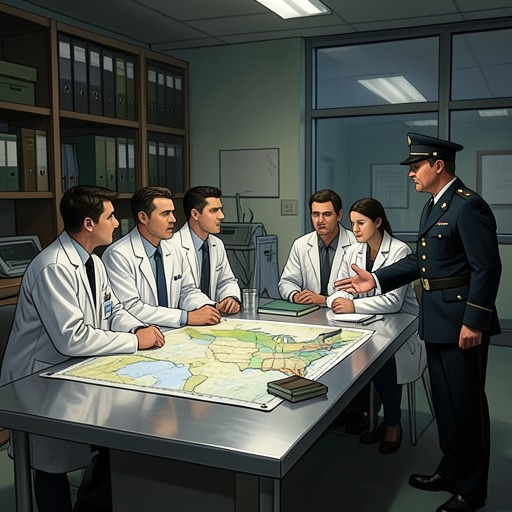
The dispute over the proposed thermonuclear “Super” made the changing scale of nuclear danger stark. In 1949, after the Soviet Union’s atomic success had intensified the arms race, the General Advisory Committee argued that moral consequences could not be separated from technical or military assessments. A thermonuclear weapon, if feasible, might have a yield of 100 million tons of TNT, compared with 15,000 tons for the Hiroshima bomb, and could devastate 150 to 1,000 square miles or more. The committee warned that “a super bomb might become a weapon of genocide.” Its argument was not simply that the weapon would be destructive: even possession of such a weapon could damage American security by persuading the world that the United States contemplated catastrophe.
Oppenheimer and the committee proposed refusing to build the Super and reopening arms-control negotiations. They also argued that a Soviet attempt to develop such a weapon would have to be tested and detected, and that existing atomic weapons could provide an effective response. Rather than racing to amass the largest possible arsenal, they favored producing smaller tactical weapons for defined military purposes, alongside conventional forces in Western Europe. This was an early argument for nuclear sufficiency: a force designed around specific strategic needs, rather than sheer accumulation. It offered an alternative to the assumption that greater destructive capacity automatically meant greater security.
That alternative carried its own danger. Oppenheimer supported tactical weapons partly because he hoped they could displace genocidal city-bombing plans and make military strategy more limited. In the Project Vista debate, he argued that such weapons could assist combat forces rather than function as weapons of totality or terror. Yet bringing nuclear arms onto the battlefield also made their actual use more conceivable, with the risk that a limited engagement could trigger an escalating exchange. The account stresses this tension: Oppenheimer’s effort to make nuclear policy more discriminating could also help normalize nuclear weapons as instruments of war.
Secrecy, vulnerability, and public warning
The Nuclear Age was also shaped by the secrecy surrounding nuclear policy. Oppenheimer argued that citizens and even allies were kept ignorant of what weapons existed, how they might be used, and what consequences their use would bring. He warned that a policy built around a massive, sustained first strike could not be honestly debated while its essential facts remained classified. Secrecy did not merely conceal information; it narrowed the public’s ability to judge the strategy pursued in its name and allowed rumor and official claims to flourish without adequate scrutiny.
His warning extended beyond state warfare to nuclear terrorism. In a closed Senate hearing in 1946, Oppenheimer was asked whether a small group could bring bomb components into New York and destroy the city. He answered that it could be done; when asked what could detect a bomb hidden somewhere in a city, he pointed to the impossible practical implication of searching every crate or suitcase. The point was not that such an attack was inevitable, but that a weapon of this kind made a large city vulnerable in ways ordinary defenses could not reliably eliminate. In the book’s framing, the only complete defense against nuclear terrorism was the elimination of nuclear weapons.
An unfinished inheritance
Oppenheimer’s warnings did not stop the spread of nuclear arms. The book observes that after the Cold War ended, the danger of annihilation seemed to recede, yet nuclear war and nuclear terrorism could appear more imminent in the twenty-first century than before. The Nuclear Age therefore has no clean endpoint in this account: political circumstances change, but the weapons and the responsibilities attached to them remain.
At Oppenheimer’s death, George Kennan described the widening gap between human power over nature and human moral strength, and recalled Oppenheimer’s passionate wish to avert catastrophe. That judgment joins the scientific, political, and personal strands of the era. Oppenheimer’s life illustrates both the reach and the limits of expertise: he helped unlock atomic power, worked for international control, and challenged strategies he considered dangerous, but could not persuade his country to abandon the nuclear path. The lasting significance of the Nuclear Age lies in that unresolved inheritance—the power to destroy on a vast scale, and the continuing failure to find a durable way to make that power safe.