Nuclear Stalemate
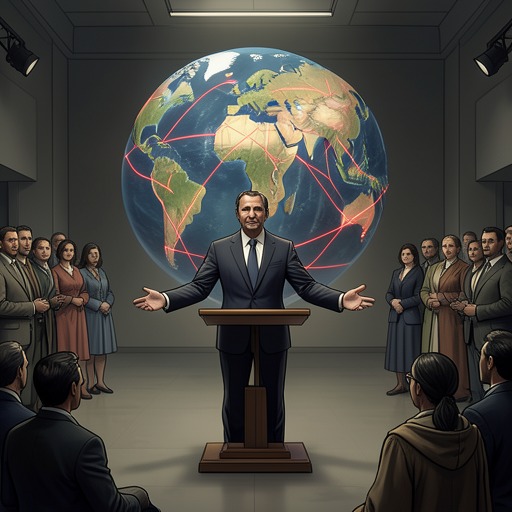
American PrometheusNuclear Stalemate was the condition of mutual vulnerability created by rival atomic arsenals: each side could devastate the other, yet possessing more weapons could not reliably secure safety. For J. Robert Oppenheimer, this was not a settled balance but a perilous political predicament, in which a supposed deterrent could drive the arms race it was meant to restrain. The image of two scorpions confined together captured its central contradiction: survival depended on choices that had to be made again and again, not on a stable guarantee that neither side would strike.
From wartime secrecy to a postwar dilemma
At the May 31, 1945 meeting of the Interim Committee, Oppenheimer encountered the problem before the war had ended. The scientists had been invited to advise on atomic policy, but the question of using the bomb against Japan was not on the agenda; military-use decisions were understood to rest with the White House. Secretary of War Henry L. Stimson nevertheless described the bomb as a revolutionary change extending beyond the needs of the present war. The discussion exposed a fault line that would persist after victory: the United States might try to preserve its advantage through secrecy and rapid production, or recognize that nuclear knowledge and the means to build weapons could not remain an exclusive American possession indefinitely.
At the meeting, General George C. Marshall questioned whether two prominent Soviet scientists might be invited to witness the test. James F. Byrnes opposed the idea, fearing that Joseph Stalin would seek a place in the project. Oppenheimer and Marshall’s argument for considering cooperation sat uneasily beside the insistence that the United States push ahead in production to stay ahead. The committee’s attempt to combine accelerating the arms effort with improving relations with the Soviet Union left the contradiction unresolved. Oppenheimer understood that the drive for superiority could encourage the other side to build its own arsenal, turning an initial advantage into the beginnings of a dangerous contest.
The Super and the logic of sufficiency
By 1949, the Soviet Union’s atomic success had given the debate a new urgency. On October 28, Oppenheimer convened the General Advisory Committee’s three-day consideration of the proposed hydrogen bomb, or Super. He heard the other members before stating his own position. Their discussion joined technical judgment to moral consequences: the question was not simply whether the weapon could be built, but what kind of security, if any, it could provide.
The prospective scale made the distinction stark. Against the Hiroshima bomb’s yield of 15,000 tons of TNT, a feasible thermonuclear weapon might reach 100 million tons and destroy 150 to 1,000 square miles or more. The Committee warned that a Super might become a weapon of genocide. Oppenheimer also argued that no legitimate military target was large enough to make such a weapon proportionate: even if the Soviet Union developed one first, American atomic retaliation could be comparably effective. Building the Super, therefore, would not remove the danger of being attacked; it could stimulate Soviet development while adding a weapon whose very existence might damage American security and standing in world opinion.
The alternative the Committee put forward was not disarmament by assertion. It proposed refusing to build the Super and reopening the possibility of arms-control negotiations, while accelerating production of fissile material for smaller tactical atomic weapons and strengthening conventional forces in Western Europe. This was an early argument for nuclear sufficiency: an arsenal sized for particular military purposes rather than enlarged without limit. Yet the alternative contained its own tension. Tactical weapons might be more credible in a battlefield defense, but their use could make nuclear war more likely rather than less. In 1951, Oppenheimer supported a strategy that would bring the battle back to the battlefield, reasoning that tactical weapons could assist a military campaign rather than serve as instruments of total terror. The book also marks the danger in that reasoning: battlefield use could act as a nuclear trip-wire, escalating toward weapons of far greater scale.
The Committee’s recommendations received a narrow endorsement from the Atomic Energy Commission on November 9, 1949: three commissioners opposed a crash Super program, while Lewis Strauss and Gordon Dean supported it. Oppenheimer initially thought the contest had been won. Instead, advocates of the weapon and officials who considered war with the Soviet Union inevitable mounted a political counteroffensive. The dispute revealed two increasingly opposed approaches to the stalemate: arms controllers sought limits and a more defensible measure of sufficiency, while arms racers treated further accumulation as the necessary answer to uncertainty.
A stalemate that demanded repeated restraint
Oppenheimer continued to argue that the danger could not be solved by simply making the arsenal larger. On January 30, 1950, he appeared before the Joint Committee on Atomic Energy despite knowing that his opposition to a crash program would be unwelcome. Asked what would happen if the Soviet Union obtained the Super first, he answered that the United States would be badly off either way. His underlying point was that American development would help accelerate Soviet development, so matching a weapon did not escape the predicament. He feared not only the physical consequences of thermonuclear war but the loss of mankind’s moral capacity to avoid it.
The idea of a nuclear stalemate also shaped Oppenheimer’s later advice on testing, first use, and public knowledge. In discussions with McGeorge Bundy and other advisers, a proposed moratorium on thermonuclear tests offered a way to halt the arms race before a successful test further stimulated Soviet efforts. The argument did not assume that Soviet intentions were benign; it rested on the expectation that a test would demonstrate that a weapon was feasible and intensify the competition. The panel also considered an official commitment not to be the first to use atomic weapons in a new war, alongside stronger conventional forces. Such proposals attempted to reduce reliance on nuclear threats without pretending that the rivalry had disappeared.
In a classified report prepared as Dwight D. Eisenhower entered the White House, Oppenheimer and Bundy described a possible nuclear stalemate as a strange stability. Even if both powers refrained from using suicidal weapons, they argued, that condition would not make the world calm: peace would depend on statesmen rejecting rash action every time a crisis arose. The report warned that unless the arms contest was moderated, society would face grave peril. Its recommended policy of candor challenged the secrecy that kept the public ignorant of the scale and implications of the danger. Oppenheimer argued that simply staying ahead could not offset the Soviet threat indefinitely, and that citizens and allies needed a truthful account of the situation. The policy joined disclosure to restraint: public understanding could expose the limits of military superiority and signal that the United States did not intend a preemptive strike.
Strategic advice and its political limits
The stalemate was not only a question of how many weapons either power possessed. In 1951, Oppenheimer saw an Air Force strategic plan calling for the destruction of Soviet cities on a scale he considered criminally genocidal. Project Vista, whose fifth chapter he primarily authored, instead assigned greater importance to tactical weapons and proposed that the United States publicly adopt a no-first-use policy. The recommendation challenged the Strategic Air Command’s emphasis on retaliatory bombing and the allocation of resources to its city-destroying forces. It also exposed the limits of Oppenheimer’s own position: tactical weapons might counter a Soviet ground invasion without relying on a massive initial strike, but making them more usable could lower the threshold for nuclear war.
The institutional reception of these ideas showed how far they were from settled policy. Air Force leaders feared that air defense and battlefield weapons would draw resources from strategic retaliation. Oppenheimer’s influence on Project Vista and later defense studies alarmed officials who opposed his recommendations; General Hoyt S. Vandenberg quietly removed his name from an Air Force list of people cleared for Top Secret information. The strategic argument was thus bound up with bureaucratic power: which service would control resources, which plans would define national security, and whether an adviser could challenge the prevailing doctrine without becoming suspect.
By 1953, the new administration had received Oppenheimer and Bundy’s warning that Soviet stockpiles might grow to thousands of bombs and that a nuclear stalemate could preserve neither comfort nor lasting safety. Oppenheimer’s public case for candor challenged the secrecy surrounding the arsenal and the assumption that an immense retaliatory strike was a credible route to security. Yet Lewis Strauss, appointed chairman of the United States Atomic Energy Commission, opposed public debate over nuclear strategy and sowed suspicion about Oppenheimer. The stalemate therefore remained both a strategic condition and a political struggle over whether its risks could be openly examined. Its defining insight was unsettlingly simple: parity in the capacity to destroy did not end the contest. It made restraint, communication, and judgment more consequential, while leaving each vulnerable to the next failure of judgment.