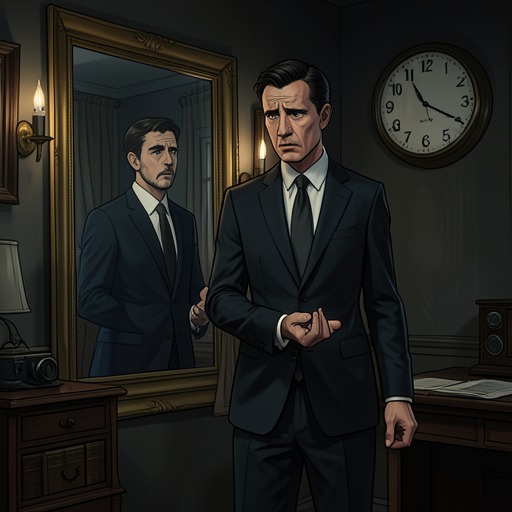
Oppenheimer's misleading report of Chevalier's proposal to pass nuclear information to the Soviets
American PrometheusOppenheimer's misleading report of Chevalier's proposal to pass nuclear information to the Soviets began with a short conversation about an approach by George C. Eltenton and became one of the most consequential and contested episodes in J. Robert Oppenheimer's security history. Its central difficulty is not simply what Eltenton proposed, but how Oppenheimer described the proposal, his friend Haakon Chevalier's part in conveying it, and the circumstances of their conversation. Accounts made at different times diverge, while later investigations turned those divergences into questions about judgment, candor, and loyalty.
The Initial Conversation
In Chevalier's memoir, he described telling Oppenheimer that Eltenton had proposed a way to transmit scientific information to Soviet scientists. Chevalier said he was alerting his friend, not soliciting information from him or serving as a conduit. He remembered Oppenheimer as visibly disturbed; the two exchanged only a few remarks, then returned to the living room. The conversation, in this version, ended without further action. Chevalier recalled that Katherine Oppenheimer had recently bought an illustrated French book on mycology, whose hand-painted orchids the two couples looked through over their martinis before dinner. The domestic calm of the scene stands in sharp contrast to the dangerous proposal being discussed.
Oppenheimer's later account placed the conversation in the kitchen, where Chevalier followed him and mentioned having seen Eltenton. He recalled being told that Eltenton had a means of getting technical information to Soviet scientists. Oppenheimer testified that he objected that this would be treason, and said Chevalier agreed; he characterized the exchange as brief and concluded. The precise wording he claimed to remember was itself qualified: he was unsure whether he had said the word treason, though he was certain he had objected in some way. His account made the episode a moment of rejection, but did not settle how the proposal had reached him or what he understood Chevalier to be doing.
Katherine Oppenheimer later offered a conflicting recollection. She said she had noticed something was amiss when Chevalier arrived, tried not to leave the two men alone, and was present when he described Eltenton's proposal. In her version, she—not Robert—exclaimed that it would be treason. She believed Oppenheimer later took her words into his own account to keep her out of the matter, and consequently maintained that the men had spoken alone in the kitchen. Chevalier, by contrast, insisted Katherine had not entered the kitchen during the discussion. These incompatible memories leave the scene's participants and exact words unresolved; the differences also show how each retelling assigned responsibility and protected, or implicated, the people involved.
From Private Disclosure to Official Inquiry
The episode entered an official setting when Oppenheimer spoke with Boris Pash in August 1943. The record identifies that interview as a central source for the later reconstruction of what Oppenheimer said about Eltenton and his association with Chevalier. The account became part of a larger security inquiry, where a private conversation was no longer merely a disagreement between friends: it bore on what Oppenheimer had reported to authorities and whether his description accurately represented the original approach. The surviving material points to a misleading report, but the competing versions caution against treating every remembered detail as settled fact.
The affair also involved uncertainty about Eltenton himself. Oppenheimer reportedly described him as far left, whatever his affiliations; the available evidence cited in the book does not establish that Eltenton belonged to the Communist Party. His work and friendships with Russian scientists, including Yuli Borisovich Khariton, help explain why the possibility of scientific communication with the Soviet Union could be raised, but they do not by themselves prove the political status or intentions attributed to him. Distinguishing documented contact from later inference is essential to understanding why the episode generated suspicion without yielding a simple account.
Reappearances and Conflicting Testimony
The matter did not end with the wartime interview. Chevalier and Eltenton signed statements for the FBI on June 26, 1946, and Oppenheimer was interviewed later that year. A wiretap recorded Chevalier arranging a visit with Katherine Oppenheimer, and the evidence suggests that Chevalier and Oppenheimer may have met three times in 1946: at Stinson Beach in May, at Eagle Hill on June 4, and again sometime after Chevalier's FBI interrogation but before Oppenheimer's interview. The precise count is presented as an inference from records, not as an uncontested certainty. The documented contacts nonetheless show that the friendship and the disputed proposal continued to intersect with official scrutiny.
When the episode resurfaced in Oppenheimer's 1954 security hearing, he again described a brief kitchen conversation and his objection to passing technical information. Chevalier's memoir and Katherine's later account supplied different versions of the same encounter. The disparity was not a minor detail: whether Oppenheimer had heard a warning from a friend, been approached as a potential intermediary, or later recast the exchange affected how his candor could be judged. The hearing thus revisited not only the proposal itself but also the history of Oppenheimer's explanations.
Significance
The affair's force lies in the distance between a short conversation and the elaborate record it produced. A few remarks, remembered and retold years apart, became evidence about trust in a friendship and reliability under security questioning. The book's presentation preserves that uncertainty rather than smoothing it away: Chevalier's recollections, Katherine's account, Oppenheimer's testimony, and official records offer overlapping but incompatible views. The result is not a fully recoverable scene, but a clearer picture of how a private exchange acquired public and political weight—and how its consequences depended as much on the credibility of later accounts as on the original proposal.