Philip Morrison
American PrometheusPhilip Morrison’s path through the story runs from the Berkeley seminar room to the bomb’s preparation on Tinian and, finally, to the task of describing Hiroshima. A gifted theoretical-physics student and Communist Party member, he belonged to J. Robert Oppenheimer’s intellectual circle before following him to Los Alamos. His work joined abstract calculation to the accelerating demands of war; after the bomb was used, his account of Hiroshima made the distance between technical achievement and human consequence difficult to preserve.
Formation and Berkeley
Born in Pittsburgh in 1915, Morrison grew up near the childhood home of Katherine(Kitty)Oppenheimer. He received a public-school education and earned a bachelor’s degree in physics from Carnegie Institute of Technology in 1936. That autumn he entered the University of California, Berkeley, to study theoretical physics with Oppenheimer. He arrived wearing a brace on one leg, the lasting mark of childhood polio. During convalescence he had learned to read at five pages a minute; as a graduate student, he impressed people with the breadth of his knowledge, which ranged from military history to physics.
Morrison was one of several young theorists who treated Oppenheimer as a mentor and model. The group included Giovanni Rossi Lomanitz, David Bohm, Max Friedman, and Joseph Weinberg. Morrison described them as “self-conscious and daring intellectuals.” Their attachment to theoretical physics coexisted with political engagement: they participated in Popular Front causes, though their degrees of connection to the Communist Party varied. Morrison was not simply a student who happened to share Oppenheimer’s interests; he became part of a circle where intellectual allegiance, political discussion, and scientific work overlapped.
Politics and the question of the Party unit
Morrison joined the Communist Party in 1936. He did not conceal his left-wing views, but neither did he publicize his membership; his Berkeley office-mate Dale Corson did not know he belonged to the Party. Morrison later recalled that meetings could resemble college bull sessions, with members and nonmembers difficult to distinguish and discussion ranging over “everything under the sun.” As a cash-strapped graduate student, he paid dues of twenty-five cents a month.
His membership continued through the Nazi-Soviet Pact, but he drifted away after Pearl Harbor. By then he was teaching at the University of Illinois. His small unit decided that helping the war effort should take priority, leaving no time for political discussion. The change, as Morrison described it, was practical as well as political: the wartime emergency redirected the group’s activity rather than producing a dramatic public break.
The later dispute over whether Morrison had belonged to the same Party unit as Oppenheimer exposed the uncertainty surrounding these associations. Haakon Chevalier recalled a Berkeley “closed unit” whose members paid dues through a known Party member, whom he identified as Morrison, while Oppenheimer, Chevalier speculated, paid separately—or, as Oppenheimer maintained, made contributions without paying dues. Chevalier characterized the group as academics who met to discuss international affairs and politics, not as a body taking Party orders. Morrison acknowledged his own Party membership but flatly denied that he had shared Oppenheimer’s unit, observing that a student would not have been assigned to a unit with faculty members. The accounts do not resolve into a single uncontested version; Morrison’s own political history is clear, while the proposed organizational link to Oppenheimer remained disputed.
From calculation to wartime deadlines
Morrison’s work in Oppenheimer’s circle included an early encounter with the implications of nuclear fission. After Oppenheimer introduced Joseph Weinberg to leading physicists and graduate students, Weinberg, Morrison, and Sydney M. Dancoff went to lunch at the student-union restaurant, the Heartland. They discussed a telegram from Niels Bohr about the discovery of fission. Someone sketched a bomb on a napkin using the idea of a chain reaction. Morrison made preliminary calculations and concluded that the imagined device would not work: the chain reaction, he thought, would fizzle before it could explode. The scene captures both the speed of the group’s speculation and the provisional character of its first answers. A bomb could be drawn in a few strokes; deciding whether its physics would hold required calculation.
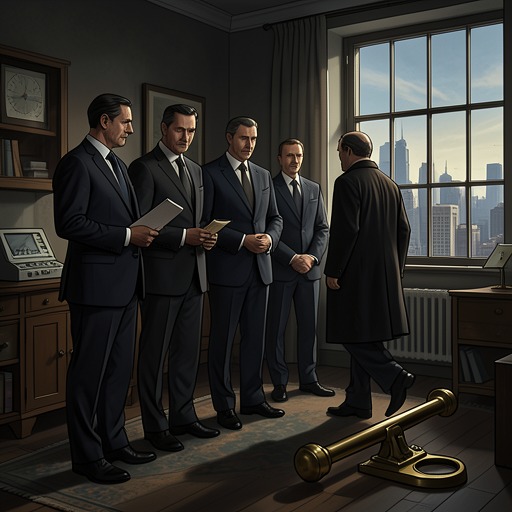
The questions became more consequential in the summer of 1942, when a seminar met in the fourth-floor attic of LeConte Hall, above Oppenheimer’s office. The French doors opened onto a balcony, but a thick wire net had been fastened across it for security, and Oppenheimer alone held the room’s key. Weinberg remembered Oppenheimer pointing out how sunlight cast the net’s shadow across papers and people at the table. For the physicists gathered there, the pattern made their enclosure visible: scientific discussion took place inside a physical and institutional cage.
The group’s calculations helped establish the scale of the undertaking. By late August, after further work had resolved the concern that an atomic explosion might ignite the atmosphere, Oppenheimer was preparing the seminar’s summary. The report estimated that an atomic device would release 150 times the energy of an earlier calculation, while requiring six times the previously estimated critical mass of fissionable material. Its conclusion was not that the bomb was easy to build, but that it was feasible only through the mobilization of immense scientific, technical, and industrial resources. Morrison’s earlier unsuccessful sketch belonged to a developing process in which speculative possibility was repeatedly tested against the limits of calculation and material supply.
When the project entered its final wartime push, the pressure was measured in dates as well as equations. Morrison recalled being told that a date near August 10 was a “mysterious final date” that the technical staff had to meet “at whatever cost in risk or money or good development policy.” The expected entry of the Soviet Union into the Pacific War and the approaching Potsdam meeting formed part of the urgency surrounding the work. The deadline compressed scientific judgment into a schedule: the bomb had to be ready, even when improvements might make more efficient use of material, because delay itself was treated as a danger.
Hiroshima: from celebration to witness
Morrison was at Tinian, where he had helped prepare the bomb and load it aboard the Enola Gay, when news came of Hiroshima. That night, Los Alamos personnel held a party. Morrison later remembered the celebration as understandable in wartime, but his recollection turns on a different image: sitting on the edge of a cot and wondering what was happening on the other side, in Hiroshima. The celebratory gathering and the solitary question occupy the same moment. Victory did not cancel the effort to imagine what the weapon had done to people beyond the project’s walls.
In October, Morrison returned from Hiroshima and Nagasaki with Bob Serber and the first group of scientific observers. His descriptions changed how some people at Los Alamos understood the attacks. Jean Bacher recalled that Morrison’s account left her unable to sleep and shaking from shock. This response points to his role not only as a scientist who had helped prepare the weapon, but as a witness whose descriptive power brought the consequences nearer to a community that had previously tried to grasp them from a distance.
Morrison gave a formal briefing in Los Alamos and also summarized his observations for an Albuquerque radio station. He described circling low over Hiroshima and seeing the level ground of a city scorched red. The decisive contrast in his account was between the familiar scale of a prolonged air raid and the new concentration of destruction: no hundreds of planes arriving through a long night, but one bomber and one bomb transforming a city of three hundred thousand into a burning pyre in the time it took a rifle bullet to cross it. His phrase “That was the new thing” named not merely a more powerful weapon but a changed scale and tempo of destruction. Morrison’s account translated the aerial view into terms his listeners could grasp without making the devastation ordinary.
Friendship, reputation, and the limits of the record
Morrison’s closeness to Oppenheimer remained part of how others remembered him. Chevalier encountered him on a New York street after the outbreak of war and regarded him as a former comrade, as well as one of Oppenheimer’s closest prewar friends and a key physicist who had followed him to Los Alamos. The surviving account identifies the encounter and the history Chevalier attached to it, but does not provide the substance of their conversation. That limit matters: Morrison appears in the episode as a figure linking Chevalier’s political past to Oppenheimer’s wartime circle, not as the source of a new revelation about their exchange.
Across these episodes, Morrison’s role changes without breaking into separate lives. He is the quick-reading student whose range of knowledge impressed his peers, a Party member whose political associations later became contested, a physicist testing whether a chain reaction could sustain an explosion, a technical worker facing a deadline, and a returning observer asked to make Hiroshima intelligible to others. The movement from napkin sketch to radio description gives his trajectory its particular force: first he calculated whether the weapon could work; later he described what its working meant.