Roger Robb
American PrometheusRoger Robb was the prosecutor at the 1954 security hearing that ended with J. Robert Oppenheimer losing his security clearance. Selected by Lewis Strauss to bring the case, Robb entered the proceedings with extensive investigative material, a carefully designed approach to cross-examination, and access to evidence the defense could not always see in advance. His role extended beyond questioning witnesses: the record also connects him to efforts to shape the hearing’s procedures and, later, to a documented request for FBI Director J. Edgar Hoover to intervene with the review board.
Background and Selection
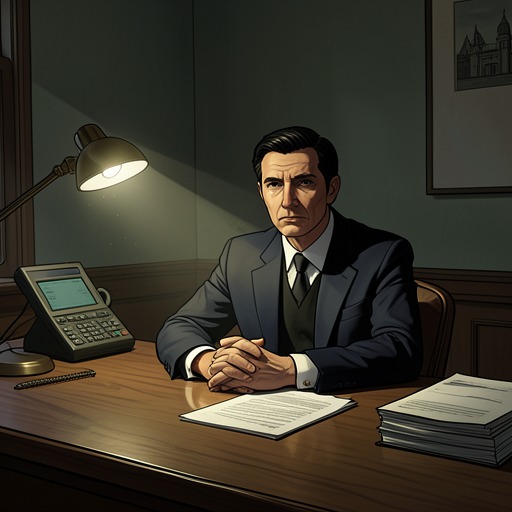
By the end of January 1954, Strauss had chosen Robb to prosecute Oppenheimer. Robb was forty-six, a Washington native, and an experienced assistant United States attorney. He had tried twenty-three murder cases and won convictions in most of them, giving him a reputation for aggressive advocacy and forceful cross-examination. His background included a strikingly different assignment: in 1951, as a court-appointed attorney, he successfully defended Earl Browder against contempt-of-Congress charges. Browder called him a reactionary while acknowledging his legal ability.
Robb was politically conservative, represented the right-wing broadcaster and columnist Fulton Lewis Jr., and maintained cordial contacts with the FBI. J. Edgar Hoover had been told that Robb was entirely cooperative with Bureau agents. Robb had also written to Hoover to congratulate him on his response to a critical essay by civil-liberties scholar Thomas Emerson. When Strauss arranged a security clearance for the prosecutor, it was granted in eight days. These connections did not by themselves determine the hearing’s outcome, but they situated Robb within the network of officials and investigators assembling the case against Oppenheimer.
Preparing the Case
Robb prepared in February and March by drawing on material supplied by Strauss and the FBI. Strauss sent him documents from his own notes on Oppenheimer’s file, selected to undermine the anticipated testimony of defense witnesses, including Lewis Strauss’s prospective opponents Robert Bradbury, Isidor Rabi, and Leslie Groves. At Strauss’s urging, the FBI also furnished Robb with extensive investigative reports, including selected material taken from Oppenheimer’s trash at Los Alamos. The prosecution thus had advance access to a substantial body of information about both the defendant and the people expected to support him.
Robb also studied the FBI record of Oppenheimer’s 1943 interview with Lieutenant Colonel Boris Pash. The files indicated that the conversation had been recorded; the FBI retrieved the ten-year-old Presto disks, and Robb listened to Oppenheimer’s first account of the Chevalier incident. He found that it differed markedly from Oppenheimer’s 1946 account. Oppenheimer, unaware that the earlier conversation had been recorded, did not know that Robb possessed this comparison. When questioning turned to the incident, Robb could therefore press details that Oppenheimer himself could not readily reconstruct.
The preparation extended to potential witnesses. Allan Ecker, an assistant to defense counsel Lloyd Garrison, recalled hearing a tape played in the hearing room and then seeing Robb leave with people who would later testify for the prosecution. Ecker understood that Robb had brought prospective witnesses to listen to a recording of Pash’s 1943 interrogation. In this way, the same recording used to challenge Oppenheimer’s testimony also became part of the prosecution’s preparation of its witnesses.
Cross-Examination and Control of the Hearing
Robb’s questioning was designed to unsettle Oppenheimer early. He later described planning the sequence of questions and references to FBI reports on the theory that if he could shake Oppenheimer at the start, the physicist would become more communicative. On April 14, after Garrison’s direct examination had reinforced Oppenheimer’s answers to the AEC’s charges, Robb began a relentless cross-examination. He led Oppenheimer to acknowledge that close association with the Communist Party was inconsistent with work on a secret wartime project, then pressed him on whether former party members could appropriately work on such a project. The exchange exposed the difficulty of applying later security expectations to earlier periods, when Oppenheimer’s own understanding and practice had changed over time.
When Robb asked why Oppenheimer had invented an account of the Chevalier approach involving three people, Oppenheimer answered that he had done so because he was an idiot. Robb later portrayed the moment as a devastating collapse, describing Oppenheimer as hunched over, wringing his hands, and white as a sheet, and claiming that he had gone home believing the defendant had destroyed himself. The book rejects that account as self-serving courtroom publicity. It interprets Oppenheimer’s remark instead as a colloquial, self-deprecating attempt to remove ambiguity about a story for which he had no rational explanation. The distinction matters: Robb’s later dramatic version turned a calculated moment of testimony into evidence of his own supposed discomfort and of Oppenheimer’s supposed breakdown.
Robb also used narrow questioning to diminish a defense witness’s authority. When the mathematician John von Neumann explained that his understanding of security had developed over time, Robb asked whether he had ever trained as a psychiatrist. Von Neumann had known Oppenheimer professionally and socially, but was not a psychiatrist; the question implied that his observations about Oppenheimer’s behavior were outside his expertise. Midway through the proceedings, Robb further announced that the prosecution would not disclose its intended witnesses in advance unless ordered to do so. He justified this by claiming that scientific witnesses might face pressure, although the defense had already supplied its witness list and Robb had used it to prepare detailed questions, sometimes based on classified documents. The asymmetry left the defense less able to prepare for the prosecution’s witnesses.
Witnesses, Board Deliberations, and Outcome
Robb’s conduct toward Edward Teller illustrates the contested boundary between preparation and influence. On April 27, Robb met Teller before his testimony. Teller later placed the meeting on a different day, but a handwritten note he sent to Strauss supported the April 27 date. According to Teller’s account, Robb asked whether Oppenheimer should be cleared; Teller answered that he should. Robb then showed him part of Oppenheimer’s still-secret testimony admitting that he had invented a false story. Teller later claimed to have been astonished by the admission. The account in the book treats this presentation as a way of making it easier for Teller, who had long resented Oppenheimer’s influence, to testify against him.
The hearing board’s deliberations brought Robb into the effort to influence the result. After a ten-day recess, Gordon Gray learned that board member Ward Evans had drafted a dissent supporting Oppenheimer. Strauss feared Evans might sway another member. Robb called the FBI and asked Hoover to speak with the board, describing the matter as extremely urgent and warning that a decision in Oppenheimer’s favor would be a tragedy. Strauss separately urged Hoover’s aide to secure the director’s intervention. Hoover refused, judging it improper to discuss the case with the board.
Years later, when confronted with an FBI memorandum documenting his request, Robb denied that he had encouraged a meeting intended to influence the board. The documentary record, the book concludes, shows that denial to be false. Gray also asked Robb to rewrite Evans’s dissent so it would not appear so vulnerable that Evans might look like a planted member of the board. Robb agreed, explaining that he did not want the dissent to make Evans look like a board member placed there to serve the defense.
On May 23, the Gray Board ruled two to one that Oppenheimer was loyal but a security risk and recommended that his clearance not be restored. Robb was the prosecutor, not the decision-maker; the formal verdict belonged to the board. But his role in preparing the case, testing the defense, and intervening around the board’s deliberations made him central to the process that produced the recommendation. The AEC commissioners subsequently voted against Oppenheimer, with only Henry DeWolf Smyth rejecting the Gray Board’s decision and only Evans on the board voting to uphold the clearance. Oppenheimer lost access to classified work but retained his position as director of the Institute for Advanced Study. The hearing’s record therefore preserves two versions of Robb’s part in the affair: the forceful advocate who prosecuted the case, and the participant whose later denial of seeking Hoover’s intervention was contradicted by the documentary evidence.