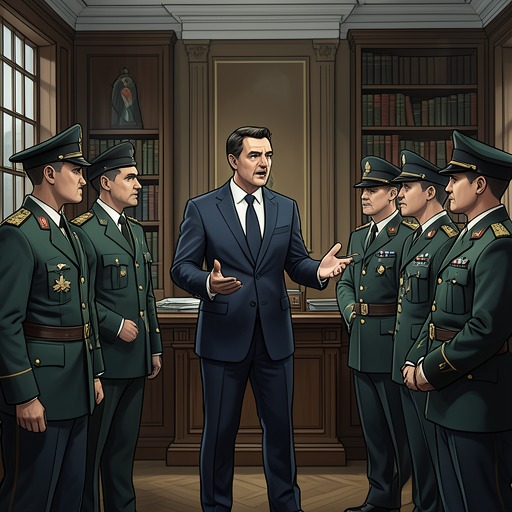
Scientists' Public Role and Dissent
American PrometheusScientists’ public role and dissent are presented as a struggle over who may speak about a weapon, and what kind of authority that speech can claim. J. Robert Oppenheimer helped build institutions that required intense collaboration under military secrecy, yet he also argued that the consequences of atomic weapons could not be contained within technical work. His career exposes the instability of the boundary between scientific expertise and political judgment: he crossed it, tried at other times to hold it in place, and ultimately became an example of the penalties attached to crossing it.
Scientific work under military authority
The tension began before the bomb project. Ernest Lawrence’s increasingly powerful cyclotrons represented a new scale of science: large machines, substantial funding, industrial methods, and close relations with powerful business and political patrons. The book contrasts this emerging big science with the smaller, theoretical work to which Oppenheimer was attached. Some physicists found the culture of the large laboratories alienating, especially where technology and military purposes outweighed the older ideal of inquiry for its own sake. The conflict over public responsibility therefore arose within a changing scientific profession, not outside it: researchers were becoming more dependent on institutions whose goals they did not wholly control.
At Los Alamos, that dependence took the form of a weapons laboratory built in an isolated New Mexico setting, with the Army responsible for security and much of the organization. Oppenheimer had to become an administrator on a deadline, recruiting scientists and coordinating a project whose demands differed sharply from his earlier academic life. The laboratory’s physical and institutional conditions mattered. Its initial facilities were rudimentary, its location remote, and its work governed by compartmentalization. Yet the science also required exchange. Oppenheimer supported Hans Bethe’s proposal for a weekly colloquium, insisting that scientists needed sustained discussion because earlier information barriers had left too much of the work divided into compartments. At the first gathering, held in the former schoolboys’ library on April 15, 1943, he had Bob Serber explain the project to roughly forty scientists. Security concerns interrupted even that technical briefing: Serber was told to substitute the neutral term gadget for bomb.
The formal rules of secrecy and the needs of research pulled against one another. Edward Teller warned Oppenheimer that excessive secrecy was an obstacle; during a visit, Ernest Lawrence disregarded Leslie Groves’s restrictions while lecturing. Officially, compartmentalization remained in force, but scientists increasingly discussed problems across its boundaries. This was not simply a contest between security and openness. The same informal communication that made the laboratory more effective also made military control less complete, while the scientists’ growing knowledge gave them reason to consider the weapon’s purposes.
The dispute over whether scientists should speak
By late 1944, Robert Wilson and other scientists were troubled by the continued development of the bomb. Wilson had discussed its possible use with Oppenheimer and proposed a formal meeting about the issue. Oppenheimer initially tried to dissuade him, warning that the security authorities might object. Wilson nevertheless posted notices for a discussion titled The Impact of the Gadget on Civilization. About twenty people attended the cold evening meeting in the building that housed the cyclotron. They considered why work on the bomb continued when the war in Europe was nearly won and what the weapon would mean after the war.
Accounts differ about Oppenheimer’s attitude toward such discussions. Victor Weisskopf recalled that Oppenheimer opposed formal meetings on the bomb’s political implications, saying that these were political matters and not the scientists’ task. Weisskopf also remembered a March 1945 meeting, attended by about forty scientists, at which Oppenheimer again discouraged attendance. Wilson, by contrast, remembered Oppenheimer appearing at his meeting and making a forceful argument. These recollections resist a simple portrait of either a consistent advocate or a consistent opponent of scientific dissent. Oppenheimer could discourage scientists from debating the weapon’s use while still attending a meeting and trying to shape its conclusion.
At Wilson’s meeting, Oppenheimer argued that the war should not end with the new weapon preserved as a military secret. If the world remained ignorant of it, he reasoned, a future war would likely bring atomic weapons into use. The device therefore had to be tested, and the delegates assembling for the new United Nations should begin their deliberations with knowledge of what humanity had created. This position drew on Niels Bohr’s emphasis on openness and on the expectation that postwar international arrangements might address the threat. It allowed some scientists to continue the work: they could understand their labor not only as producing a weapon, but as making a new and dangerous fact known to the world. For Wilson, Oppenheimer’s presence and argument helped resolve doubts that the weapon might be used against Japan after the defeat of Germany.
That argument did not amount to opposition to every decision about use. At the Interim Committee discussion of the bomb, Oppenheimer did not object to the proposed target principles, which described a war plant surrounded by workers’ homes. He raised the possibility of conducting several atomic strikes simultaneously, but Leslie Groves rejected it. Groves also attacked scientists he considered insufficiently discreet or loyal, and the meeting agreed that they should be removed from the program after the bomb was used. Oppenheimer appears to have assented without speaking against the proposed purge. He had advocated informing the Soviet Union about the new weapon, but that proposal was derailed; he did not challenge the target language or the treatment of dissident scientists. The episode reveals the limits of his influence and the compromises within it: advocacy for openness in one domain could coexist with silence about civilian danger and the suppression of dissent in another.
From wartime dissent to public policy
After the war, Oppenheimer increasingly described weapons work as a moral choice rather than an inevitable extension of scientific employment. In September 1945, he told Dean Acheson that many Manhattan Project scientists were disinclined to continue working on weapons, not just a super bomb, because such work ran against their hearts and spirits. He rejected Edward Teller’s request that he press for continued research on the Super, telling him that he neither could nor would do so. Oppenheimer also helped Herbert Marks draft Harry S. Truman’s message to Congress on atomic energy. The message called for new international arrangements and treated atomic energy as a force that could not be governed by old assumptions. Oppenheimer believed he had secured a presidential commitment to abolish atomic weapons.
His subsequent effort to express scientists’ concerns was more complicated. When the Los Alamos scientists’ document calling for public consideration of atomic policy was classified, Oppenheimer initially reassured colleagues that the administration might act responsibly. He later supported waiting until Truman had addressed Congress, a reversal that appeared to some scientists to make him more compliant the longer he spent in Washington. Yet in private discussions with officials, he continued to report the depth of scientific opposition to further weapons work. He was not simply a spokesperson for his colleagues: he sometimes restrained their public action, even as he carried their misgivings into government circles.
The security hearing transformed that tension into a warning. Oppenheimer was not found to have passed atomic secrets, and the Gray Board had cleared him of that accusation. Nevertheless, Lewis Strauss and his allies succeeded in stripping him of his position and influence. The book presents the case as consequential beyond one scientist’s career: it demonstrated that a person could be punished as a security risk even where espionage was not established, and that criticism of the government’s nuclear policy could carry serious costs. Scientists who had briefly been treated as public intellectuals, entitled to advise on the larger meaning of their work, were increasingly confined to serving as technical experts. The hearing marked a narrowing of the public role available to scientists working within government institutions.
The afterlife of the hearing
The punishment did not make Oppenheimer a straightforward public dissident. In the years after the hearing, his public transformation from Washington insider to exiled intellectual was more evident than any embrace of activism. Friends saw him as passive or deferential in the face of authority. At a 1955 meeting about the danger of war over the Formosa Straits, he agreed with a proposed public warning but declined to sign it, concerned about the consequences of doing so. He also argued against a protest that might imply Washington was not already giving careful attention to the issue. The episode shows how dissent could be narrowed without being formally forbidden: Oppenheimer could retain his judgments while declining the public act that would make them politically legible.
The restraint was not complete. Oppenheimer spoke about Hiroshima with regret, telling a graduating class in 1956 that the bombing might have been a tragic mistake and that American leaders had lost a sense of restraint. In correspondence with Max Born, he acknowledged that he shared some of Born’s disapproval of what he had done. Yet his brother Frank thought that Oppenheimer remained frustrated by his exclusion from official circles and wanted to regain a place in them. The lasting significance of his public role lies in this unresolved condition. He had spoken, advised, persuaded, acquiesced, and sometimes withdrawn; after his excommunication, he did not simply become free to dissent. The case instead made the costs of public criticism plain and encouraged the very self-censorship that later marked his conduct.