Soviet Union’s first atomic bomb test
American PrometheusThe Soviet Union’s first atomic bomb test, known to American officials as Joe-1, was a turning point in the nuclear age: it ended the United States’ atomic monopoly and transformed debate over secrecy, deterrence, and the next generation of weapons. The test was detected from the air, confirmed by a panel that included J. Robert Oppenheimer, and reluctantly acknowledged by President Harry S. Truman. For Oppenheimer, the Soviet achievement was both a long-expected fact and a narrow opportunity to change the direction of nuclear policy. The response instead accelerated weapons production and intensified the contest over the thermonuclear bomb.
Background: An Expected End to the Monopoly
The test came amid a striking contrast between the speed of wartime scientific organization and the difficulty of sustaining openness after the war. The Berkeley Radiation Laboratory had grown out of Ernest Lawrence’s cyclotron program, an increasingly expensive form of “big science” built around large machines and institutional backing. Oppenheimer, whose work had been associated with theoretical “small” science, had nevertheless become central to the wartime effort to coordinate physicists and turn nuclear research into a weapon.
At Los Alamos, that work had required Oppenheimer to remake himself as a laboratory director: he had to recruit, organize, and direct scientists on a fast schedule while adapting to military security rules. The project’s compartmentalization proved increasingly difficult to maintain. Oppenheimer supported a weekly open-ended colloquium because scientists needed a thorough discussion of complicated work that had previously been divided among them. Yet the project was also subject to surveillance: the Army arranged full-time technical and physical monitoring of Oppenheimer, including the monitoring of his mail and home telephone and a wiretap on his office. These wartime tensions between shared scientific knowledge and security control formed part of the institutional inheritance against which he later argued for a more rational policy.
Oppenheimer had not expected the American monopoly to last. A year before the Soviet test, he had warned in Time that “Our atomic monopoly is like a cake of ice melting in the sun. . . .” The image framed the new development not as an inexplicable shock but as the realization of a foreseeable limit. The question, as he saw it, was what the United States would do once that limit had been reached.
Detection and Confirmation
The Soviet Union secretly exploded its bomb on August 29, 1949, at an isolated testing site. Nine days later, an American B-29 reconnaissance plane flying over the northern Pacific detected radioactive readings on filter paper designed to reveal an atomic explosion. On September 9, the finding reached senior officials in the Truman administration. The evidence was consequential enough to demand technical review, but the prospect of a Soviet bomb was so unwelcome that officials, including Truman, were reluctant to accept it.
The Defense Department chose Vannevar Bush to chair a panel of experts. Bush proposed that Oppenheimer lead the technical review instead, but an Air Force general said the department preferred Bush. Bush accepted the chairmanship and ensured that Oppenheimer joined the panel. Oppenheimer had just returned from Perro Caliente when Bush informed him of the assignment.
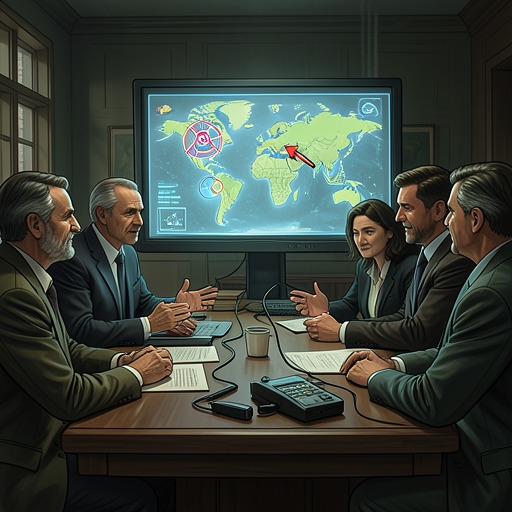
The panel met for five hours on the morning of September 19. Bush presided; Oppenheimer directed many of the questions. By lunchtime, the experts agreed that the evidence was overwhelming: “Joe-1” was an atomic bomb test, and the device was a close copy of the Manhattan Project’s plutonium bomb. The finding established more than the existence of a Soviet weapon. It showed that the American design could be reproduced, and that secrecy had not preserved a lasting national advantage.
The Announcement and Oppenheimer’s Response
The next day, David Lilienthal briefed Truman on the panel’s conclusion and urged him to announce it immediately. Lilienthal recorded that his arguments made little apparent headway. Truman remained doubtful that the Soviets had a real bomb and said he would hold the news for a few days while he considered it. Oppenheimer, hearing of the delay, was incredulous and upset. He told Lilienthal that the administration was missing an opportunity to seize the initiative.
Three days later, Truman reluctantly announced that an atomic explosion had occurred in the Soviet Union, while pointedly declining to call it a bomb. Edward Teller asked Oppenheimer what to do. Oppenheimer replied, “Keep your shirt on.” The brief exchange registered the difference between the alarm surrounding the news and Oppenheimer’s effort to contain panic. He told a Life reporter that autumn that “ ‘Operation Joe’ is simply the fulfillment of an expectation.” His calm description did not mean the consequences were small. He hoped the Soviet bomb might persuade Truman to revive efforts to place nuclear technology under international control, but feared that the administration might instead overreact; he had heard talk of preventive war.
Oppenheimer pressed Lilienthal to treat the moment as an opening against secrecy. Lilienthal found him “frantic, drawn” with nervous energy. Oppenheimer warned, “We mustn’t muff it this time; this could be an end of the miasma of secrecy.” He believed that the administration’s secrecy was irrational and counterproductive, and he and Lilienthal had spent the year trying to persuade the president and his advisers to be more open about nuclear issues. At a meeting of the Atomic Energy Commission’s General Advisory Committee, Oppenheimer expressed hope that the Soviet achievement would lead the United States toward a more rational security policy. In his view, continued secrecy could no longer be defended as a way to preserve a monopoly that had already ended.
Arms Expansion and the Thermonuclear Dispute
The immediate policy response moved in the opposite direction. Within days, Truman endorsed a Joint Chiefs proposal to increase nuclear production. The United States had about fifty atomic bombs in June 1948; the stockpile was projected to grow rapidly to roughly three hundred by June 1950. Lewis Strauss argued that declining military superiority could be recovered only through a “quantum jump” in technology and urged a crash program to develop the Super, or thermonuclear weapon.
Oppenheimer doubted both the weapon’s practicality and the wisdom of building it. He wrote to James Conant, “I am not sure the miserable thing will work,” adding that it might not be deliverable to a target except by ox-cart. The concern was not merely technical. A fusion weapon could yield vastly more explosive force than a fission bomb, and its potential yield had no comparable physical limit: adding more heavy hydrogen could produce a still larger explosion. Oppenheimer feared that such a weapon would intensify the arms race and make mass, indiscriminate destruction the defining logic of nuclear strategy.
In the General Advisory Committee’s deliberations, that ethical objection was joined to a strategic argument. A thermonuclear weapon might yield as much as 100 million tons of TNT, compared with the Hiroshima bomb’s 15,000 tons, and could destroy 150 to 1,000 square miles or more. The committee warned that a super bomb might become “a weapon of genocide.” Its mere possession could also damage American security by persuading other countries that the United States was prepared to contemplate catastrophe. Oppenheimer and the majority hoped the weapon would never be produced and that refusing to build it might reopen arms-control negotiations.
The committee also argued that an American decision not to build the Super would not stop the Soviet Union from trying. Since a thermonuclear weapon could not be developed without testing, a Soviet test would be detected. The report reasoned that existing American atomic forces could inflict comparably effective retaliation. If the Super had no feasible military target, the committee proposed accelerating the production of fissionable material for smaller tactical atomic weapons instead, alongside stronger conventional forces in Western Europe. This was an early argument for nuclear sufficiency: an arsenal designed for specific military purposes rather than expanded through an open-ended race. On November 9, 1949, the Atomic Energy Commission’s commissioners voted three to two to endorse the committee’s recommendations, but the dispute over the Super continued.
A Changed Strategic Landscape
The test therefore revealed a danger and sharpened a choice, but it did not produce the policy change Oppenheimer wanted. The administration responded with a larger stockpile and, soon, a drive toward thermonuclear weapons. Oppenheimer’s fear was that the pursuit of a weapon capable of exterminating populations would make strategic policy less defensible, not more secure. He and the committee maintained that the consequences extended beyond the destruction of military installations: thermonuclear use would carry the policy of exterminating civilian populations still further than the atomic bomb.
His later strategic arguments exposed another tension in his search for alternatives. In 1951, appalled by an Air Force plan to obliterate Soviet cities on a vast scale, he called it a criminal plan of genocide. Yet he also supported giving tactical atomic weapons priority as an alternative to city-destroying thermonuclear bombs. He described them as weapons to assist combat forces in a military campaign, rather than weapons of totality or terror. The logic was intended to bring war back to the battlefield and reject the annihilation of cities; its danger was that battlefield nuclear weapons might actually be used and could trigger an exchange of increasingly powerful weapons. Oppenheimer’s response to the Soviet test thus carried no simple faith in deterrence. It joined the hope of limiting the arms race to persistent anxiety that each proposed military solution might widen the path to nuclear war.