State Department Panel of Consultants on Disarmament
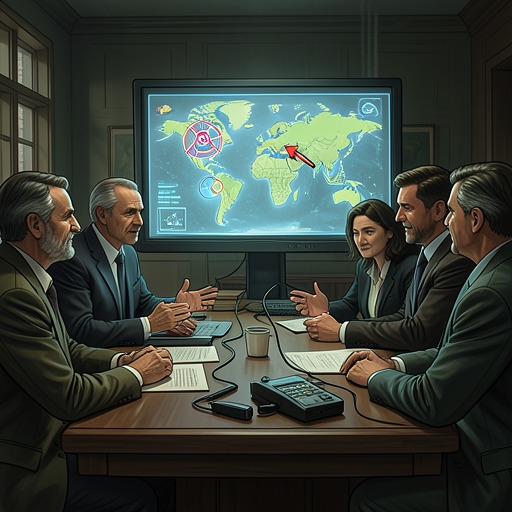
American PrometheusThe State Department Panel of Consultants on Disarmament was a 1952 advisory group whose proposals challenged the assumption that American security depended on building and keeping ahead in nuclear weapons. Chaired by J. Robert Oppenheimer, it argued for a thermonuclear test moratorium, a policy against first use of atomic weapons, and public candor about the danger of the arms race. Its advice did not stop the coming test, but its confidential report traced how a nuclear stalemate could become a precarious condition requiring repeated political restraint.
Formation and Membership
In April 1952, Secretary of State Dean Acheson asked J. Robert Oppenheimer to join the panel. Its members included Vannevar Bush, John Sloan Dickey, Allen Dulles, and Joseph Johnson, president of the Carnegie Endowment for International Peace. As was customary in the advisory groups he joined, Oppenheimer was elected chairman. His participation continued even as he and James B. Conant and Lee DuBridge resigned from the General Advisory Committee in June, frustrated by Washington’s treatment of their counsel and by a movement to remove them. A contract-consultant arrangement also kept Oppenheimer available to the Atomic Energy Commission and extended his top-secret Q clearance for another year.
The panel’s work joined expert analysis to the practical politics of communicating it. Acheson recruited McGeorge Bundy, then a thirty-three-year-old Harvard professor, as recording secretary. Bundy had written about the atomic bombings with Henry Stimson and came to the assignment eager to meet Oppenheimer. Oppenheimer took an immediate liking to him; the two soon exchanged handwritten notes about policy as well as academic and family matters. Bundy would later serve as the report’s wordsmith, while many of its central ideas came from Oppenheimer.
Survival, Testing, and First Use
The panel framed its central problem as the survival of the United States and the Soviet Union in a nuclear standoff. Oppenheimer knew that supporters of the hydrogen bomb expected to test a device that autumn. When Vannevar Bush proposed a complete ban on thermonuclear tests before that threshold was crossed, the panel examined whether an agreement could work without inspections: any violation, its members reasoned, would be detected, while without tests the hydrogen bomb could not be developed into a reliable military weapon.
At a June meeting hosted by Bundy in his Cambridge home, James B. Conant joined as an unofficial participant. He argued that atomic weapons had made American cities vulnerable and that military leaders relied too heavily on them as the principal hope of victory in an all-out war. Conant proposed that the United States officially announce it would not be the first to use atomic weapons in a new war, and supported Bush’s proposal for a tacit moratorium on thermonuclear testing. Oppenheimer endorsed both ideas. The panel warned Acheson that a successful test would give the Soviet Union evidence that a thermonuclear device was possible and might provide useful information about its dimensions through analysis of the fallout. Members knew that the first test, code-named Mike, was scheduled for that autumn and that the Air Force would vigorously oppose efforts to stop it.
The Report’s Argument
The panel’s final report was forwarded to the departing Acheson as Dwight D. Eisenhower entered the White House. It remained highly classified, circulating among only a handful of officials in the new administration. The report warned that the Soviet Union might possess 1,000 atomic bombs within a few years and 5,000 only a few years later—a destructive capacity that threatened civilization itself. It considered whether a nuclear stalemate might produce a strange stability, with both sides refraining from using suicidal weapons, but emphasized how fragile that prospect would be: peace would depend on statesmen resisting rash action again and again.
To counter the complacency and ignorance produced by excessive secrecy, the panel urged a policy of candor. The new administration, it recommended, should tell the public about the atomic danger and disclose the rate and impact of atomic production. Merely keeping ahead of the Soviet Union could not, the report argued, remove the danger. This was more than a request to release figures: it challenged the premise that greater stockpiles alone could secure the country, and insisted that citizens needed enough information to understand the risks being taken in their name.
Rejection and Significance
The panel’s proposals met a closed door. On October 9, 1952, the National Security Council rejected its recommendation for a thermonuclear test moratorium. Three weeks later, the United States detonated a 10.4-megaton bomb in the Pacific, vaporizing the island of Elugelab. The test made plain the gulf between the panel’s warning and the government’s course: its members had argued that a test could intensify Soviet efforts, but their confidential advice could not become public opposition without risking their security clearances.
The panel did not control the nuclear program or persuade the administration to pause it. Its significance lies instead in the connected case it made: testing could accelerate an arms race; secrecy could leave the public unprepared to judge it; and a balance of terrifying weapons would be stable only if leaders repeatedly resisted using them. In a policy debate dominated by demands to build more and move faster, the panel treated disclosure, restraint, and the conditions of political choice as matters of national security.