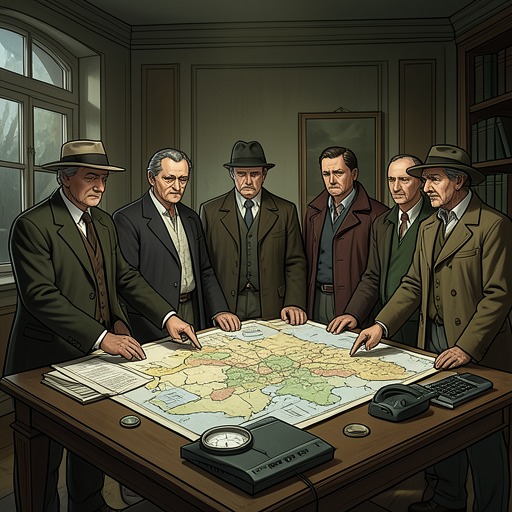
The Setback of American Liberalism
American PrometheusThe Setback of American Liberalism names the political consequence the book draws from J. Robert Oppenheimer’s security case: in the early Cold War, a liberal could be discredited not for espionage, but for challenging the country’s reliance on nuclear weapons. Oppenheimer’s trajectory—from the broad Left and concern for the New Deal to service in government nuclear deliberations and opposition to a hydrogen-bomb crash program—made his humiliation a warning about which arguments could safely be made in public.
From the broad Left to political caution
In the late 1930s, Oppenheimer was a prominent professor who spoke on political issues and signed public petitions. The Molotov–Ribbentrop Pact unsettled left-wing circles and led many American Communists to leave the Party. Oppenheimer’s name did not appear on an open letter defending the Soviet Union’s pact with Nazi Germany, but Haakon Chevalier recalled that Oppenheimer tried to explain it as a treaty of necessity, shaped by Western appeasement at Munich. That account places him amid the political argument without establishing that he endorsed every Communist position.
The pamphlets titled Reports to Our Colleagues offer a similarly qualified record. They defended the New Deal’s social programs and opposed America’s entry into the European war; Chevalier said Oppenheimer drafted them and paid for printing and distribution, while Gordon Griffiths corroborated his involvement. The evidence does not establish Oppenheimer as their sole author. One pamphlet warned that the war was changing American politics, that the New Deal was being abandoned, and that reaction was mobilizing. A later pamphlet portrayed Franklin D. Roosevelt as a reactionary and war-monger, language at odds with Oppenheimer’s measured style and with the limited evidence of his own disappointment in Roosevelt. The material suggests that his chief concern was the war’s effect on domestic politics, not that every pamphlet position can be assigned to him.
His political activity also carried a professional risk. As conservative scrutiny of the University of California intensified, Oppenheimer worried that an investigation of the university’s radicalism could cost him his job. His colleague Martin Kamen recalled that he sometimes withdrew from political activity when alarmed, then became active again when events provoked him. That unevenness is part of the political context: a visible liberal could speak, but could also feel pressure to draw back.
Atomic policy and the limits of openness
At the Interim Committee meeting on May 31, 1945, Oppenheimer joined four scientific consultants advising on atomic policy. The committee was not deciding whether the bomb should be used against Japan; that question was treated as effectively settled, and military-use decisions were understood to belong to the White House. Yet the meeting reached beyond the immediate war. Henry L. Stimson described the bomb as a revolutionary change in humanity’s relation to the universe, with consequences extending past the conflict.
Oppenheimer urged that the United States not prejudge the Soviet response and supported the prospect of cooperation. George C. Marshall argued that the Russians might even be invited to observe the test; James F. Byrnes objected that this could lead Joseph Stalin to demand access to the project. The discussion exposed a tension Oppenheimer would continue to confront: officials acknowledged that the bomb’s physics could not remain secret indefinitely, while also treating American production and research as instruments for staying ahead. The committee’s conclusion favored pushing ahead while seeking better relations with the Soviet Union, leaving the contradiction between cooperation and competitive accumulation unresolved.
The hydrogen-bomb debate
By 1949, Oppenheimer was chairman of the General Advisory Committee, where he tried to hear the committee’s members before stating his own view. At its October meeting, the participants considered the hydrogen bomb amid pressure on the Truman Administration to answer the Soviet Union’s new atomic capability with a visible show of resolve. The committee’s discussion addressed both military utility and moral consequence; its final recommendations opposed an accelerated hydrogen-bomb program.
The alternative was not simply to trust that the Soviet Union would refrain from building the weapon. The committee reasoned that an American crash program would not deter Soviet development, and that the existing stock of atomic bombs could provide a comparable retaliatory response. It also argued that smaller tactical weapons and conventional forces in Western Europe could offer a more credible defense than an immense weapon with no plausible military target. This was an argument for nuclear sufficiency—an arsenal built for defined purposes rather than enlarged through an open-ended race.
On November 9, the commissioners voted three to two to endorse the committee’s recommendations. Oppenheimer was gratified, but his personal secretary predicted that the report would bring trouble. The apparent victory soon gave way to a counteroffensive from hydrogen-bomb supporters, while officials voiced fears of an inevitable war and urged preemptive destruction of the Soviet Union. The dispute thus exposed a widening division between advocates of arms control and those who treated restraint as perilous.
Oppenheimer continued to explore alternatives with George F. Kennan. After Kennan visited Princeton in November 1949, Oppenheimer called his proposals reasonable but warned that Washington’s prevailing climate could make safeguards seem absolute and any pause seem dangerously naive. Kennan drafted a possible presidential statement against proceeding with the hydrogen bomb at that time, arguing that a weapon of almost unlimited destructive power had no purely military use, that no arsenal could provide absolute security, and that building the weapon would encourage others to do the same. Their exchange shows Oppenheimer not only opposing a policy, but trying to formulate a politically intelligible case for restraint.
A shrinking public forum
The political opposition to Oppenheimer’s views had powerful institutional channels. William Liscum Borden, an aide to the Joint Committee on Atomic Energy, regarded the Soviet threat as imminent and had warned of a future nuclear attack on the United States. He read Oppenheimer’s criticism of proposed military and civilian nuclear projects as evidence of a born leader and manipulator. Such suspicion transformed policy disagreement into a question of character and loyalty.
For a time, Oppenheimer’s case for candor appeared capable of reaching the new administration. Dwight D. Eisenhower found the disarmament argument thoughtful, but Lewis Strauss—first appointed as the president’s atomic energy adviser and later chairman of the United States Atomic Energy Commission—opposed public discussion of the American stockpile and nuclear strategy. Strauss raised suspicions about Oppenheimer with the president, including his wartime hiring of David Hawkins and his support for a mathematician whose father had led the Communist Party. The political climate around Oppenheimer was therefore shaped not only by arguments over weapons, but by the effort to recast policy disagreements as security concerns.
The security case had a consequence beyond the fate of one scientist. The book distinguishes it from cases in which espionage was the underlying accusation: despite Strauss’s suspicions, no evidence showed that Oppenheimer had passed secrets, and the Gray Board had exonerated him of such allegations. His earlier connections to the broad Left, Popular Front causes, and Communists nevertheless remained politically consequential even after his disillusionment with the Soviet Union and his place among liberal foreign-policy figures such as George C. Marshall, Dean Acheson, and McGeorge Bundy.
Oppenheimer’s defeat thus became a defeat for American liberalism in a specific sense. Even when loyalty was not in doubt and espionage was not established, challenging the wisdom of reliance on a nuclear arsenal could be dangerous. The hearing narrowed the public forum: it made the boundary of acceptable debate visible, and showed that dissent about the purpose and scale of American power could itself become grounds for exclusion.