U.S. Army
American PrometheusThe U.S. Army became the military authority that organized, built, and secured the wartime atomic-bomb project, turning scattered research into a national undertaking while imposing rules that reached into scientific work and personal life. Its relationship with J. Robert Oppenheimer rested on a practical bargain: the Army would command the project and control entry to its isolated laboratory, while Oppenheimer directed the scientists and defended their need to share information. The bargain enabled the work, but its tensions endured in surveillance, restrictions on researchers, and later arguments over how nuclear weapons should be used.
Taking Command of the Project
The Army’s role expanded as the government moved to give the uranium project a more urgent and centralized direction. Brehon Somervell, the senior officer responsible for Army logistics, told James B. Conant that he already had an officer in mind to supervise the project. On September 17, 1942, Somervell met Leslie Groves in a corridor outside a congressional hearing room. Groves wanted an overseas combat assignment, but Somervell told him he would remain in Washington; the assignment, he argued, could help win the war.
On September 18, Groves formally took charge of the Manhattan Engineer District, commonly known as the Manhattan Project. The Army’s new director moved quickly from appointment to acquisition: that day he arranged to buy 1,200 tons of high-grade uranium ore, and the following day he ordered the acquisition of a site at Oak Ridge, Tennessee, for processing uranium. He then toured laboratories across the country working on uranium-isotope separation. The speed and scale of these actions made the Army more than a sponsor. It became the organization assembling the people, sites, materials, and authority required for a weapon.
Groves met Oppenheimer at a Berkeley luncheon on October 8. Their working relationship began amid a sharp contrast in temperament and experience: Groves was an Army engineer and administrator, while Oppenheimer was a theoretical physicist without a record of directing a large organization. The Army’s choice was far from obvious to scientific leaders, and when Groves proposed Oppenheimer to the Military Policy Committee, the suggestion met considerable opposition. Groves asked members to name a better candidate; after weeks of discussion, no superior choice emerged, and by the end of October the appointment was Oppenheimer’s. In selecting him, the Army accepted a scientific leader whom many doubted could manage a laboratory, while Oppenheimer had to learn to operate within a military enterprise.
Building a Military Laboratory and a Scientific Community
The Army’s security requirements shaped the choice of a remote site for the new laboratory. Oppenheimer favored an isolated rural location, and Groves saw that isolation as an advantage for security. On November 16, 1942, Oppenheimer and Edwin McMillan accompanied Major John H. Dudley to Jemez Springs, northwest of Santa Fe, during the search for a laboratory site. Oppenheimer knew the surrounding high country from horseback trips; the selected location offered a view of the Sangre de Cristo Mountains, but only a winding gravel road and one telephone line connected it to the outside. Army construction crews raised barracks and makeshift physics and chemistry laboratories, painting the buildings Army green.
The site’s isolation also meant that the Army and the scientists had to create a functioning town as well as a weapons laboratory. When the first group of scientists was due to arrive in March 1943, the promised community was to include homes and bachelor quarters, electricity but no telephones, wood-fired stoves, a school, library, laundry, hospital, garbage collection, and an Army post exchange. The reality was far rougher. John Manley, arriving from Chicago’s established scientific environment, found Los Alamos without the equipment, technicians, or infrastructure needed for experimental physics. His criticism exposed a central consequence of the Army’s choice: isolation strengthened control over access but made the ordinary work of research and daily life much harder to provide.
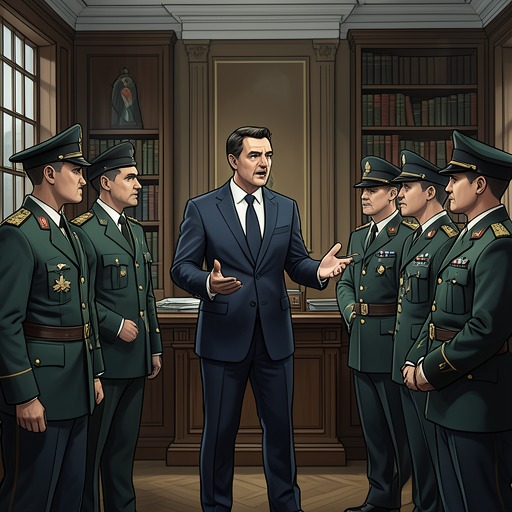
Military discipline also provoked resistance among scientists. By February 1943, Isidor Isaac Rabi and other physicists had persuaded Oppenheimer that the laboratory should be demilitarized in its scientific work. Groves agreed to a compromise: scientists would remain civilians during experimentation but wear uniforms when testing the weapon. Los Alamos would be fenced and designated an Army post; within the laboratory’s Technical Area, however, the scientists would report to Oppenheimer as Scientific Director. The Army controlled access to the community, while Oppenheimer took responsibility for the exchange of information among the scientists. The arrangement preserved military authority over the site without making the laboratory’s internal scientific hierarchy simply an extension of Army command.
That distinction mattered because research depended on discussion. At Hans Bethe’s suggestion, Oppenheimer established a weekly open-ended colloquium, insisting against Groves’s attempt to stop it that scientists needed time to work through a complicated body of information. At the first meeting, on April 15, 1943, in the former schoolboys’ library, Robert Serber briefed a group of fewer than forty scientists. Oppenheimer had Manley prompt Serber to use the neutral term gadget rather than bomb. The episode joined two purposes in one room: exchanging technical knowledge and managing the language through which that knowledge could be spoken. In practice, the need for scientific cooperation increasingly weakened the Army’s compartmentalization policy. Even senior visitors such as Ernest Lawrence did not always observe its limits, and restrictions that were formally maintained became progressively less effective among researchers.
Counterintelligence and Its Human Costs
The Army’s security function extended beyond the remote laboratory. Before Los Alamos opened, Army counterintelligence arranged for full-time technical and physical surveillance of Oppenheimer. On March 22, 1943, the FBI suspended its own direct surveillance of him at the Army’s instruction, while continuing to watch people who might have been connected with him through Communist Party activity. Army Counter-Intelligence Corps officers were already working undercover before Oppenheimer arrived; Andrew Walker served as his personal driver and bodyguard. Walker later confirmed that officers monitored Oppenheimer’s mail and home telephone, while his office was wiretapped. Oppenheimer, who tried to comply with security requests and carefully kept classified memoranda in his pocket, was at once a laboratory director and the object of sustained scrutiny.
The investigation reached back to Berkeley. Lieutenant Colonel Boris Pash treated a transcript of a conversation between Steve Nelson and an unidentified man known as Joe as evidence of espionage and as support for his suspicions about Oppenheimer. The transcript came from an illegal wiretap, so it could not be used to prosecute the speakers; the information was instead used to trace contacts at the Radiation Laboratory. Investigators focused on Giovanni Rossi Lomanitz, then identified Joseph Weinberg, David Bohm, and Max Friedman through a photograph purchased from a campus photographer. Pash believed he had uncovered an espionage network and, in July 1943, wanted the four men taken out to sea and interrogated. The FBI intervened to discourage the plan, noting that the proposed questioning would produce no usable evidence in court.
Even without such an interrogation, security suspicions altered the researchers’ prospects. When Bohm’s thesis work was classified in the spring of 1943, his notes were seized and he was barred from writing up his research. Oppenheimer certified that Bohm had met the requirements for a thesis, and Berkeley awarded him his Ph.D. in June. Oppenheimer then requested that Bohm transfer to Los Alamos, but Army security officers denied him clearance. They gave Oppenheimer a false explanation, citing Bohm’s relatives in Germany; the evidence presented in the account identifies Bohm’s association with Weinberg as the actual reason. Bohm remained at the Radiation Laboratory, studying plasmas.
Other young physicists suffered different consequences. Lomanitz received an Army draft notice shortly after Ernest Lawrence appointed him liaison between the Radiation Laboratory and the Manhattan Project plant at Oak Ridge. Lawrence and Oppenheimer tried to intervene, but Lomanitz spent the rest of the war in stateside Army camps. Friedman was fired from the Radiation Laboratory, later found work at the University of Wyoming and the Met Lab in Chicago, and was dismissed from the latter after six months when security officers caught up with him. Weinberg, kept under close surveillance without new evidence connecting him to espionage, was drafted and sent to an Army post in Alaska. In these cases, security enforcement did not merely protect a project from suspected leaks; it redirected careers, separated students from their research, and restricted who could participate in the work.
Strategy, Weapons, and the Limits of Control
The Army’s influence also figured in the postwar dispute over the scale and purpose of nuclear forces. In 1949, Oppenheimer and the General Advisory Committee argued that a thermonuclear weapon could be so powerful that any legitimate military target would be too small. Their report warned that a weapon capable of devastating hundreds of square miles might become a weapon of genocide, and argued that refusing to build it might leave room to reopen arms-control negotiations. If the Soviet Union developed such a weapon first, the committee reasoned, the United States’ existing stock of atomic bombs could provide an effective reprisal. It proposed that a more economical and credible defense might instead rely on fissionable-material production for smaller tactical weapons, alongside conventional forces in Western Europe.
That strategic alternative connected nuclear policy to the Army’s interest in battlefield forces, but it carried a danger its advocates did not resolve. In the 1951 Project Vista report, Oppenheimer favored bringing nuclear weapons back to the battlefield as tactical aids to military operations rather than treating them only as instruments of total war or terror. This approach supported the Army’s demand for a larger share of the atomic budget, in contrast to the Air Force’s emphasis on strategic bombing. Yet battlefield use could make nuclear weapons more likely to be used at all and could create a trip-wire to a much larger exchange. The Army’s institutional preference for tactical weapons therefore belonged to a larger argument over how to deter war without normalizing nuclear combat.
Across the wartime project and its later strategic debates, the Army’s authority both enabled and constrained the scientific enterprise. It concentrated resources, built a secure site, and imposed a chain of command; the same security system interrupted research, exposed people to surveillance, and could exclude them from work on the basis of association. Los Alamos made the tension visible in its physical and organizational design: an Army post around a scientific community whose effectiveness depended on exchanges that strict military compartmentalization could not sustain. The Army could govern the project’s perimeter, but it could not make the production of scientific knowledge conform completely to the logic of secrecy.