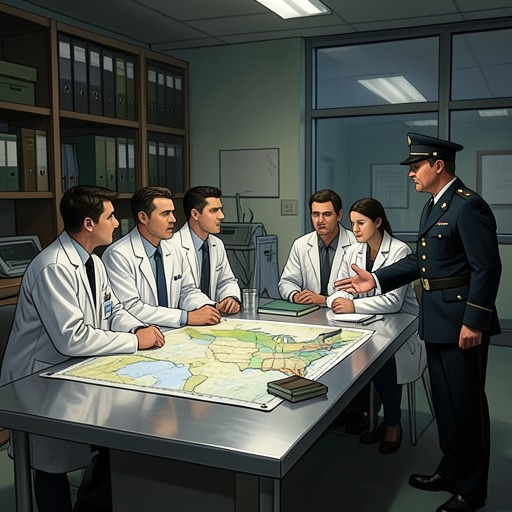
University of California Radiation Laboratory
American PrometheusThe University of California Radiation Laboratory was a Berkeley research center associated with Ernest Lawrence’s cyclotron work and with the scientists whose research became entangled in wartime atomic projects. The accounts place it at the crossing point of experimental physics, the movement of researchers into weapons work, and postwar disputes over whether atomic information should be shared. Its history in these episodes is also a history of how a scientific institution could become a focus of security claims that ranged from documented approaches for information to unverified political accusations.
Identity and Research Setting
The laboratory appears in the book as part of the Berkeley physics world built around Ernest Lawrence. The account situates its development within Lawrence’s work on cyclotrons, including references to the construction of the machines that made the laboratory a significant setting for nuclear research. The available narrative does not provide a full institutional history or a formal account of its administrative structure; it identifies the laboratory chiefly through its researchers, its scientific work, and its connections to the wider atomic research effort.
Those connections mattered as the war redirected scientific labor. Frank Oppenheimer had worked with Lawrence at the Radiation Laboratory during the early war years before joining his brother at Los Alamos in 1945. His move illustrates the passage of trained physicists from a Berkeley research setting into the Manhattan Project’s weapons laboratory. It does not mean that the two laboratories had identical roles: the evidence distinguishes Lawrence’s Berkeley laboratory from the later work at Los Alamos, even as personnel and scientific questions linked them.
Researchers and Atomic-Project Claims
The laboratory also figured in political talk about the bomb. In a conversation monitored by the FBI in November 1945, Communist Party officials described J. Robert Oppenheimer as one of their associates and claimed that he had discussed the atomic project with them in detail two or three years earlier. One speaker also referred to scientists at the Radiation Laboratory working on a weapon more powerful than the one used against Japan, and spoke of publishing a simplified diagram of the bomb. These were claims made in a recorded political conversation, not a demonstration in the account that the speakers possessed such a diagram or that Oppenheimer had given them classified information.
The same surveillance record complicates any simple conclusion about Oppenheimer’s political affiliation. The FBI itself noted uncertainty about whether he was actually a Party member. When officials later tried to recruit him to speak at a rally, he declined, while his brother Frank agreed. The distinction matters for the laboratory’s history: the recorded assertions linked its scientific work to political networks, but they did not establish that the laboratory as an institution participated in those networks or that its researchers collectively shared a political position.
The Attempt to Obtain Information
A separate episode concerned a specific request to pass scientific information to the Soviet Union. According to George C. Eltenton’s 1946 account to the FBI, a Soviet official had asked him in late 1942 whether he knew Lawrence and Oppenheimer and whether information could be obtained for Soviet scientists. Eltenton said he relayed the request to Haakon Chevalier, describing a proposed route involving photographic reproduction. The approach arose while the Soviet Union was fighting Nazi Germany, but the book presents the request and its subsequent handling rather than evidence that laboratory information was actually transferred through this channel.
Eltenton told investigators that Chevalier returned to say there was no chance of obtaining data because Oppenheimer did not approve. Chevalier confirmed the broad outline of Eltenton’s account and signed an affidavit stating that he had approached no one other than Oppenheimer to request information about the Radiation Laboratory’s work. He qualified that statement by acknowledging that he might have mentioned the desirability of obtaining information for Russia in passing, while denying any other specific proposal. These accounts establish an attempted approach and a reported refusal; they do not show that the laboratory’s information was supplied.
The interrogations took place in June 1946, when FBI agents questioned Chevalier and Eltenton separately for hours. Neither initially knew the other was being questioned on the same day. Their later comparison of accounts revealed the parallel interviews but did not resolve how the FBI had learned of the earlier conversations. The episode therefore attaches the laboratory to a contested chain of solicitation, refusal, surveillance, and retrospective testimony, rather than to a proven transfer of its research.
Security Allegations and Institutional Significance
A 1947 report to the California Joint Fact-Finding Committee on Un-American Activities included an allegation that the International Federation of Architects, Engineers, Chemists and Technicians had been used as a front for Communist espionage connected with atomic research at the laboratory. The book presents this as a charge contained in the report, not as an established finding about the laboratory’s conduct. That distinction is essential: the Rad Lab’s appearance in the allegation shows how atomic research became a target of political suspicion, but does not itself substantiate espionage by the institution or its staff.
Taken together, the episodes give the laboratory a significance beyond its scientific setting. Its researchers and work were linked to the expanding wartime effort; its name appeared in claims about secret information and in investigations of possible Soviet contacts; and its scientific activity became part of a wider argument about security and political loyalty. The evidence does not support treating every allegation as fact. Instead, it shows how the laboratory’s place in atomic research made it vulnerable to both genuine security concerns and claims that rested on contested testimony, recorded assertions, or official accusation.