.357 Magnum
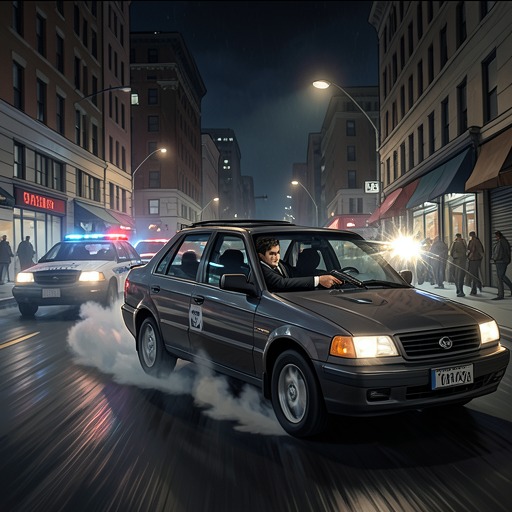
American PsychoThe .357 Magnum is Patrick Bateman's most consequential firearm: a concealed object carried beneath an Giorgio Armani wool overcoat and repeatedly transformed from a private sign of control into the visible engine of a citywide breakdown. Its decisive appearance comes during a dinner at Bouley, where Bateman's confession that his life is a living hell is ignored by a table absorbed in talk of investments, status, exercise, and power. He leaves before dessert, uses cocaine in the restroom, retrieves the gun from the coatcheck, straps it into a holster, and carries it into the misty streets of Tribeca.
Appearance and Function
The weapon is not introduced as an isolated object but as part of Bateman's carefully managed wardrobe and routine. His Giorgio Armani overcoat conceals it while he moves through an expensive restaurant, preserving the outward appearance of a well-dressed professional. Once retrieved, however, the gun changes the meaning of that costume: the overcoat becomes a hiding place, the holster gives his body a new purpose, and the dinner's controlled social setting gives way to an armed flight through the city.
Bateman explicitly treats the gun as a symbol of order. Before the Bouley sequence, he places it back in a locker in a reflective moment, intending to use it another time. The statement gives the weapon an ideological role in his private system: it promises decisiveness and structure even as every subsequent use produces confusion, error, and escalating disorder. Its material presence therefore contradicts the order Bateman claims to find in it.
The Tribeca Shooting
In Tribeca, Bateman approaches a young saxophonist playing outside an abandoned bistro. He listens to music from Les Misérables, attaches a silencer, and raises the .357 Magnum while the musician continues playing. The silencer fails. Bateman fires in mid-note, killing the saxophonist, then reloads the weapon and discovers that the gunshot has attracted a police squad car.
The firearm turns the attempted departure into a chain reaction. Bateman runs through an alley, flags down a taxi, and points the gun at the young Iranian driver, who pleads not to be shot. Bateman kills him, pushes the body from the cab, and tries to drive away despite blood and fragments covering the windshield. The taxi crashes into a Korean deli near Lotus Blossom, and the .357 Magnum remains the instrument that allows Bateman to move from one failed escape to another.
At the wreck, Bateman struggles with a police officer. Although the officer initially wrestles with him for control of the weapon, Bateman brings the gun to the officer's face and fires. The shot does not immediately kill him, so Bateman lowers his aim and shoots again. The violence draws onlookers, police vehicles, and further gunfire. A later round strikes the police car's gas tank, producing an explosion that shatters the windows of Lotus Blossom and turns the street into a scene of fire, rain, wreckage, and pursuit.
Escape and Public Exposure
The gun continues to organize Bateman's flight as he runs toward Wall Street, attempts to enter buildings, and sets off car alarms while searching for a vehicle. In a mistaken office building, he shoots a night watchman through the glass doors and then kills a janitor who witnesses the scene. The .357 Magnum has by then ceased to be a concealed accessory; it has become the visible trace of an attack that cannot be contained by clothing, professional identity, or the anonymous architecture of Manhattan.
Bateman eventually reaches his new office, signs in, and places the weapon away from immediate use while attempting to restore calm. With shaking hands, he telephones Harold Carnes and leaves a message confessing to dozens, perhaps hundreds, of murders. Police vehicles, ambulances, a SWAT team, flares, and a helicopter appear across the city as he speaks. The contrast is central to the object's narrative force: the gun has produced spectacular public consequences, yet Bateman can still retreat behind an office desk, a telephone, and the routines of corporate anonymity.
Concealment, Identity, and Unreliable Reality
The .357 Magnum belongs to the same world of surfaces as Bateman's business card, designer clothing, bottled water, and carefully maintained appearance. At the restaurant, he is preoccupied with how objects signify status; in the streets, the gun makes his identity materially dangerous. It is both an accessory of the social performance and the device that tears through that performance. The weapon's concealment under the overcoat allows Bateman to cross thresholds—restaurant, street, taxi, office—without changing his appearance until violence makes the hidden object legible.
Its appearances also intensify the novel's uncertainty about what has occurred. Bateman describes the shootings in exhaustive physical detail, but the aftermath does not provide a stable public confirmation equal to his account. His later message to Harold Carnes presents the violence as a confession, while the larger narrative repeatedly surrounds Bateman with mistaken names, interchangeable faces, and failures of recognition. The .357 Magnum thus operates on two levels: as a concrete weapon within Bateman's narration and as a recurring sign of the gap between what he claims to have done and what the social world appears capable of seeing.
Narrative Significance
The weapon's most important transformation is from an object Bateman imagines as orderly into an agent of uncontrolled consequence. It begins beneath an immaculate coat, passes through a failed silencer and a series of reloadings, and ends amid police fire, an exploding vehicle, and a desperate retreat to the office. Each stage strips away another layer of managerial self-command. The gun does not stabilize Bateman's identity; it exposes how fragile that identity is when the rituals of consumption and professional status no longer contain his impulses.
Even after the night of violence, the .357 Magnum remains available for future use rather than becoming a completed symbol of punishment or resolution. Its recurrence preserves the novel's unresolved tension between performance and reality. Bateman can put it away, retrieve it, and hide it again, just as he can return to restaurants, offices, reservations, and fashionable clothing. The object therefore embodies the book's larger pattern: extreme violence erupts through ordinary systems, then is absorbed back into them without producing a clear moral or institutional reckoning.