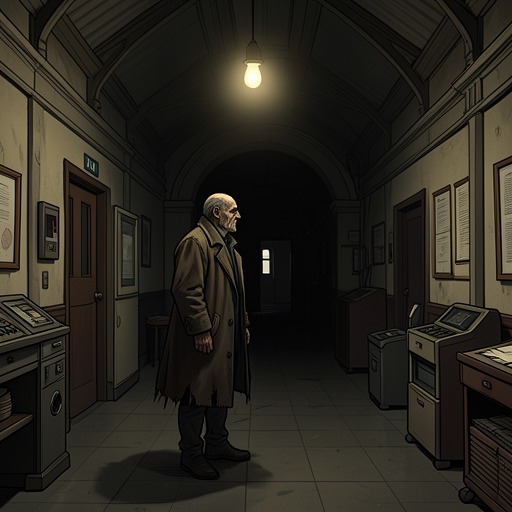
April Fools' Day
American PsychoApril Fools' Day is less a celebratory occasion than a temporal signal in the novel's damaged moral landscape. Appearing amid Wall Street anxiety and recurring scenes of sexual, social, and bodily detachment, it helps establish a world in which joking, cruelty, spectacle, and fear continually exchange places. The date's conventional promise of harmless deception is absorbed into the narrator's broader experience of unreliability, where ordinary reality is already difficult to distinguish from performance, repetition, or hallucinated significance.
Temporal Marker and Social Atmosphere
April Fools' Day is introduced as a terse calendar-like interruption before a taxi journey through lower Manhattan. The surrounding scene moves past the Chemical Bank near Eleventh and First, where the words "Abandon all hope ye who enter here" are scrawled in blood red lettering. Timothy Price notices the warning only briefly before a bus carrying an advertisement for Les Misérables blocks his view; he is more interested in paying the driver five dollars to turn up "Be My Baby" on WYNN. The date therefore arrives within a collision of ominous graffiti, commercial imagery, popular music, and financial-class conversation rather than within any atmosphere of playfulness.
Price's speech gives the moment its social context. He presents himself as resourceful, creative, young, unscrupulous, highly motivated, and highly skilled, insisting that society cannot afford to lose him because he is an asset. His confidence quickly turns into dissatisfaction with work, money, and the possibility of returning to Los Angeles, while the taxi passes further signs of urban menace, including the word FEAR sprayed on a McDonald's. April Fools' Day thus accompanies a culture that treats identity as a sales pitch and anxiety as background noise. The date's joke structure is already present in the gap between Price's grand self-description and the surrounding evidence of alienation.
Bodily Performance and Disease Panic
The date's atmosphere is echoed in scenes where intimacy and bodily display are reduced to surfaces, measurements, and risk calculations. In one encounter, a woman reports that Stash has tested positive for the AIDS virus and speculates that he will probably sleep with Vanden that night. The narrator responds with approval rather than concern, and she calls him evil with a mixture of excitement and recognition. The exchange turns a serious medical danger into another item in a game of sexual provocation, exposing how disease panic, moral numbness, and erotic performance have become entangled.
A later confrontation with Courtney Lawrence makes the same distortion more explicit. Concerned about unsafe sex, she cries that she has a promotion, an August trip to Barbados, and a desire to wear a Norma Kamali bikini bought at Bergdorf Goodman; she fears that Kaposi's sarcoma will ruin those plans. The narrator treats the condom as a technical object whose correct placement should settle the dispute, slapping her lightly and forcing her to look at it while she sobs. April Fools' Day's comic premise is displaced here by a cruel parody of rationality: material correctness and consumer aspiration coexist with terror, coercion, and the refusal of empathy.
Repetition, Media, and Emotional Distortion
The date belongs to a narrative saturated with repeated media images and unstable reactions. At the Yale Club, David Van Patten, Craig McDermott, and the narrator sit in expensive clothes while discussing drinks, massages, and a television episode about Nazis. The narrator says that the program gave him a real charge and applauds when one Nazi juggles grapefruits. Luis Carruthers sits nearby, smiling toward the table, while the narrator deliberately pretends not to notice him and laughs whenever Luis looks over. The scene converts social etiquette into a ritual of exclusion, and the television's grotesque entertainment becomes continuous with the group's own polished cruelty.
The same media environment appears later in the narrator's account of summer. Air disasters are captured on videotape and replayed endlessly, with slow-motion crashes, wreckage, burned bodies, and rescue workers retrieving remains. The Patty Winters Show offers only repeats, while the narrator moves through restaurants, taxis, nightclubs, movie theaters, and the abandoned building in Hell's Kitchen in a stupor. His encounters with summer associates are marked by failed conversation about The Toolbox Murders on HBO, followed by silent tables, additional bottles of San Pellegrino, and requests for the check. April Fools' Day consequently participates in a larger pattern in which novelty has become repetition and catastrophe has become programming.
Seasonal Crisis and the Collapse of the Mask
By August, the narrator says that the unfortunate, weak, and aged line the streets everywhere. His platinum American Express card snaps in half during a restaurant dinner with two summer associates, yet he can still pay from the cash in his gazelleskin wallet. This small material failure punctures the apparent invulnerability of luxury without changing the underlying ritual of spending. The repeated restaurants, branded clothing, television programs, and theatrical outings preserve an external order even as the narrator's interior state deteriorates.
He describes life as a blank canvas, a cliche, and a soap opera, while feeling lethal and close to frenzy. His nightly bloodlust overflows into the daytime, his mask of sanity seems close to slipping, and he calls the period his bone season before deciding that he needs a vacation in the Hamptons. Evelyn Richards accepts the proposal like a spider. In this seasonal movement, the comic calendar marker has been overtaken by an autumnal logic of decay: the promise of April's renewal is contradicted by a consciousness moving toward violence, exhaustion, and collapse.
Unreliable Time and the Question of Reality
The temporal meaning of April Fools' Day is finally inseparable from the narrator's unstable relation to memory and fact. When he returns to the building containing Paul Owen's apartment with a real estate agent, he tries to retrace the night and week during which he murdered two girls, while knowing that he has never returned to the apartment afterward. The question of the apartment's value forces itself into his mind, and his chest feels like ice. The immediate scene is interrupted by recollection, self-pity, commercial calculation, and the television topic of people with half their brains removed.
The changed locks and the voices inside the apartment confront him with a reality that resists his private script. He watches the elevator operator stare at the floor, walks toward the apartment with keys in hand, and is startled when a middle-aged broker opens the door and asks whether he is the eleven o'clock appointment. He answers no. The moment does not clarify whether the earlier murders occurred exactly as remembered; instead, it intensifies the novel's unreliable narration by placing a claimed atrocity beside ordinary real-estate activity and an apparently mundane appointment. April Fools' Day therefore becomes an emblem of a world where deception requires no prank, because appearances, memories, identities, and moral responses are already structurally unstable.