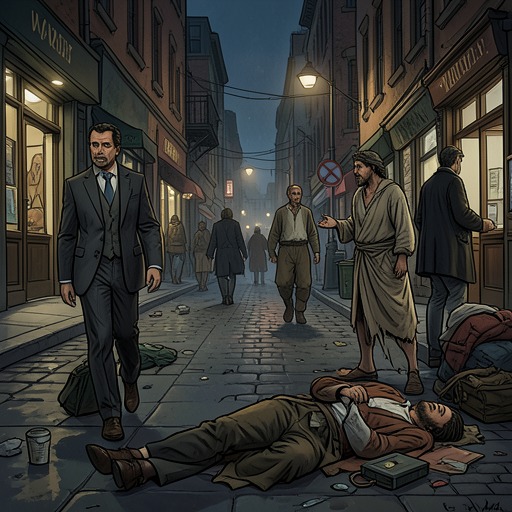
Bateman's killings of Al and Gizmo
American PsychoBateman's killings of Al and Gizmo are among the clearest demonstrations of how Patrick Bateman's cultivated public persona can coexist with, and even prepare the way for, extreme violence. In the episode, a seemingly charitable approach to a homeless man and his dog becomes an intimate assault staged through shifting roles: benefactor, adviser, tormentor, and killer. The scene's decisive significance lies not only in the deaths themselves but in the speed with which compassion becomes performance, poverty becomes an object of disgust, and murder becomes another occasion for appetite and consumer pleasure.
Setting and Initial Encounter
The episode takes place late at night in the antique district below Fourteenth Street, where the streets are nearly empty and the surrounding details form a bleak urban inventory: a closed newsstand, a dry cleaner, a church, a diner, an occasional taxi, garbage bags lining the curbs, steam rising from below the pavement, and the moon hanging near the Chrysler Building. On Twelfth Street, the homeless man lies in the doorway of an abandoned antique store on top of an open grate. A Gristede's shopping cart beside him contains newspapers, bottles, and aluminum cans, while a hand-painted sign asks for food and shelter. The setting places Al outside the protected interiors of Manhattan's restaurants, offices, and apartments that dominate Bateman's ordinary social world.
The man is accompanied by a small, short-haired, rail-thin mutt named Gizmo. The dog is initially easy for Bateman to overlook; only after he circles the block does he notice it lying on newspapers and guarding its owner. Gizmo wears a collar with an oversized nameplate, wags its thin tail, and licks Bateman's gloved hand when he offers it. That brief gesture supplies the encounter with its only uncomplicated sign of trust, while the dog's presence also makes the scene a relation of mutual dependence rather than an isolated meeting between a wealthy passerby and a nameless victim.
Bateman identifies the man as being in his forties, heavyset, intoxicated, and dressed in a stained, ill-fitting combination of lime-green polyester clothing, washed-out Sergio Valente jeans, and a ripped orange-and-brown sweater. The physical description is filtered through Bateman's contemptuous attention to fashion and bodily condition. The man's smell of cheap alcohol, excrement, and urine becomes, for Bateman, an almost material barrier between social classes. Yet the encounter is not presented as a simple refusal of contact: Bateman kneels, introduces himself as Pat Baternan, and asks whether the man wants money or food.
Charity as Performance
The man's name is eventually given as Al. When Bateman asks whether he wants money or food, Al nods and begins to cry. Bateman first takes out a ten-dollar bill, then changes his mind and offers a five-dollar bill instead. The small alteration in the amount turns charity into a calculation, and the gesture remains under Bateman's control even while he presents himself as generous. Al's gratitude reinforces the role Bateman is performing: Al calls him kind, and Bateman answers with soothing language while petting Gizmo.
Bateman then changes from donor to self-appointed instructor. When Al says he cannot find a shelter, Bateman tells him to get a job and attributes his homelessness to a negative attitude and failure to get his act together. He offers to help, but the offer is detached from any practical assistance. The advice treats poverty as a defect of character and transforms structural abandonment into an individual moral failure. Bateman's claim to compassion therefore contains its opposite: he can speak the language of aid only by placing Al beneath him as an object lesson.
The performance collapses when Bateman tells Al that he reeks and admits that he has nothing in common with him. His irritation escalates into an attack on Al's crying, followed by a brief gesture of renewed compassion that is immediately revealed as a trap. Bateman quietly asks whether Al knows what a loser he is, and Al nods helplessly. The movement from tenderness to humiliation is not accidental; it is the mechanism by which Bateman converts dependence into permission for violence.
The Killings
Bateman puts the five-dollar bill back into his jacket instead of giving it to Al. With his other hand, he draws a long, thin serrated knife. He first drives the blade into Al's right eye, then pulls down the man's trousers and stabs him repeatedly in the stomach and hands while Al tries to protect himself. The attack is described as deliberate rather than impulsive: Bateman is careful, pauses over the body, and prolongs the victim's awareness. The violence makes Al's body into an object for inspection, penetration, and manipulation, while the surrounding street remains largely indifferent except for the passing headlights of a taxi.
Bateman then attacks Al's other eye, slits his nose, and wipes the knife across his face. Rather than allowing the assault to end with the killing, he adds an insult and throws a quarter into Al's bloodied face, presenting the coin as a grotesque substitute for the money he had pretended to offer. The gesture compresses charity, mockery, and punishment into a single object. Money is not merely withheld; it is returned as a token of degradation after the victim has been physically destroyed.
Gizmo reacts by barking and crouching as though ready to jump. Bateman stomps on the dog's front legs, shattering both, and watches it fall squealing with its paws raised at what he perceives as a satisfying angle. He laughs and lingers over the scene before leaving when a taxi approaches. The killing therefore includes a separate act of violence against the animal, not as collateral damage but as a chosen extension of the assault. Gizmo's earlier trust and guarding behavior are answered with deliberate mutilation, showing how the episode denies even the possibility of reciprocal loyalty between vulnerable beings.
Aftermath and Narrative Meaning
Two blocks away, Bateman feels exhilarated and physically energized, comparing the sensation to exercise, cocaine, a cigar, and champagne. The comparison places murder within the same sensory economy as luxury consumption and drug use. Violence produces a high that he experiences as bodily gratification, but the feeling quickly becomes hunger. He goes to the McDonald's in Union Square, orders an extra-thick vanilla milk shake, and sits at a front table where he imagines Al would have sat. His Armani clothing remains lightly spattered with blood, yet the restaurant's ordinary commercial routine continues around him.
The aftermath is deliberately anticlimactic. Two waitresses from the Cat Club sit across from him and smile flirtatiously; an old woman chain-smokes nearby; a police car passes; a worker studies the stains on Bateman's jacket without confronting him. After two more milk shakes, the high fades into boredom, tiredness, and regret that he did not join Reed Thompson and others at a Salvadorian bistro. The event's emotional consequence is not remorse or fear but dissatisfaction with the quality of the evening. Murder is absorbed into the same competitive and consumerist judgment that governs restaurants, clothes, drinks, and social invitations.
The episode also demonstrates the instability of Bateman's narration. The account is delivered through his intimate first-person perspective, which supplies precise clothing, food, street, and bodily details while presenting extraordinary crimes as part of an apparently continuous night. The polished specificity can make the violence feel documented, but the broader narrative repeatedly leaves uncertain whether such acts occurred as described, were fantasies, or were rendered invisible by the interchangeable identities of the men around Bateman. That uncertainty does not neutralize the scene. Whether read as literal confession, imagined violence, or a deliberately unstable mixture of both, the episode reveals a consciousness that treats the homeless, animals, and even its own victims as disposable surfaces.
The contrast with Bateman's other social performances sharpens the event's significance. Elsewhere he carefully manages appearance through Armani clothing, air kisses, business cards, restaurant etiquette, and professional conversation; he can present a new business card with pride while waiting for his companions to admire it, and he can move through elite rooms while thinking about how he is perceived. In the street encounter, those same habits of classification and display are redirected toward a man whose poverty makes him socially unreadable to the privileged world. The public mask does not disappear so much as reveal its hidden logic: people are sorted by clothing, money, usefulness, and recognizability, and those who fall outside the system can be treated as if they have no claim on protection. Al and Gizmo's deaths thus stand as a concentrated expression of Bateman's psychopathy and of a social order in which indifference makes extreme violence imaginable, pleasurable, and almost consequence-free.