Bateman's taxi shooting spree and escape
American PsychoBateman's taxi shooting spree and escape is the decisive public eruption of Patrick Bateman's violence. What begins with an agitated exit from a dinner among Wall Street professionals becomes a sequence of shootings, pursuit, wreckage, and flight through Tribeca and lower Manhattan. The scene matters not only because it records multiple killings, but because Patrick's polished social identity, criminal confession, and apparent return to ordinary office life occupy the same narrative space without producing a stable public consequence.
Causes and Background
At a Tuesday-night dinner at Bouley, Patrick sits among Richard Perry, Edward Lampert, John Constable, Craig McDermott, Jim Kramer, and Lucas Tanner while they argue about asset allocation, stocks, real estate, gold, exercise, fashion, influence, and the management of successful lives. Patrick tells them, "Listen, guys, my life is a living hell," but they ignore him and continue their conversation. The dinner therefore establishes the immediate contrast governing the escape: an orderly, expensive social world remains absorbed in professional and consumer talk while Patrick experiences the people inside it as potential victims.
His agitation becomes physically unmanageable. He sees prey everywhere—in business meetings, nightclubs, restaurants, taxis, elevators, automated teller lines, pornography, television, and even ordinary commercial life. Before leaving, he excuses himself, uses cocaine in the restroom, retrieves a .357 Magnum from the coatcheck, and straps on a holster. The weapon is not an improvised object but a chosen accessory carried beneath his Giorgio Armani overcoat, linking the violence to the same system of grooming, clothing, and controlled presentation that structures his public persona.
The Shooting Spree
In misty Tribeca after midnight, Patrick encounters a young saxophonist playing in the doorway of an abandoned bistro on Duane Street. The musician is performing a melody from Les Misérables, with an umbrella containing a dollar and some change at his feet. Patrick listens, takes out the .357 Magnum, attaches a silencer, and then pauses when the musician notices the gun. He gestures for him to continue playing before shooting him in the face. The silencer fails, and the gunshot produces the first unmistakable rupture between Patrick's imagined control and the noisy reality of the street.
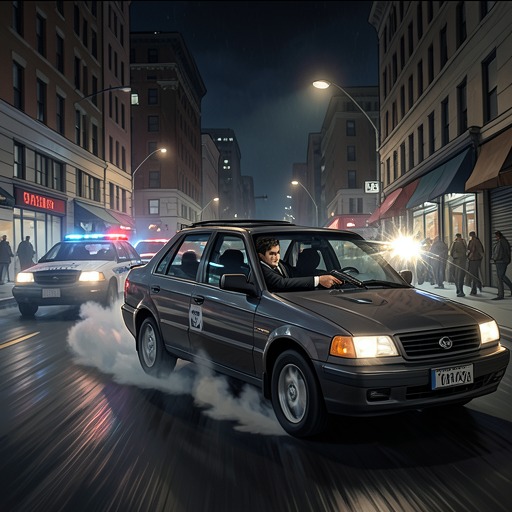
A police squad car arrives almost immediately. Patrick initially walks away as though innocent, then runs through an alley toward Broadway and City Hall Park. He flags down a taxi driven by a young Iranian man and orders him to drive while waving the gun in his face. The driver panics and pleads not to be shot. Patrick kills him, pushes the body from the cab, and takes the wheel. Blood, brain matter, and fragments of the driver's head cover the windshield, leaving Patrick unable to see clearly; he swerves into a parked limousine and then crashes through a Korean deli beside the Lotus Blossom karaoke restaurant, striking a cashier and destroying the storefront.
The crash transforms escape into open combat. A police officer reaches the wreckage and struggles with Patrick for the gun while onlookers gather without helping. Patrick shoots the officer in the head and face. When more police arrive, he fires back from the street. A stray bullet hits the police car's gas tank, producing an explosion that sends a fireball through the darkness, shatters the windows of Lotus Blossom, and washes over the policemen. The episode's violence therefore expands from isolated attacks into an urban chain reaction involving vehicles, storefronts, bystanders, and emergency forces.
Flight Through the City
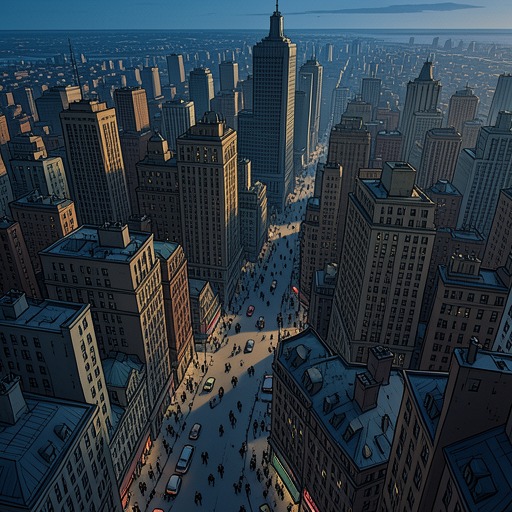
Patrick runs toward Wall Street through rain, darkness, fog, and streets he experiences as a shifting blur. He tries the doors of parked Porsches and sets off their alarms, looking for a black Range Rover whose technical specifications he recites with the same consumerist attention he gives to clothes and restaurants. The detail makes the attempted escape part of his familiar language of acquisition: even while fleeing a gunfight, he evaluates a vehicle through its drive system, aluminum body, chassis, and engine.
The flight becomes increasingly disoriented. Patrick imagines that a car is following him, forgets his destination, and reaches what he believes is the building containing Pierce & Pierce. The lights appear to go out floor by floor, as if darkness were rising through the structure. He enters the wrong building, shoots a night watchman through the revolving doors, and kills a janitor who witnesses the scene. He then crosses the street, enters his actual office building, nods to the night watchman Gus, signs in, and takes the elevator upward. The escape thus ends not with disappearance into a separate criminal underworld but with reentry into the workplace and its procedures of identification.
Confession and Aftermath
Once inside the anonymity of his new office, Patrick calls Harold Carnes and leaves a message confessing everything, including what he describes as thirty, forty, or a hundred murders. The confession is delivered to an answering machine rather than to a present listener. While he speaks, he watches a helicopter search the building he has just left, surrounded by police cars, ambulances, and a SWAT team. He also says that he left a woman in a parking lot near a Dunkin' Donuts somewhere around midtown, then ends by calling himself a very sick man before calling again with another message asking Harold to keep his eyes open if Patrick appears at Da Umberto's.
The sunrise follows almost immediately, with night turning into day so quickly that the change resembles an optical illusion. This accelerated transition does not provide legal resolution or moral recognition. Patrick's detailed confession, the police response, and his return to work coexist without a visible arrest or verified public reckoning. The scene therefore converts confession into another unstable performance: an act that sounds like disclosure but produces no certain external confirmation.
Narrative Function and Significance
The event's structure moves from front-stage civility to backstage compulsion and then back to institutional normality. At dinner, Patrick is surrounded by men who discuss status and economic power; in the street, he becomes a visible armed killer; in the office, he resumes the gestures of a professional employee. Clothing, weapons, automobiles, music, restaurants, and office architecture operate as recurring props in a performance whose surfaces remain intact even as its violence becomes impossible to contain.
The narration also makes the episode a crucial test of reliability. Patrick presents the shootings with tactile precision, then describes his own panic, confusion, and sense that the dream might break. His account contains evidence of action—the gun, the bodies, the wreckage, the pursuit—but the social world does not yield a corresponding certainty. Earlier patterns of hidden violence and unstable recognition intensify this problem: Timothy Price handles a small envelope of supposed cocaine in a locked men's-room stall; Patrick encounters Al and Gizmo in a doorway surrounded by garbage and a sign declaring hunger and homelessness; at Central Park Zoo he moves through an emptied landscape and responds to spectators with hostility; at Paul Owen's apartment he prepares tools and escorts while Owen's disappearance is being investigated. Against that background, the taxi episode is both culmination and distortion, a moment when private fantasies become an apparently public crime spree and yet remain vulnerable to the novel's larger uncertainty about what can be seen, proved, or remembered.
The final image is not freedom but suspended identity. Patrick has escaped the immediate pursuit and reached his office, but another cab later carries him toward the docks while its driver recognizes him as the killer of Solly and drives toward the water. The supposed escape therefore does not settle into safety: it opens another confrontation in which Patrick is trapped, unable to unclench his hands, and reduced from powerful observer to frightened passenger. His wealth remains his last consoling thought, but it cannot restore control over the road, the cab, or the identity others assign to him.