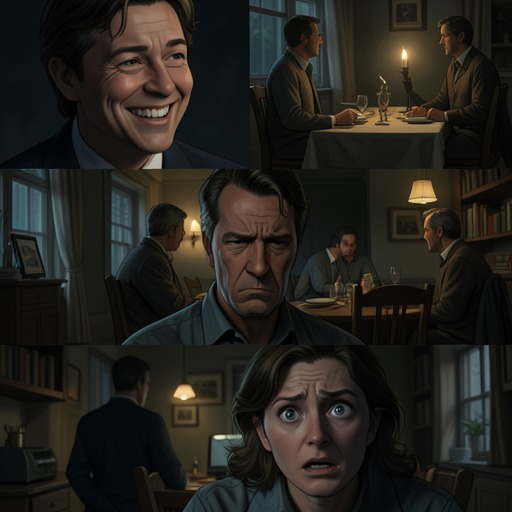
Bethany
American PsychoBethany is a former Harvard partner of Patrick Bateman whose return becomes one of the clearest demonstrations of how ordinary romantic ritual can conceal extreme violence. Their reunion begins with the codes of dating—clothes, grooming, lunch, alcohol, remembered poetry, and sexual expectation—but ends when Bateman turns his apartment into a sealed private stage for assault. Her role is therefore both personal and structural: she recalls a past in which Bateman could imagine tenderness, while her fate exposes the terrifying discontinuity between his polished public identity and the violence he narrates in private.
Identity and Reappearance
Bethany reenters Bateman’s life unexpectedly on a rainy street. As he tries to hail a cab, he recognizes her as a girl he dated at Harvard and by whom he was later dumped. She is carrying an open white umbrella and wearing Christian Lacroix clothing; the encounter is marked by Bateman’s shock and her smile, suggesting familiarity without establishing any genuine emotional security. The circumstances immediately combine old intimacy with present uncertainty: she is recognizable, but the relationship has already been defined by rejection and loss.
Her return prompts Bateman to arrange lunch at Vanities, a new bistro in Tribeca. He is unusually nervous despite having exercised for nearly two hours and lifted weights in his office. He attributes the anxiety partly to the possibility of rejection and partly to the sticky Italian mousse in his hair, a small but revealing displacement in which bodily presentation competes with emotional fear. He expects that Bethany wants to see him, have lunch with him, and resume sexual relations, yet he cannot stabilize that expectation into confidence.
Courtship as Performance
Bateman prepares for the lunch through a series of controlled surfaces. He attempts to read a fashionable short-story collection, abandons it after its repeated opening line irritates him, drinks J&B and takes Xanax, and writes Bethany a poem before falling asleep. The poem recalls the longer, darker poems he used to write for her when they were both at Harvard, before their breakup. This is one of the few moments in which his past attachment appears as an activity rather than a mere possession: he makes an effort to reproduce an earlier form of courtship, but the effort is surrounded by medication, self-monitoring, and fear of comparison with another man.
He arrives at Vanities fifteen minutes late and checks his reflection in a mirror to confirm that the mousse looks good. The scene makes romance inseparable from impression management. Bateman’s clothes, hair, lateness, alcohol, and literary gesture all function as props in a performance whose success depends on Bethany’s response. The performance is unstable because the narrator’s attention repeatedly returns to his own appearance and sexual desirability rather than to Bethany’s experience.
During lunch, Bateman asks whether Bethany is seeing anyone. She answers that she has a boyfriend, and the disclosure changes the encounter from anticipated reconciliation into humiliation and rivalry. He suppresses his rage behind soothing language, apologizes, asks her to describe the relationship, and privately expresses violent sexual hostility while continuing to smile. Bethany’s composure and her apparent satisfaction in announcing the boyfriend intensify his sense that the social scene is controlled by someone else. The romantic meeting thus becomes an adversarial test in which politeness conceals resentment.
Memory, Violence, and the Apartment
Bethany’s conversation awakens Bateman’s memory of Harvard, but the recollection is not sentimental. While she describes her recent past, he recalls a freshman he met in a Cambridge bar who spoke of life as full of endless possibilities. He recounts that the girl later died before completing her sophomore year, her decapitated body found in the Charles River with her head hanging from a tree. He also reflects that his rages at Harvard were less violent than those of the present and that his disgust has not disappeared. Bethany’s return therefore links an earlier period of Bateman’s life to the escalation of his violence rather than offering a path away from it.
After lunch, Bethany accompanies Bateman to his apartment. She admires the interior, touches the Wurlitzer 1015 jukebox, and studies the David Onica painting above the fireplace while Bateman locks and bolts the door. He pours J&B, begins growling to himself, and notices that his hands are shaking. From an armoire he retrieves a new nail gun purchased near his Wall Street office, puts on black leather gloves, and checks that the weapon is loaded. The apartment changes from a site of hospitality into a controlled enclosure, while the familiar objects of cultivated taste become part of the apparatus of threat.
When Bethany asks what he is doing, Bateman waits until she sees the nail gun and his gloved hands before accusing her of being involved with Robert Hall. She tries to escape through the front door, but he blocks her and strikes her unconscious four times with the nail gun. He drags her into the living room, lays her on a white cotton sheet, and nails several fingers of each hand to the wooden floor. When she regains consciousness and screams, he sprays Mace into her eyes, mouth, and nostrils, then covers her head with a camel-hair Ralph Lauren coat. He continues driving nails into her hands until they are immobilized.
The assault is presented as both physical domination and theatrical production. Bateman alternates shouted abuse with whispered obscenities, removes Bethany’s shoes when her kicking marks the stained white oak floor, and responds to her pleas by continuing rather than relenting. He attempts to bite flesh from an unpinned thumb, then places a Sony Handycam on its stand and sets it to record what follows. The camera converts private suffering into a spectacle and shows how his violence is mediated through the same consumer objects and polished domestic setting that organize his social identity.
Narrative Uncertainty and Significance
Bethany’s fate is narrated with extreme confidence inside Bateman’s account, yet the broader narrative repeatedly makes his perceptions and claims difficult to verify. His later confession to Harold Carnes includes an admission of dozens or even a hundred murders, but it produces no clear public confirmation in the supplied sequence. Against that uncertainty, Bethany’s encounter remains significant whether read as a literal murder scene, a violent fantasy, or a deliberately unstable mixture of both: it records the collapse of Bateman’s romantic performance and the conversion of remembered intimacy into an occasion for punishment.
Bethany also clarifies the contrast between Bateman’s front-stage and back-stage selves. In public, he is late, groomed, anxious about his hair, equipped with a poem, and capable of apologizing while discussing her boyfriend. In private, he bolts the door, arms himself, stages the attack, and records it. The same attention to surfaces that governs his clothes and lunch continues inside the apartment, where sheets, furniture, clothing, weapons, and video equipment organize violence as meticulously as a restaurant reservation organizes social display.
Her return finally reveals the limits of Bateman’s capacity for attachment. He remembers writing to her, wants her approval, and is disturbed by the prospect of rejection, but these signs of vulnerability do not produce care. They become fuel for possessiveness, resentment, and retaliatory violence. Bethany is consequently not merely a former girlfriend who reappears in the plot; she is the figure through whom the narrative shows how quickly the promise of renewed connection can be absorbed into Bateman’s pattern of control, objectification, and emotional collapse.