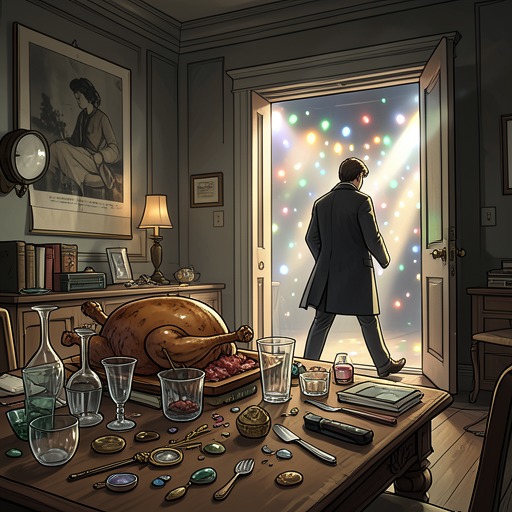
Christmas
American PsychoChristmas functions in American Psycho as a public ritual of celebration that repeatedly exposes the private emptiness beneath Patrick Bateman’s social world. Its decorations, parties, gifts, mistletoe, expensive clothing, and cheerful formulas promise intimacy and renewal, yet the season instead becomes a setting for Bateman’s cruelty, contempt, emotional evasion, and unstable perception. Christmas compresses the novel’s central opposition between polished appearance and moral reality: the surfaces remain festive while the human relationships beneath them deteriorate.
Seasonal Ritual and Social Display
Christmas first appears as a social occasion governed by consumption and performance. Before making an appearance at Evelyn Richards’s Christmas party, Bateman drinks with Charles Murphy at Rusty’s, where Murphy’s tirade about Japanese ownership of the Empire State Building and Nell’s provokes a violent reaction in him. Bateman leaves the bar and attacks a Japanese delivery boy in the doorway of a closed restaurant, slitting his throat and dumping the delivered food over him. The episode joins seasonal socializing to racial hostility, class anxiety, and arbitrary violence: a conversation among privileged men becomes the immediate emotional trigger for an act that Bateman experiences as an irritatingly practical interruption to his evening.
The party itself restores the vocabulary of ordinary festivity without repairing what has occurred. Evelyn Richards rushes toward Bateman wearing a sable jacket and velvet pants by Ralph Lauren, holding mistletoe in one hand and a candy cane in the other. She places the mistletoe above his head, cries, "Mistletoe alert!" and kisses him dryly on the cheek before wishing him and Jimmy a merry Christmas. Bateman cannot push her away because he is holding both a martini and a Waldorf salad. The scene makes the holiday’s ritual mechanical and almost comic: a conventional gesture of affection is performed amid luxury, alcohol, and Bateman’s inability to respond with genuine feeling.
Christmas also intensifies the novel’s system of visible status competition. Bateman’s new business card is displayed at dinner from a gazelleskin wallet bought at Barney’s for $850, only to be eclipsed by David Van Patten’s card, whose elegant color and "Eggshell with Romalian type" produce a brief spasm of jealousy. The exchange is not specifically a Christmas ritual, but it clarifies the social environment in which the holiday operates. Objects, clothing, restaurants, drinks, and gifts become instruments of ranking; their exchange value and display matter more than their practical use or emotional meaning. Christmas therefore arrives not as an interruption of consumer culture but as one of its most concentrated expressions.
The Christmas Party and Failed Intimacy
Bateman’s attempt to participate in Evelyn Richards’s celebration is shaped by reluctance, contempt, and performance. He first fortifies himself with drinks, then enters a gathering where festive language and social obligations demand an appearance of warmth. Evelyn Richards tries to make the occasion meaningful, but Bateman’s responses remain defensive and hostile. When she complains that he is ruining the time of year for her, he recasts the damage as "Christmas frost" and then as "expensive Christmas frost." Her willingness to describe the experience as exciting to "slum" reveals the class-conscious theatricality surrounding the holiday: even discomfort is converted into an experience to be consumed.
The party’s atmosphere also shows how Christmas converts personal conflict into a seasonal script. Evelyn Richards attempts to impose cheer through mistletoe, kisses, and language of celebration, while Bateman remains fixed on irritation and escape. The holiday’s signs are present, but their emotional content has been hollowed out. A kiss does not create closeness; it becomes an obligation from which Bateman cannot immediately withdraw. A seasonal greeting does not communicate care; it operates as a formula that can coexist with violence only moments away.
The sequence moves from the public party into a limousine conversation in which Evelyn Richards proposes the Rainbow Room and rejects Bateman’s suggestion of Club Chernoble. Her complaint that he should not ruin the season for her gives Christmas a direct interpersonal stake: the holiday is important to her as a time of expectation, while Bateman treats it as another venue whose value depends on exclusivity and controlled appearances. Their disagreement is not resolved. Instead, the limousine carries the incompatibility forward, preserving the surface of companionship while exposing the distance between their desires.
Gifts, Fraternity, and Emotional Vacancy
Christmas gift-giving provides another measure of Bateman’s damaged relationships. He considers giving Sean Bateman a tie purchased at Paul Smith, then decides to keep it because the thought of Sean hanging himself with it pleases him. He substitutes a Casio QD-150 Quick-Dialer combination wristwatch, calculator, and data bank, a device capable of storing fifty names and numbers, while privately laughing at the idea that Sean does not even have fifty acquaintances. The replacement gift is technologically elaborate but emotionally empty, and Bateman’s mockery turns the act of giving into an instrument of aggression.
The object’s supposed usefulness becomes part of the insult. Bateman does not choose the watch because it expresses knowledge of Sean or affection for him; he chooses it while imagining its uselessness and measuring his brother’s social worth through the number of names he might store. The gift becomes a miniature of the holiday world: a costly or novel object stands in for attention, while the person receiving it remains unseen. Christmas fraternization is thus reduced to calculation, resentment, and the maintenance of family appearances.
Bateman’s surrounding routines reinforce this separation between surface and feeling. He repeatedly notices designer clothing, branded accessories, restaurants, alcohol, and American Express cards with intense precision, yet his responses to other people remain unstable or absent. Even bodily care is presented through commodities and procedures. His membership at Xclusive, a private health club on the Upper West Side costing $5,000 annually, offers remodeled facilities, machines, courts, pools, training, massage, sauna, steam rooms, tanning booths, and a juice bar. The detail is not merely decorative: it shows a world in which selfhood is assembled through purchasable surfaces, exactly the kind of world Christmas intensifies through gifts and display.
Christmas as a Distorted Calendar Marker
The holiday is also a temporal marker that organizes Bateman’s unreliable, fragmented experience. A Christmas party appears after an episode in which he experiences an existential emptiness while shopping at Bloomingdale’s, takes three Halcion, buys six tubes of Clinique shaving cream, and considers whether his treatment of Evelyn Richards has contributed to that emptiness. He plans to appear at the party even while diverting his attention toward a VCR tracking-device problem. Seasonal obligation, consumer purchase, pharmaceutical use, and technological malfunction occupy the same mental register, making Christmas part of a calendar whose emotional significance cannot be separated from Bateman’s compulsions.
The word Christmas is repeatedly displaced by Bateman’s violent or commercial associations. When Evelyn Richards insists that it is Christmas, Bateman answers with bewilderment, asking what that is supposed to mean. Her phrase cannot stabilize him inside a shared social time. Christmas is plainly present in the scene, but it fails to provide a common moral or emotional framework. The holiday becomes a word other people use to demand coherence from a consciousness that continually evades it.
This instability continues when Christmas is contrasted with later seasonal markers. A subsequent Valentine’s Day scene presents Bateman at home while a maid silently removes blood smears from walls and discards gore-soaked newspapers. The calendar advances from Christmas to Valentine’s Day, but the contrast does not produce moral change. Festive and romantic occasions remain interchangeable settings for violence, domestic maintenance, and emotional disconnection. The recurring holidays suggest not renewal but repetition: the dates change while the underlying condition persists.
Narrative and Thematic Significance
Christmas concentrates the novel’s themes of consumerism and materialism, social homogeneity, depersonalization and emotional numbness, misogyny and the commodification of women, and appearance versus reality. Its rituals depend on recognition—greeting, kissing, giving, attending, celebrating—yet Bateman experiences recognition primarily as status confirmation or threat. The holiday asks him to belong to a community, while his narration repeatedly reveals that community as a collection of interchangeable bodies, clothes, brands, reservations, and scripted lines.
The holiday’s most disturbing effect comes from its proximity to ordinary life. The same narrator who catalogs a sable jacket, a candy cane, a Waldorf salad, and a martini can describe murder with procedural calm. The festive objects do not conceal the violence so much as sit beside it, sharing the same flat descriptive space. That stylistic continuity makes Christmas significant within the novel’s unreliable narration: the reader cannot rely on the season’s conventional promise of safety, benevolence, or emotional truth.
Christmas ultimately fails as a redemptive season because no shared meaning survives its performance. Evelyn Richards seeks cheer, companionship, and the preservation of a recognizable holiday mood; Bateman answers with evasion, contempt, and images of expensive frost. The result is a seasonal tableau in which celebration continues, but intimacy does not. Christmas marks not the restoration of human connection but the endurance of its polished imitation.