Club Chernoble
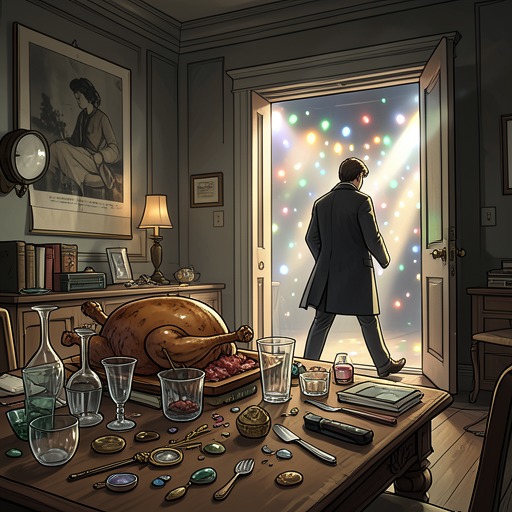
American PsychoClub Chernoble is a Manhattan nightclub defined less by its interior than by the social theater surrounding admission. Patrick Bateman reaches it by limousine with Evelyn Richards after abandoning her Christmas party, then uses borrowed identity, conspicuous wealth, and the vehicle itself to pass through a crowded snowy entrance. Inside, the club becomes a volatile space where Wall Street status, celebrity imitation, drug use, sexual display, and class hostility continually replace one another.
Setting and Access
Club Chernoble first appears as the destination Patrick Bateman chooses in the limousine after Evelyn Richards has become distressed during their night together. The choice is abrupt and instrumental: he tells the driver to go to Club Chernoble, and the limousine carries them away from Evelyn’s brownstone toward Riverside Drive. The club therefore enters the narrative as an alternative to domestic obligation, a public venue where Patrick can exchange the emotional demands of Evelyn’s Christmas party for the anonymous privileges of nightlife.
Its entrance is governed by visible scarcity and informal recognition. A crowd ten people deep waits outside the ropes in the snow, while Patrick and Evelyn arrive in a limousine. Patrick pushes through by using Evelyn as a blocker and by calling out to a man who resembles Jonathan Leatherdale. When the crowd responds to the name and the apparent Jonathan answers with a greeting intended for someone else, Patrick and Evelyn nevertheless pretend to belong to his party. The doorman asks whether they arrived in the limousine; their eager confirmation is enough to secure admission. The scene makes access depend not on verification but on a convincing display of wealth, confidence, and borrowed association.
Social Performance Inside the Club
The club’s entrance system condenses the larger social order of Patrick’s world. A limousine, a recognizable name, and the confidence to occupy a place in a privileged group function as credentials. Patrick does not need an authentic relationship with Jonathan Leatherdale; he needs only to perform one before the doorman and the waiting crowd. Club Chernoble thus operates as a stage on which identity is interchangeable, provided the costume and social signals are persuasive enough.
This logic parallels the status rituals visible elsewhere in Patrick’s social circuit. At Pastels, Patrick displays his new business card from a gazelleskin wallet costing $850, while David Van Patten’s card provokes jealousy through its elegant color and Romalian type. At Xclusive, a private health club on the Upper West Side, membership costs $5,000 annually and the institution offers an elaborate catalogue of machines, courts, pools, treatments, and personalized programs. Club Chernoble belongs to the same economy of conspicuous consumption, but converts its signals into immediate bodily access: the limousine, the rope, the doorman, and the crowd all make rank visible.
The club’s clientele is not stable. Later in the night, Patrick notices that the crowd has changed: there are more punk rockers and Black patrons, fewer Wall Street men, and more bored rich girls from Avenue A. The music has changed as well, replacing Belinda Carlisle’s pop with a rap track whose title Patrick struggles to identify. The alteration does not produce a more democratic space. Instead, it reveals the club as a succession of temporary social formations, each with its own style, music, and exclusions. Patrick remains obsessed with locating people he can classify as attractive, wealthy, or socially useful, even as the club’s changing atmosphere makes his own Wall Street identity conspicuous and unwelcome.
Patrick Bateman and Evelyn Richards
Patrick’s passage into Club Chernoble damages Evelyn Richards’s claim to control the evening. She arrives carrying a Christmas present and is physically used by Patrick to force their way through the entrance. The successful admission is therefore also a public humiliation: her body becomes a tool in his performance of entitlement, while her gift and her distress are treated as inconveniences.
Once inside, Patrick abandons Evelyn again. In the bathroom he orders her to leave, and he hears her sobbing that he made her walk out of her own Christmas party. A girl responds with contempt, telling Evelyn to get a life. Patrick reacts not with remorse but with raucous laughter, banging his head against the side of the stall after shoveling cocaine from an envelope into his nose with his platinum American Express card. The club’s public glamour and its private degradation are joined in the same sequence: the expensive card that signifies status becomes a drug implement, while the bathroom provides a secluded backstage for cruelty and intoxication.
The scene also clarifies the emotional emptiness of Patrick’s relationship with Evelyn. Her distress is not treated as a demand for recognition but as another stimulus that can be mocked, eroticized, or discarded. After using cocaine, Patrick imagines Evelyn in a sexual encounter with another woman and leaves the bathroom horny and desperate for contact. Desire, jealousy, drug use, and humiliation do not resolve into intimacy; they accelerate one another until the club becomes a space of compulsive pursuit.
Drugs, Hostility, and the Night’s Reversal
The bathroom is Club Chernoble’s most important counter-space to the entrance. Outside, Patrick has presented himself as a well-connected guest who can move through the ropes. Inside the stall, he is reduced to gasping over cocaine, laughing at Evelyn’s pain, and seeking further stimulation. The movement from the doorman’s scrutiny to the unlocked stall reverses the club’s promise of controlled exclusivity. The institution filters bodies at the door, but it cannot contain what its patrons bring into the rooms behind it.
After leaving the bathroom, Patrick approaches two wealthy young women in Betsey Johnson-type dresses and tries to begin a conversation by asking whether he has seen one of them at Salomon Brothers. His Wall Street credential, which has just helped him enter the club, now marks him as an intruder. One woman tells him to go back to Wall Street, and the other calls him a yuppie. The exchange transforms the club’s earlier promise of belonging into rejection. Patrick’s method remains unchanged: he identifies people through institutions and status, then attempts to establish contact through those signs. The result is hostility rather than recognition.
Club Chernoble also belongs to the wider nocturnal route through which Patrick crosses Manhattan’s social and spatial divisions. He leaves Evelyn’s brownstone in a limousine, passes through a snowbound queue at the club, later wanders among changing downtown crowds, and moves through streets where taxis, party hustlers, crack sellers, newsstands, diners, and homeless people occupy a different urban register. The club is a privileged enclosure within that city, but Patrick’s movement in and out of it exposes how thin the enclosure is.
Narrative Significance
Club Chernoble concentrates the novel’s conflict between appearance and reality. Its rope line rewards the appearance of belonging; its patrons change identities with the music and crowd; its bathroom conceals cocaine use and emotional abuse; and its social floor converts recognition into a fleeting, competitive performance. Patrick’s admission is a success only in the narrowest sense. He gets inside, but the borrowed greeting, the distressed companion, and the later insults reveal that his status is always contingent on the next observer accepting his performance.
The club also sharpens the connection between consumption and violence. Patrick’s social world is organized through expensive clothing, cards, restaurants, transportation, membership, and branded objects, yet the same objects become instruments of domination or self-destruction. His platinum American Express card helps him perform wealth at the entrance and administer cocaine in the bathroom. The transition is not an accidental contrast: Club Chernoble shows how the polished surface of elite consumption can coexist with, and even facilitate, compulsive appetite and cruelty.
As a location, Club Chernoble does not offer refuge, pleasure, or stable community. It is a pressure chamber for status anxiety. The doorman’s rope, the limousine, the borrowed name, Evelyn Richards’s tears, the cocaine, and the anti-yuppie taunts all belong to one mechanism: a social world that recognizes surfaces while leaving the person beneath them unread. Patrick can enter because he looks as though he belongs, and he can remain unrecognized because the club’s entire system has already made genuine recognition unnecessary.