Courtney Lawrence–Luis Carruthers relationship
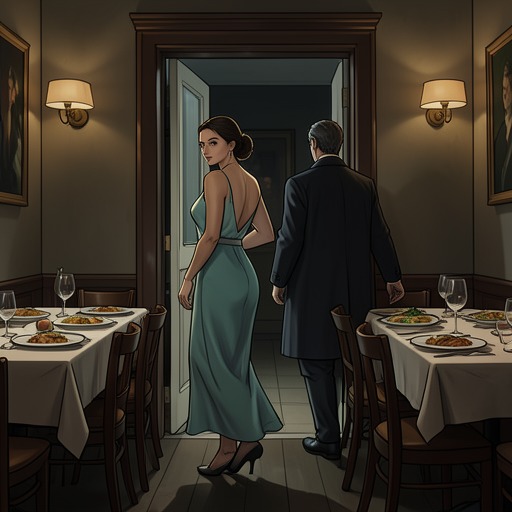
American PsychoThe Courtney Lawrence–Luis Carruthers relationship occupies a revealing place in the social world of the novel: it is publicly legible as a fashionable romance, yet repeatedly appears through irritation, jealousy, avoidance, and social performance. Courtney is identified as Luis’s girlfriend while she manages a dinner party, but later announces that she and Luis are no longer planning an expected dinner, and finally is reported to have married him. The relationship therefore moves through a conspicuous contradiction: its private deterioration does not prevent its public consolidation.
Identity and Social Setting
Courtney Lawrence is introduced in direct relation to Luis Carruthers. At a gathering where Evelyn Richards has spent an hour rearranging sushi into Patrick Bateman’s initials, Courtney physically redirects Patrick Bateman toward the kitchen and explains that Evelyn may instead spell Timothy Price’s initials because she lacks enough yellowtail to complete the letter B. Her practical intervention places the Courtney Lawrence–Luis Carruthers relationship inside a crowded social scene governed by flirtation, display, and the management of other people’s awkwardness. The relationship is not introduced through a private declaration of affection but through Courtney’s social role and her ability to keep the party moving.
Courtney’s relationship with Luis is also framed by the group’s emphasis on status. When Evelyn Richards and Timothy Price discuss Courtney, Price mocks the standards by which friends are selected, invoking whether a person appears in the society pages of W. The exchange reduces social intimacy to visibility and prestige, while Courtney’s connection to Luis becomes another object for collective commentary. Patrick Bateman’s attempt to interrupt their exchange by asking what is happening between Courtney and Luis shows that their relationship is already understood as unstable enough to require explanation.
Deterioration and Emotional Distance
The relationship’s instability is conveyed indirectly before it is stated plainly. When Patrick Bateman asks about Courtney and Luis, Evelyn Richards begins to say that the dreadful thing about Courtney is not that she no longer likes Luis, implying that Courtney’s withdrawal from him is known within the group. Timothy Price immediately converts the issue into a joke about a canceled charge at Bergdorf Goodman, and Patrick laughs and high-fives him. The moment turns a possible emotional rupture into consumer humor, showing how the group’s social language deflects rather than examines distress.
Courtney’s connection to Luis remains sufficiently active for her to be called his girlfriend, but it is not presented as emotionally secure. At the U2 concert in New Jersey, Luis has organized the outing and repeatedly tries to placate the group, while Courtney is among the women who have privately confided that they do not want to be there. The tickets are front-row seats originally intended for Japanese clients who canceled their trip to New York, and Luis justifies the occasion by citing Donald Trump’s enthusiasm for U2 and John Gutfreund’s record purchases. His effort to make the event socially acceptable cannot produce genuine enthusiasm. Courtney’s reluctance places the relationship within a broader pattern in which expensive access and elite associations substitute for shared desire.
The concert also displays the distance between Courtney and Luis through the narrator’s distorted social perception. Evelyn glares at Courtney throughout the limousine ride, while Paul Owen repeatedly mistakes Patrick Bateman for Marcus Halberstam. Courtney is surrounded by people who are watching, misrecognizing, and evaluating one another, and Luis’s attempts at reassurance become another form of performance. The relationship is thus embedded in a social environment where even companionship is mediated by status, mistaken identity, and the need to maintain appearances.
Breakup, Continuity, and Marriage
Later, Courtney tells Patrick Bateman that she and Luis were supposed to have dinner at Tad and Maura’s but that she does not think they will go after all. Her statement supplies a concrete domestic consequence to the earlier hints of dissatisfaction: an anticipated shared meal has become uncertain, and the uncertainty is treated as a matter of scheduling rather than an openly articulated emotional crisis. Patrick responds with intense interest, but the conversation does not produce a clear account of what has happened between them. The relationship’s condition remains suspended between cancellation and continuation.
The available account ultimately reverses the expectation of separation. When Patrick later speaks with Harold Carnes, he says that he and Evelyn Richards have broken up. Carnes asks about Courtney, and Patrick is told, with no suggestion that the information is doubtful, that Courtney married Luis. The answer clarifies the relationship’s public outcome while leaving its emotional meaning unresolved. Courtney’s earlier reluctance, the reports that she no longer liked Luis, and the canceled dinner do not culminate in a confirmed permanent separation. Instead, the relationship becomes a marriage, an outcome that exposes the gap between the social evidence of unhappiness and the institutionally recognizable fact of union.
The wording of the revelation also carries a small but telling correction. Patrick asks whether Courtney married Luis, receives the surname “Grassgreen,” and then is corrected to “Carruthers.” The exchange treats marriage as a change in public naming and social classification. What matters in the conversation is not Courtney’s account of the decision or the couple’s emotional state, but the correct label by which their relationship can be recorded.
Narrative Function and Significance
The Courtney Lawrence–Luis Carruthers relationship helps establish the novel’s pattern of unstable knowledge. Patrick Bateman receives fragments: Courtney is called Luis’s girlfriend; Evelyn suggests that Courtney no longer likes him; Courtney cancels or doubts a dinner; later, Courtney is said to have married him. No single account reconciles these stages. The relationship is therefore experienced through secondhand remarks, social jokes, and retrospective information rather than through sustained mutual intimacy.
Its apparent arc also parallels the novel’s larger concern with interchangeable identities and unreliable narration. In the same later conversation in which Patrick hears that Courtney married Luis, Harold Carnes cannot recognize the significance of Patrick’s declarations about Paul Owen. Carnes says that he had dinner with Paul Owen twice in London only ten days earlier, directly contradicting Patrick’s insistence that he killed Owen. The contrast is crucial: the marriage is treated by the social world as a stable fact, while Patrick’s account of murder produces no comparable recognition. Both relationship information and criminal testimony pass through a world in which names, appearances, and personal histories are repeatedly confused.
The relationship consequently resists a conventional romantic structure. It contains the outward markers of a romance, signs of dissatisfaction, a possible breakup, and a final marriage, but no verified reconciliation or emotional transformation. Its endpoint is not a happily-ever-after resolution grounded in shared feeling. It is a socially legible outcome that remains compatible with the surrounding atmosphere of depersonalization, consumerist performance, and uncertainty about what anyone genuinely wants.