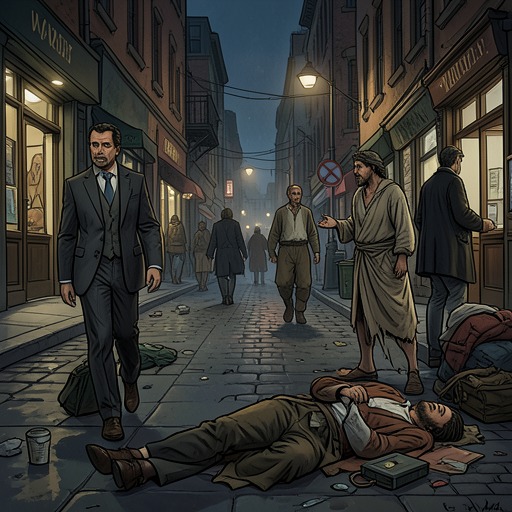
Dehumanization of the homeless
American PsychoDehumanization of the homeless names one of the novel’s most brutal connections between consumer privilege and social abandonment. Homeless people appear in the same urban circuits as Wall Street offices, expensive restaurants, luxury stores, and private cars, but they are denied the status of full subjects within those spaces. Patrick Bateman and his companions read them as nuisances, jokes, odors, surfaces, or targets rather than as people with histories and needs. The result is not only physical violence but a systematic collapse of attention: the city sees homelessness everywhere and responds by refusing to see the homeless.
Urban Visibility and Social Exclusion
Homelessness is introduced against the financial geography of Manhattan. As a cab leaves Wall Street, Timothy Price watches the city through a dirty window while a blood-red message—Abandon all hope ye who enter here—is briefly visible on a Chemical Bank building before a bus advertisement blocks it. The obstruction is emblematic: signs of menace and abandonment are present within the landscape of finance, but spectacle and commercial imagery repeatedly cover them. Price remains absorbed in his career, earnings, and status, speaking of himself as an indispensable asset while the cab passes graffiti and the city’s less polished surfaces.
The same hierarchy governs the group’s movement through luxury consumption. After a meal at Pastels costing $475, the men divide the bill, discuss cash and credit, and leave an undrunk bottle of champagne behind. Outside, a different homeless man asks first for change and then, more hopefully, for food. The group does not meet his request as a human appeal. The encounter becomes material for mockery, with his appearance treated as a defect and his tie proposed as a joke. The contrast between an extravagant, wasteful meal and a request for food makes deprivation visible as a direct neighbor of abundance, while the men’s response converts that proximity into entertainment.
The city’s spatial structure intensifies the exclusion. Walking through the antique district below Fourteenth Street, Patrick passes newsstands, shops, a church, a diner, taxis, garbage, steam, and isolated pedestrians before reaching the doorway where Al sleeps. The route links fashionable commodities and civic infrastructure to an improvised shelter on an open grate. Al’s cart contains newspapers, bottles, and aluminum cans, while a hand-painted sign identifies him as hungry and homeless. His poverty is therefore displayed in public, but only as an inventory of discarded objects and a request that affluent passersby can ignore.
The Beggar as Object of Contempt
The earliest encounters establish the language of dehumanization before it becomes openly murderous. When Price sees a beggar in a filthy green jumpsuit, he calls him a numerical bargain—Bingo: thirty—and holds the cab door open as if staging a prank. He then asks whether the man accepts American Express. The joke imports the logic of premium consumption into an encounter with extreme poverty: a credit card, a status object for the wealthy, becomes the measure by which the beggar’s humanity is denied.
Al initially appears through Patrick’s hostile inventory of bodily signs: dirty hair, unshaven skin, stained clothing, alcohol, excrement, and an unfocused gaze. The description does not begin with Al’s identity or experience but with the sensations he imposes on the observer. Even his dog, Gizmo, is first encountered as part of the visual arrangement of garbage bags, newspapers, and a shopping cart. Yet the dog’s hungry licking and protective presence briefly expose a reciprocal relation that Patrick refuses to grant its owner. Gizmo recognizes touch and responds to it; Al remains, in Patrick’s perception, an obstacle to be assessed.
Al’s own words challenge that reduction. He repeats that he is hungry, explains that he lost his job, and says that he cannot find a shelter. Patrick answers not with assistance but with an accusation that it is unfair for Al to take money from people who have jobs. The statement turns structural deprivation into an individual moral failure. Patrick tells Al to get a job and claims that he will help him, while the promise is immediately undermined by contempt for Al’s alleged negative attitude. Compassion becomes a performance that allows Patrick to occupy the role of benefactor without surrendering any money or recognizing any obligation.
The contradiction reaches its most concentrated form when Patrick places the bill back in his jacket, touches Al’s face with apparent compassion, and asks him what a loser he is. The gesture and the insult occur together. Patrick’s language neutralizes the victim before the attack: Al is not a worker who lost employment, a person unable to find shelter, or a man asking for food, but a category defined by failure. Dehumanization thus functions as a moral preparation for violence, making the threatened victim seem already outside the circle of protection.
Violence and the Collapse of Human Boundaries
Patrick’s encounter with Al converts social contempt into deliberate physical torture. He draws a serrated knife, blinds Al, strips him, and repeatedly stabs him while Gizmo yips beside the cart. The violence is carefully controlled rather than accidental; Patrick emphasizes that he is being careful not to kill Al at first, treating injury as an adjustable procedure. He then throws a quarter into the bloodied man’s face and tells him to buy gum. The coin reduces the relation between attacker and victim to a grotesque transaction, echoing the earlier question about American Express while reversing the power of money into an instrument of humiliation.
The dog’s presence makes the scene a cross-species tableau of vulnerability. Gizmo guards Al, reacts to the attack, and is sprayed with blood, but Patrick treats the animal as another disposable extension of the homeless man’s existence. The human victim and the dog are bound together by the cart, the leash, and the street, and Patrick’s violence erases the distinction between assaulting a person and destroying an unwanted object. Dehumanization here is not merely an attitude toward poverty; it is a practice of placing the poor within a continuum of things that can be handled, damaged, or discarded.
A later street encounter repeats that continuum with another homeless person and a dog. Patrick kills the dog first, then attacks its owner, whose death is followed by gunshots to the face. The scene ends with Patrick entering a grocery store, using an expired coupon for a box of oat-bran cereal, and experiencing a small thrill when the transaction succeeds. The abrupt passage from slaughter to retail consumption makes violence and shopping part of the same instrumental rhythm. Human remains, expired coupons, food, and commercial permission all become interchangeable components in a world organized by access, possession, and disposal.
Indifference, Spectatorship, and Recurrence
The novel does not restrict dehumanization to Patrick’s direct acts. It repeatedly places poverty beside crowds whose attention is directed elsewhere. In the zoo, Patrick observes a landscape surrounded by Central Park, Fifth Avenue apartment buildings, Trump Plaza, and the AT&T building, yet the social world inside it appears emptied of meaningful care. He insults a custodian who asks him to flush a urinal, threatens him with a knife, and moves through a setting where animals and vulnerable people are watched as spectacles. The homeless are part of the same economy of looking: present, exposed, and available to be judged, but not encountered as claims upon conscience.
The zoo sequence sharpens the connection between spectatorship and cruelty. Patrick resents the audience’s enjoyment of the seals and throws coins into their tank despite a warning that coins can cause ulcers, infections, and death. His stated objection is not to the seals themselves but to the pleasure of the audience. The distinction resembles his treatment of homeless people: he converts the suffering of others into a stage on which his contempt for spectators, institutions, and ordinary feeling can be performed. The penguin habitat, with its crowded viewers, artificial sounds, tired animals, and child separated briefly from the crowd, becomes another enclosed space in which vulnerability is visible and exposed to predatory attention.
The recurrence of the homeless man on Fifth Avenue reveals that the earlier attack has not produced recognition or remorse. Patrick encounters a beggar he blinded in spring near Trump Tower. The man’s sign claims that he is a Vietnam veteran who was blinded in Vietnam and that he and the dog are hungry and homeless. His scarred face and the dog’s suspicious reaction identify him as Al and Gizmo, but the damaged body is now also a public sign, carrying a history that passersby may read without responding to it. Even after surviving, Al remains reduced to a sign, a wound, and a request within the commercial landscape of Fifth Avenue.
Narrative and Thematic Significance
Dehumanization is reinforced by Patrick’s unreliable narration. His descriptions are intensely specific about clothing, smells, surfaces, brands, bodily damage, and prices, yet they withhold the sustained interiority that would make the victims socially legible. The homeless are described in the same cataloguing style used for restaurants, clothing, furniture, financial status, and consumer goods. This stylistic equivalence exposes a culture in which people are assessed through visible value, usefulness, cleanliness, and exchangeability.
The episodes also reveal how class privilege protects cruelty from ordinary consequences. Patrick moves from Wall Street taxis to expensive restaurants, from luxury avenues to abandoned doorways, and from murder scenes into stores and apartments. Money provides mobility and insulation, while the homeless remain fixed beside garbage, open grates, shopping carts, and public signs. The geography is therefore moral as well as economic: affluent characters pass through the city as consumers, whereas homeless people are forced to inhabit the city’s discarded edges.
At the same time, the novel makes Patrick’s behavior so extreme that it cannot be reduced to a simple portrait of ordinary indifference. His rhetoric of work, merit, and personal responsibility resembles the social language surrounding poverty, but his actions expose the violence latent in that language when it is stripped of restraint. By asking why Al does not get a job and then attacking him when he cannot answer, Patrick turns a public ideology into private torture. The homeless person is first blamed for being outside the system and then punished for remaining visible within it.
The concept’s decisive force lies in this movement from social neglect to bodily destruction. A beggar is mocked for not taking a cab, a homeless man is ridiculed outside a restaurant, Al is denied help despite directly naming hunger and lost employment, and a surviving victim later reappears with the marks of violence still attached to his public identity. Across these episodes, homelessness is not treated as an isolated personal misfortune but as a condition made worse by the wealthy city’s habits of looking, pricing, passing by, and refusing recognition. Patrick’s brutality is the most visible form of that refusal, but the surrounding world has already prepared the scene by teaching its privileged observers to regard the homeless as less than fully human.