Dogs
American PsychoDogs occupy a repeated and unsettling position in the novel's moral landscape. They appear as cherished accessories, hungry companions, sources of comfort, objects of comparison, and helpless bodies subjected to spectacle and abuse. Their recurring presence is especially significant because Patrick Bateman moves through a world that classifies both people and animals according to usefulness, appearance, wealth, and consumption. The dogs therefore do not form a single collective character, but their changing roles reveal how care is absorbed into status culture and how easily affection becomes possession or violence.
Pets, Status, and Domestic Display
Dogs first appear within scenes of social performance, where they help distinguish insiders from outsiders. At Evelyn Richards's dinner, Stash is treated as visibly out of place because he lacks the slicked-back hair, suspenders, horn-rimmed glasses, and financial polish associated with the other men. The comparison is made through the language of class and appearance, and his position is further diminished by the possibility that he could not secure a table at Camols. In this setting, a dog is part of the surrounding social theater: its presence belongs to a world where bodies, clothes, tables, and possessions are constantly assessed.
The same fusion of intimacy and consumption appears at the Hamptons. During the period when Patrick Bateman tries to make his relationship with Evelyn Richards work, he buys her a small black chow. Evelyn names the dog NutraSweet and feeds it dietetic chocolate trues, turning the animal into another carefully managed element of an affluent domestic fantasy. The couple's bicycles, tennis games, imported coffee, Hermès cups, cashmere blankets, flowers, designer luggage, books, films, lingerie, elaborate meals, and champagne create an image of romance assembled from expensive objects. NutraSweet belongs to that composition: the dog is offered as a gift, named after a commercial sweetener, and incorporated into a regime of dieting and display rather than described as an independent presence.
Gizmo and the Vulnerability of the Homeless
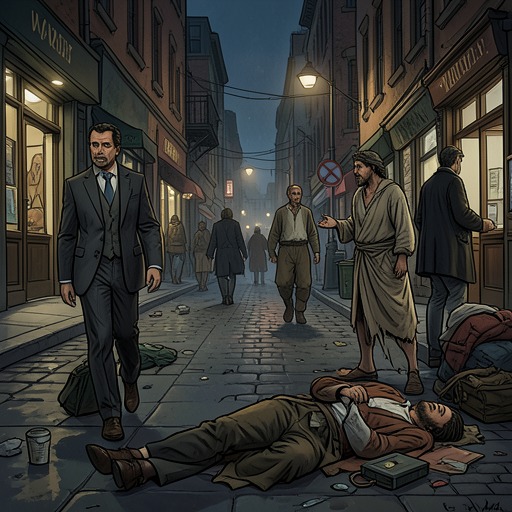
The most consequential dog in the book is Gizmo, the small mutt living beside a homeless man in the doorway of an abandoned antique store on Twelfth Street. The dog is short-haired and rail thin, tied by a makeshift leash to a Gristede's shopping cart filled with newspapers, bottles, aluminum cans, and other belongings. A cardboard sign on the cart states that its owner is hungry and homeless. Gizmo is not merely nearby: the dog lies on a pile of newspapers, guards the man, looks up at Patrick Bateman, and licks his gloved hand hungrily.
The scene initially presents a fragile form of mutual dependence. The man is drunk, exhausted, and unable to focus; Gizmo is thin, exposed, and attached to the cart that contains the remnants of their life. When the man nods for money and food, begins to cry, and says that he is hungry, Gizmo whimpers. The dog's response makes the man's suffering bodily and immediate, but it also links the two figures in the narrator's field of vision as equally available to judgment and harm. Their poverty is surrounded by garbage, bodily stench, and public neglect, while Patrick Bateman arrives from a world of restaurants, cash, taxis, and designer clothing.
That contrast does not produce compassion. After the man explains that he was fired and laid off, Patrick asks why he does not get another job. When the man cannot finish his reply and shakes miserably, Patrick's superficial offer of money gives way to assault. He attacks the man with a knife, then turns to Gizmo when the dog crouches with its fangs bared. He stomps on the dog's front legs, shattering both bones. Gizmo falls sideways, squealing, with its paws raised at an angle that Patrick finds satisfying and amusing. The dog's pain becomes part of a tableau for his enjoyment, and his laughter makes explicit that violence is not an accidental loss of control but a form of aestheticized entertainment.
Dogs as Targets and Witnesses
Gizmo's attack establishes a pattern in which dogs become collateral victims and direct targets of Patrick's violence. Later, on a dark street near Central Park West, Patrick approaches an older man walking a brown-and-white Shar-Pei. The owner is presented through the narrator's contemptuous appraisal of his clothing, age, body, skin, and mustache, while the dog initially remains occupied with ordinary acts of sniffing a tree and a garbage bag beside a white BMW 320i. Patrick's greeting, that the dog is nice, disguises the threat already prepared in his briefcase.
Patrick kills the Shar-Pei first. He grips it by the neck, pins it against a streetlamp, and cuts open its abdomen with a serrated knife. The dog cannot bark, struggles with its legs, and is dropped onto the sidewalk while its intestines spill out. The animal continues to drag itself in a circle, wagging its tail and licking or sniffing the organs that have fallen from its body. The grotesque sequence collapses the distinction between domestic pet and abject material object: a dog associated with luxury clothing and an expensive car is transformed into a spectacle of exposed flesh, while Patrick's attention remains coldly focused on the mechanics and visual effects of the killing.
The owner, shocked and still holding the leash, becomes the next victim. Patrick stabs and slashes him, then shoots him twice in the face with a silencer to make certain that he is dead. The leash connects the dying animal and the murdered owner even as Patrick separates them through violence. He then walks into D'Agostino's, uses an expired coupon for oat-bran cereal, eats from the box, and runs down Broadway with his coat flying behind him. The abrupt return to shopping and brand-marked routine makes the dog's death part of the same consumer sequence as groceries, clothing, music, and nightlife.
Dogs also appear as witnesses to earlier and later violence. The tiny Gizmo is present when its owner's body is attacked and itself becomes a victim. At another point, a dog lies beside a homeless man whom Patrick has blinded; when Patrick encounters the pair on Fifth Avenue, the dog rises, growls, and then barks while wagging its tail. Its posture is wary but protective, and its askew paws recall the earlier injury Patrick inflicted on another animal. The dog cannot expose the truth verbally, yet its recognition and alarm create a living remainder of the past. Patrick threatens it with a raised hand while pretending to offer money to the man, demonstrating that even the appearance of charity is subordinated to his desire to control the scene.
Animals Within a Manufactured World
The novel repeatedly places dogs beside other animals and animal-like images, making them part of a larger pattern of threatened or commodified nonhuman life. In the Central Park Zoo, Patrick sees a penguin that resembles Craig McDermott, reducing a living animal to a recognizable social type within a crowded exhibit. The penguins appear dazed, stressed, bored, and surrounded by artificial noises, while visitors gather to watch them. Their habitat is a managed spectacle, much like the restaurants, clubs, apartments, and social gatherings through which Patrick moves.
A dog also figures in the novel's broader language of appetite and infestation. A large rat emerges from the toilet in Patrick's apartment, follows the smell of leftover pizza, survives an oversized mousetrap, and is eventually confined while Patrick imagines ways to torture women with it. The rat is treated as an intruder and a potential instrument, yet its squealing, hunger, panic, and repeated attempts to escape give it a stubborn physical presence that resists Patrick's control. Dogs occupy the opposite social category, ordinarily associated with loyalty and companionship, but the contrast is unstable: both dog and rat are reduced to bodies that Patrick can manipulate, observe, or injure.
The narrator's own metaphors repeatedly move in the other direction, describing people through animalized or consumable imagery. Crowds stare at zoo animals; homeless people are treated as urban refuse; and Patrick himself imagines humanity as a human sausage overrun by maggots. Dogs thus mark a boundary that the novel continually erodes. They are not granted sustained independent interiority, but their hunger, fear, protective behavior, and bodily suffering interrupt the narrator's abstractions and expose the consequences of treating life as material for appetite or display.
Narrative and Ethical Significance
Dogs function as recurring tests of the distance between social polish and ethical conduct. In affluent settings, they accompany gifts, romance, fashion, diet, and domestic aspiration. In the streets, they share the precarious conditions of homeless people, guard them, depend on them, and suffer alongside them. In Patrick Bateman's encounters, the contrast is stark: the same culture that lavishes money and aesthetic attention on selected pets leaves other animals attached to shopping carts or abandoned in public doorways.
Patrick's treatment of Dogs also clarifies the structure of his unreliable narration. He records textures, prices, clothing, blood, food, music, and brand names with comparable intensity, so that a dog's injury can be described beside a designer garment or a cereal purchase without a stable moral hierarchy. His attention is precise but not humane. The animals' recurring bodies expose what his polished language suppresses: fear, dependence, pain, and the inability to escape a stronger will.
Most importantly, Dogs connect private cruelty to the novel's larger critique of consumerism and material display. NutraSweet is absorbed into a luxurious fantasy of romance; Gizmo is tied to a cart that carries a homeless man's possessions; the Shar-Pei is associated with expensive clothing and a white BMW before becoming a slaughtered body; and the protective dog on Fifth Avenue carries the visible memory of an earlier attack. Across these scenes, dogs move from companions to possessions, from witnesses to victims, and from signs of status to evidence of social abandonment. Their recurrence makes the boundary between affection and domination impossible to ignore, revealing a world in which the appearance of care can coexist with profound indifference to living beings.