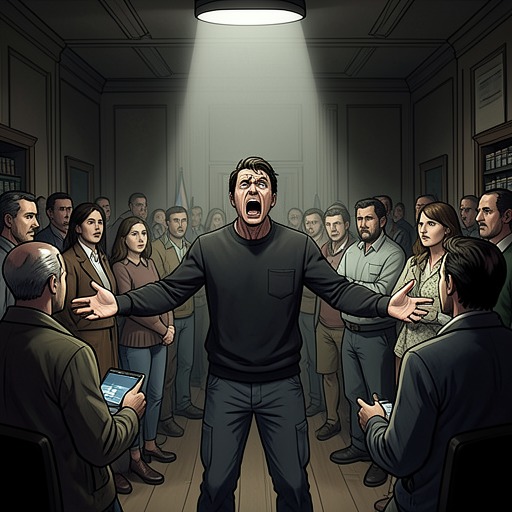
Donald Kimball's investigation of Paul Owen's disappearance
American PsychoDonald Kimball's investigation of Paul Owen's disappearance is the novel's most sustained encounter between institutional inquiry and Patrick Bateman's unreliable first-person account. Commissioned by Meredith Powell after Paul Owen vanishes, the investigation reconstructs Owen's movements through an answering-machine message, a datebook, a secretary's verification, and a witness whose identification fails. Its decisive significance lies in the clash between those records and Bateman's increasingly explicit claim that he killed Owen: the investigation produces suspicion without proof, while the later testimony of Harold Carnes suggests that Bateman's confession may describe a reality the surrounding society cannot, or will not, recognize.
Commission and Initial Inquiry
Donald Kimball introduces himself at the Pierce & Pierce office as a private investigator, not an FBI agent. He explains that Meredith Powell hired him to investigate the disappearance of Paul Owen, and frames his visit as a preliminary interview for his own files. The formal modesty of the encounter contrasts with the gravity of the case: Kimball is not publicly staging an arrest or accusation, but quietly assembling a record around a missing man whose absence has not been satisfactorily explained.
Kimball's manner is procedural and comparatively restrained. He asks Bateman basic identifying questions, beginning with his age, and continues through the ordinary accumulation of an investigative file. Bateman responds with surface politeness and attempts to perform interest in the case, asking about witnesses and fingerprints. The exchange therefore has two simultaneous layers: Kimball is seeking verifiable information, while Bateman is managing an impression of normal professional cooperation.
The office itself becomes part of that performance. Bateman notices the three copies of Sports Illustrated lying open on his desk and the Sony Walkman still running, then closes the magazines and puts both them and the Walkman away before the conversation proceeds. The gesture reveals how quickly the investigation converts ordinary objects into potential evidence of character. Bateman's concern is not only what Kimball knows about Owen, but what Kimball might infer from the setting in which he finds him.
Evidence, Dates, and the Broken Alibi
Kimball reports that Owen's answering machine contains a message saying Owen went to London. This apparent explanation is immediately weakened by Owen's girlfriend, who does not believe he traveled there. A supposed witness, Stephen Hughes, claims to have seen Owen at a restaurant in London, but Kimball checks the account and discovers that Hughes had mistaken Hubert Ainsworth for Owen. The London story thus survives as a recorded message but loses its independent confirmation.
Kimball then asks Bateman where he was on the night of Owen's appearance, identified in Kimball's notes as June 24. Bateman invents an alibi about returning videotapes and a date with a woman named Veronica, consulting his datebook as though the record were genuine. Kimball immediately notices that the account does not match his own notes. The discrepancy is important because Bateman's lie is not prompted by a direct accusation; he supplies it while trying to occupy the ordinary role of a busy man with a plausible social calendar.
The documentary contradiction becomes sharper when Kimball states that Owen's datebook, verified by Owen's secretary, records a dinner with Marcus Halberstam. Bateman treats this as an opportunity to place himself elsewhere, but Kimball says he has already questioned Halberstam. Bateman continues laughing while becoming dizzy, and Kimball reveals that Halberstam was not with Owen. Instead, Halberstam was at Atlantis with Craig McDermott, Frederick Dibble, Harry Newman, George Butner, and Bateman himself.
This discovery does not simply eliminate one suspect. It collapses Bateman's attempted separation from the relevant evening. His name appears in the very group record that he is trying to manipulate, and his improvised explanation about having dinner with Victoria on the following night becomes visibly inadequate. Kimball does not need to accuse him openly; the chronology itself forces Bateman into the scene.
Investigation as a Social Performance
The interview's tension arises from the difference between Kimball's method and Bateman's habitual social world. Bateman is accustomed to treating identity as a matter of clothing, names, reservations, professional affiliations, and polished manners. In the office, however, Kimball treats identity as a sequence of dates and corroborations. The expensive surfaces that usually certify Bateman's status become irrelevant beside a secretary's verification or a mismatch between two calendars.
The same conflict appears elsewhere in the surrounding narrative. At dinner, Bateman carefully presents a new business card from his gazelleskin wallet, purchased at Barney's for $850, and waits for the table's reaction. At another social encounter, his clothing, air-kissing, and formal gestures sustain a controlled front. Even his response to Jean's dinner plans is organized around appearances, with his breath and muscles tightening while he tries to express pleasure. These scenes establish the social system in which Bateman's investigation unfolds: objects and manners are treated as proof of belonging, but they also make people interchangeable.
Kimball's arrival interrupts that system. He is not impressed by the office's prestige or by Bateman's practiced conversational tone. He closes his book only after reiterating that he was hired by Meredith Powell, adding that Owen supposedly owed her a great deal of money. The investigation therefore has both a factual and a financial dimension, yet Kimball's restrained presentation leaves the precise stakes unresolved. His notes retain authority because they appear less invested in the theatrical display that governs Bateman's environment.
Confession Against Testimony
The investigation's most radical development occurs after Bateman begins confessing to Harold Carnes. Bateman insists that his earlier message was true, that he killed Owen by chopping off his head, and that he tortured dozens of women. He repeats the claim with escalating urgency, attempting to force Carnes to acknowledge him as both perpetrator and witness to his own crimes. The confession is not delivered as a carefully prepared defense; it is an effort to make another person recognize the reality Bateman believes he has disclosed.
Carnes refuses the role. He says that he had dinner with Paul Owen twice in London only ten days earlier. That testimony directly contradicts Bateman's declaration that Owen is dead, but it is itself embedded in the novel's atmosphere of mistaken identities and unreliable recognition. The earlier investigation has already shown a witness confusing Hubert Ainsworth with Owen, while Bateman has repeatedly encountered people who seem to mistake one wealthy young man for another. Carnes's statement therefore does not provide a clean solution. It makes Bateman's confession legally and narratively unstable rather than conclusively false.
The consequence is an evidentiary deadlock. Bateman has motive-like fantasies, knowledge of Owen's absence, a false account of his own whereabouts, and an obsessive confession. Kimball has records and contradictions, but no visible arrest, search, or prosecutorial consequence follows from the interview. Carnes offers testimony that Owen was alive in London, yet the reader receives no independent resolution of whether Carnes's memory, Bateman's perception, or the social world itself should be trusted.
Consequences and Narrative Significance
Kimball's investigation changes the meaning of Owen's disappearance without resolving it. Before the interview, Owen's absence can be treated as a socially inconvenient mystery covered by a London message and the casual assumption that men in the same professional circle are difficult to distinguish. Kimball's questions expose the weaknesses in that explanation: the girlfriend doubts the message, the London witness is wrong, Owen's datebook places him with Marcus Halberstam, and Halberstam places Bateman at Atlantis instead.
The investigation also makes Bateman's private violence collide with public documentation. In the men's room, Bateman imagines killing Luis Carruthers and moves his hands around Luis's throat, but the intended strangling does not occur because Luis responds with an intimate kiss to Bateman's wrist. This contrast matters to the Owen inquiry: Bateman's violent intention is vivid and bodily, whereas the investigation can register only dates, statements, and inconsistencies. The gap between what Bateman experiences internally and what institutions can prove becomes the event's central pressure.
At the end of the broader sequence, Bateman leaves Harold Carnes a recorded admission of everything, claiming responsibility for thirty, forty, or a hundred murders. He later repeats the confession in person, but Carnes answers with his London dinners with Owen and treats Bateman's words as incomprehensible. The result is not exoneration or conviction. It is a world in which confession fails to produce recognition, evidence fails to stabilize identity, and the phrase Paul Owen's disappearance remains suspended between an actual crime, a misidentified absence, and the testimony of a narrator who cannot reliably distinguish desire, memory, and fact.
The investigation consequently embodies the novel's broader structure of appearance versus reality. Kimball's files, questions, and corroborations seem to promise a rational account, yet each apparently solid clue opens another uncertainty. Bateman can be named, placed, questioned, and recorded, but none of those procedures guarantees that the person being investigated is the person the institution thinks it has found. Donald Kimball's investigation is therefore significant less as a conventional solution than as a demonstration of how social anonymity and unreliable narration can defeat the ordinary machinery of truth.