Habitrail
American PsychoHabitrail is a modular rodent-cage system whose appearance in Patrick Bateman’s apartment marks the conversion of a familiar consumer object into a mechanism of cruelty. First associated with two white rats bought alongside knives and hydrochloric acid, it later becomes part of a staged torture apparatus in which confinement, recording, feeding, and spectatorship are fused. The system’s significance lies not merely in what it contains, but in how its tubes and transparent surfaces give physical form to Bateman’s desire to organize living bodies as components in a private display.
Acquisition and Domestic Setting
Habitrail first enters the narrative during one of Patrick Bateman’s episodes of disordered movement through Manhattan. After buying butcher knives, an axe, and hydrochloric acid, he visits a pet store and purchases a Habitrail together with two white rats, intending to torture the animals with the weapons and chemicals. The cage therefore appears from the beginning not as neutral pet equipment but as one item in a sequence of consumer purchases that includes tools of violence. Its retail availability and household form make the grotesque plan resemble another act of shopping.
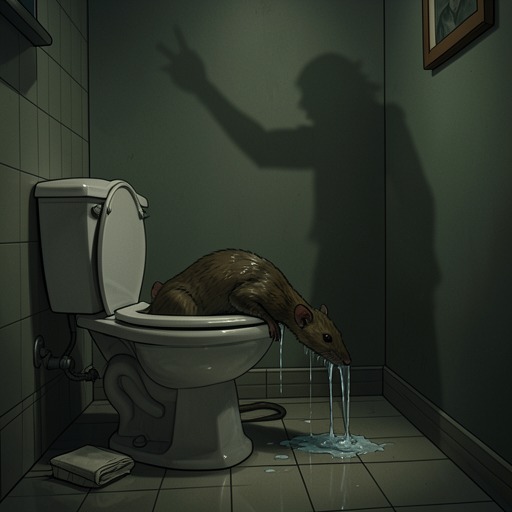
The system is later installed on Bateman’s kitchen table, amid the polished domestic and commercial world of his apartment. He observes a rat dragging what remains of its acid-ridden body halfway across the elaborate structure toward a water holder filled with poisoned Evian bottled water. The scene produces a characteristic uncertainty in his narration: he cannot decide whether the spectacle is too pitiful or not pitiful enough. Habitrail thus becomes a device for converting suffering into a problem of aesthetic assessment, with the cage providing a controlled setting in which pain can be watched without requiring compassion.
From Cage to Instrument
The Habitrail’s function expands when Bateman keeps another rat in a glass cage and begins contemplating ways to use the animal against women. The system is dismantled so that one of its hollow plastic tubes can be inserted into a victim’s body. In this altered form, the object no longer separates animal life from the domestic environment; it creates a passage between them. Bateman forces the tube into a woman’s vagina, using olive oil and then acid to make the opening accommodate it, while a jukebox plays Frankie Valli’s "The Worst That Could Happen." The ordinary plastic component becomes an invasive extension of the body and a conduit for planned violence.
The cage is then carried from the kitchen into the living room and placed beside the woman. The rat, weakened by deliberate starvation and driven by the smell of Brie, throws itself against the glass enclosure. It races into the tube and disappears inside the victim while Bateman watches and finally pulls the tube away, trapping the animal within her. The Habitrail supplies the physical route through which Bateman joins confinement, hunger, and bodily violation; its modular design allows him to reconfigure a commercial object into a bespoke instrument of torture.
Material Agency and Spectacle
Habitrail does not remain passive equipment in these scenes. Its tubes determine the route of the rat, its cage focuses the animal’s hunger, and its portability allows Bateman to move the apparatus from one room to another. The object’s material properties help shape the event: transparent glass makes the rat’s agitation visible, plastic tubing permits connection between cage and body, and the system’s separable parts make reconstruction possible. Bateman’s violence depends on this assemblage of human intention, animal movement, food, chemicals, furniture, and consumer goods rather than on an isolated act of will.
The cage also organizes watching. Bateman repeatedly films his killings with miniature cameras, and the Habitrail sequence is constructed as another controlled performance, with the victim forced to remain conscious while the rat enters the tube. The apparatus makes the animal both participant and spectacle. Yet its apparent control is unstable: the rat refuses to eat the other dead rat, thrashes against the glass, and moves with unexpected energy once it smells the cheese. The object designed to contain life becomes the channel through which life disrupts Bateman’s arrangement, even though the disruption remains absorbed into his larger violence.
Consumer Culture and Dehumanization
The Habitrail’s domestic familiarity intensifies the moral disorientation of its use. It belongs to the same world as designer clothing, expensive food, televisions, telephones, and luxury furnishings, and it is handled with the practical vocabulary of shopping and household management. Bateman buys, transports, modifies, and stores it as though cruelty were another form of apartment customization. The cage exposes the continuity between consumption and domination: living creatures become purchases, components, contents, and visual material.
This logic extends across the surrounding animal imagery. A starving dog named Gizmo lies beside a homeless man and is treated as part of a scene Bateman can inspect and later destroy. At the Central Park Zoo, penguins are displayed behind glass for spectators, while the child in the penguin habitat becomes an object of Bateman’s predatory attention. Habitrail belongs to this broader sequence of cages, tanks, storefronts, and viewing spaces. The difference between pet, prey, exhibit, and victim collapses under a gaze that treats every body as available for arrangement.
Narrative Significance
As an object, Habitrail condenses the novel’s contrast between polished surfaces and concealed brutality. Its branded, recognizable form carries the promise of harmless domestic care, but Bateman’s use of it reveals a private world in which technology and commodities are valued for their capacity to constrain, display, and manipulate. The system’s transparency is especially revealing: nothing is hidden from the observer, yet visibility does not produce knowledge or ethical recognition. It merely permits prolonged inspection.
The Habitrail also embodies the instability of Bateman’s claimed mastery. He designs elaborate procedures, poisons water, starves animals, and constructs routes through which bodies must pass, but the rat’s movement remains partly independent of him. The cage therefore stages a paradox: the more meticulously Bateman arranges matter, the more clearly the material world asserts its own resistance, weight, appetite, and unpredictability. In the novel’s economy of violence, Habitrail is both a tool of control and a reminder that control is always mediated by things, animals, and environments that can alter the course of the scene.