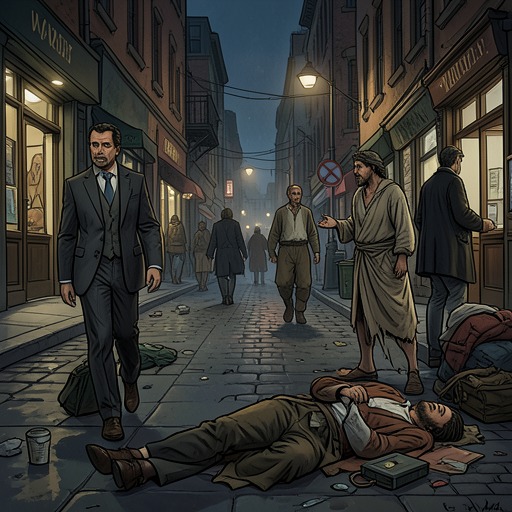
Homelessness
American PsychoHomelessness in New York City functions not merely as a social condition but as one of the book’s most persistent visible signs of exclusion. Beggars appear along the same routes that carry Patrick Bateman and his peers from Wall Street to expensive restaurants, clubs, apartments, and Central Park. Their poverty is therefore not hidden outside the city’s luxury system; it is placed directly beneath its surfaces, where it becomes an object of contempt, inconvenience, spectacle, and, in Bateman’s case, extreme violence.
Urban Visibility and Social Separation
Homeless people repeatedly occupy the margins of affluent Manhattan spaces. Leaving a cab after traveling from Wall Street, Timothy Price notices a beggar in a filthy green jumpsuit and treats the encounter as a joke, holding the cab door open only to slam it shut and asking whether the man accepts American Express. The mockery converts poverty into a failed consumer transaction: the beggar’s need is acknowledged only through the language of payment cards and purchasing power.
A similar encounter follows the meal at Pastels. The bill totals $475, a sum divided among the diners while Patrick Bateman places it on his platinum American Express card and gathers mostly fresh fifty-dollar bills. Outside, another bum asks first for change and then, more hopefully, for food. The contrast is immediate and spatially precise: an expensive, carefully managed interior gives way to a street-level appeal for basic nourishment. Bateman’s description of the man’s appearance and his companions’ amusement reduce a person in need to an unpleasant visual interruption in a night organized around status and consumption.
The city’s geography reinforces this separation without fully removing the homeless from view. Bateman moves through the antique district below Fourteenth Street, past a newsstand, dry cleaners, church, diner, phone booth, and empty streets, while dealers and party promoters circulate around him. The homeless presence belongs to this urban background alongside garbage, steam, taxis, and damaged sidewalks, yet the narrative gives it a sharper human form when Bateman encounters Al and Gizmo. The route from Wall Street, restaurants, and limousines to doorways, grates, shopping carts, and blankets maps a social order in which luxury and deprivation coexist within walking distance.
Al and Gizmo
Al is found lying in the doorway of an abandoned antique store on Twelfth Street, on top of an open grate and beside bags of garbage. His shopping cart contains newspapers, bottles, and aluminum cans, while a hand-painted sign states that he is hungry and homeless. Gizmo, a small, thin mutt, lies beside him with its leash tied to the cart, guarding him. The dog’s nameplate and its instinctive attachment to Al give the scene a modest form of domestic continuity amid the absence of housing, security, and institutional shelter.
Al’s physical condition makes homelessness concrete rather than abstract. He is drunk or possibly mentally impaired, has stained teeth, a running nose, and clothes layered in a grotesque mixture of a lime-green polyester pantsuit, washed-out jeans, and a ripped, wine-stained sweater. When he speaks, he says that he is hungry and later explains that he lost his job. He also says that he cannot find a shelter. These details establish a chain of dispossession—hunger, unemployment, exposure, and the failure to secure shelter—without presenting homelessness as a simple matter of personal choice.
Bateman briefly adopts the language of self-help and personal responsibility. Holding money just beyond Al’s reach, he asks why Al does not get a job and tells him to get his act together, promising that he will help. Al responds with gratitude, calling him kind, but the promise is hollow because Bateman has no intention of providing meaningful assistance. His rhetoric turns structural vulnerability into an alleged defect of attitude. The scene’s irony lies in the gap between Bateman’s performance of charity and his refusal to recognize any common humanity with the person before him.
That gap becomes explicit when Bateman admits that he has nothing in common with Al, then abruptly changes from simulated compassion to humiliation. He places the bill back in his jacket, touches Al’s face, and asks whether Al knows what a loser he is. The money that might have represented aid becomes a prop in a ritual of domination. Homelessness is thus shown as a condition in which even an apparently charitable encounter can leave the vulnerable person dependent on the moods and fantasies of someone with economic power.
Violence and the Denial of Personhood
The encounter with Al culminates in an assault that makes homelessness a condition of extreme exposure. Bateman blinds him with a serrated knife, stabs him repeatedly, and leaves him disfigured and bleeding. He throws a quarter into Al’s face and tells him to buy gum, reducing the aftermath of a sustained attack to the smallest possible monetary gesture. The coin is a grotesque parody of the alms Al had sought earlier: charity and violence are made interchangeable within Bateman’s logic, both serving only to assert control.
Gizmo is also drawn into the attack. The dog yips and later receives blood in its eyes, while Bateman turns his aggression toward it after mutilating Al. This detail matters because the dog’s loyalty had briefly provided Al with companionship and protection. Bateman’s violence therefore attacks not only an isolated body but also the fragile bond that gives the homeless man a form of social existence. The homeless pair is treated as disposable life, without meaningful protection from passersby, institutions, or the city’s affluent inhabitants.
The language surrounding the assault intensifies the dehumanization. Bateman frames Al as a loser and uses racist abuse while treating the attack as a private exercise of will. His earlier complaint that Al smells and his insistence that he should simply find work convert poverty, bodily deterioration, and exclusion into grounds for contempt. The violence does not emerge from an actual dispute between equals; it is enabled by the victim’s isolation and by Bateman’s assumption that no social consequence will follow.
Recurrence and the City’s Moral Landscape
Homelessness recurs as Bateman moves through the city, making Al’s assault part of a wider pattern rather than an isolated anomaly. In Central Park, the surrounding urban environment—horse-drawn carriages, skyscrapers, Fifth Avenue apartments, Trump Plaza, and the zoo—places poverty, commerce, and institutional spectacle within one enclosed metropolitan system. Bateman’s hostility toward a black custodian and his use of a knife to intimidate him show the same readiness to convert ordinary contact with socially subordinate people into a confrontation governed by fear.
Later, after returning from Central Park near the place where he murdered the McCaffrey boy, Bateman sees bodies and decay spread across Fifth Avenue. Near Trump Tower, he notices a beggar on a blanket whom he recognizes as the man he blinded in the spring. The man now holds a sign identifying him as a Vietnam veteran who is blinded, hungry, and homeless. Gizmo is still with him, suspicious at first and then barking as Bateman approaches. The recurrence transforms the earlier assault into a continuing social fact: the victim survives, remains visibly marked by violence, and continues to occupy the street with the dog beside him.
The later sighting also exposes the inadequacy of Bateman’s original fantasy of disappearance. He had treated Al as someone who could be silenced and reduced to a body, yet Al reappears in the same public world, carrying a sign that names both his injury and his deprivation. The city has not absorbed or corrected the violence; it has merely allowed the damaged man to remain in view. His return gives homelessness a memory, even within a narrative whose central consciousness repeatedly tries to erase consequences.
Consumer Culture and Narrative Significance
The book places homelessness against a dense inventory of privileged consumption. Patrick Bateman and his associates compete over business cards, admire expensive typography and materials, pay for high-priced meals, use platinum cards, and belong to Xclusive, a private health club whose annual membership costs five thousand dollars and includes courts, pools, machines, training, massage, sauna, steam rooms, tanning booths, and a juice bar. These objects and services make status measurable and visible. Against them, the homeless person’s possessions are a shopping cart, newspapers, bottles, cans, a blanket, a cardboard sign, and a dog.
This opposition is not simply between wealth and poverty; it is between lives that are socially amplified by objects and lives whose few objects testify to abandonment. Bateman’s wallet, jacket, card, clothing, and membership privileges establish an identity recognized by institutions and peers. Al’s sign attempts to make his deprivation legible, but the sign competes with the city’s advertisements, restaurants, branded goods, and architectural displays. The affluent world can turn money into evidence of personhood, while the homeless must announce hunger and homelessness before receiving even reluctant notice.
Homelessness also clarifies the novel’s unreliable moral perspective. Bateman notices precise surfaces—clothing, bodily smell, prices, signs, buildings, and branded possessions—but his attention does not produce empathy. Instead, his detailed observation makes the failure of recognition more disturbing. He can describe Al’s condition minutely and still deny that they share anything. The narrative therefore uses the homeless figure as a limit case for Bateman’s detachment: when a person’s need is unmistakable, his response is not confusion but the deliberate conversion of vulnerability into entertainment and violence.
At the same time, the repeated street scenes widen the focus beyond Bateman’s private pathology. The homeless are encountered beside luxury restaurants, financial districts, major avenues, public parks, and elite towers, so their exclusion appears built into the city’s circulation rather than confined to a remote margin. Homelessness becomes the negative image of the consumer order: the same society that celebrates mobility, choice, and individual success leaves some bodies without shelter, security, or credible access to help. Bateman’s cruelty does not create that order, but it reveals what its polished surfaces can permit when the people beneath them are treated as invisible or disposable.