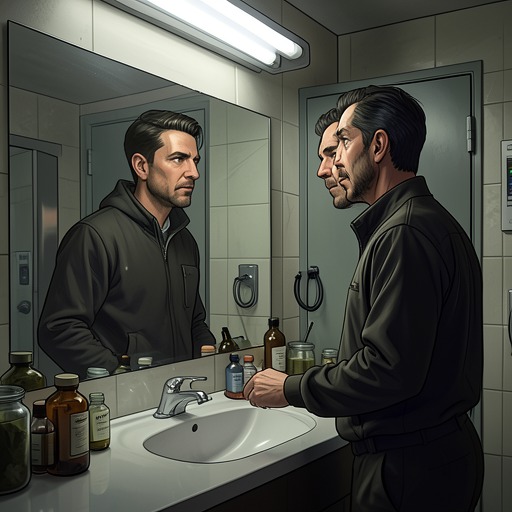
Insomnia
American PsychoInsomnia is a recurring condition in Patrick Bateman's experience, and its decisive significance lies in the way it erodes the boundary between his controlled public persona and the violent, unstable consciousness beneath it. Sleep deprivation does not merely leave him tired: it produces temporal confusion, physical distress, recurrent disaster imagery, and a mounting inability to keep ordinary reality separate from murderous fantasy or memory.
Symptoms and Physical Breakdown
Insomnia becomes especially explicit when Patrick Bateman reports sleeping in twenty-minute intervals. During this period he feels aimless and clouded, while his homicidal compulsion repeatedly surfaces, disappears, and returns. The condition accompanies ordinary errands, meals, phone calls, and encounters with Jeanette, who notices that he keeps razor blades in his wallet. The contrast between routine activity and severe sleep disruption makes his instability appear not as a private episode removed from daily life but as a force leaking through every part of his schedule.
The most extreme physical description occurs at dawn in November, when he lies awake on a futon in a suit, unable to find relief from a burning pain in his head. Drugs, food, and liquor fail to appease it; his muscles are stiff and his nerves feel as though they are on fire. The exhausted room is filled with disturbing remnants, including a pair of girl's shoes, a severed hand, bloodstained clothing, and the smell of blood cooking in the kitchen. Whether these objects belong to an external reality or to Patrick Bateman's unstable perception, insomnia has made the domestic interior inseparable from bodily violence and decay.
Distortion, Dreams, and Repetition
Sleep deprivation also reorganizes what Patrick Bateman sees and remembers. In his dreams, the smell of blood becomes a recurring presence, while the images arrive as an apparently endless reel: a burning ocean liner, volcanic eruptions in Hawaii, the violent deaths of Salomon traders, electric chairs, suicides, syringes, mutilated pinup girls, and other scenes of disaster. The dreams draw together private violence, institutional catastrophe, school memories, and mass-media imagery, suggesting that the exhausted mind can no longer sort personal experience from spectacle.
The repeated disaster footage of the summer reinforces this collapse. Air crashes are shown again and again on television in slow motion, with wreckage, burned bodies, and rescue workers retrieving body parts. Patrick Bateman experiences the images as almost deliberately arranged and endlessly repeatable. His insomnia therefore operates within a larger culture of replay: television, videotapes, movies, and nightmares all convert suffering into recurring visual material. His own nocturnal bloodlust similarly overflows into the daytime, and he describes himself as lethal and close to frenzy before deciding that he needs to leave New York City for The Hamptons.
Social Life Under Sleep Deprivation
Insomnia does not prevent Patrick Bateman from maintaining the rituals of elite social life. At the Yale Club, he has worked out at Xclusive for two hours and spends the afternoon drinking with David Van Patten and Craig McDermott before massages, while Luis Carruthers sits nearby. The polished suits, branded clothing, club setting, and elaborate attention to physical conditioning preserve the appearance of control. Yet the scene is accompanied by his disturbing fascination with a Patty Winters Show segment about Nazis, whose violence gives him an unexpected charge.
At Xclusive, his exercise regimen is described with technical precision: Stairmaster work, stretching, free weights, and Nautilus machines. He treats the body as an engineered surface requiring constant maintenance, even while sleep deprivation undermines the mind that supervises it. The gym's disciplined repetition thus functions both as a coping routine and as a counterpoint to the disordered consciousness recorded in his narration. Physical hardness and social polish become external substitutes for rest, stability, and emotional life.
Investigation, Memory, and Unreliable Reality
The pressure of insomnia coincides with the increasingly unstable account of Paul Owen. Patrick Bateman's private narrative places him at the center of Owen's disappearance, while Donald Kimball's investigation introduces records and testimony that contradict the apparent certainty of that account. Kimball reports a message on Owen's answering machine saying that Owen went to London, although Owen's girlfriend doubts the explanation. He also says that Owen's datebook, verified by his secretary, placed Owen at dinner with Marcus Halberstam on the relevant night.
Later, Patrick Bateman confesses directly to Harold Carnes that he killed Paul Owen, chopped off his head, and tortured dozens of girls. Carnes dismisses the confession because he says he had dinner with Paul Owen twice in London only ten days earlier. The contradiction makes insomnia part of a broader structure of unreliable narration: exhaustion may help explain Patrick Bateman's confusion, but the text never reduces the discrepancy to a simple medical explanation. The sleepless mind becomes a site where confession, memory, fantasy, and mistaken identity coexist without receiving a final external resolution.
Narrative Significance
Insomnia strips away the promise that Patrick Bateman's meticulous routines can stabilize him. He continues to exercise, dress carefully, eat in fashionable restaurants, watch television, use drugs and sedatives, and move through Manhattan's professional and social institutions, but rest never restores a coherent self. Instead, sleeplessness amplifies compulsive violence, grotesque imagery, and the sensation that the world itself is a sequence of disconnected surfaces.
Its recurrence also gives the narrative a rhythm of delayed revelation. Violent images return in dreams, on television, in domestic spaces, and in the investigator's conflicting account of Paul Owen's whereabouts. By the end of the 1980s, Patrick Bateman wakes in cold sweats and turns on the wide-screen television to block out construction sounds, while disaster images and violent dreams continue to intrude. Insomnia is therefore both a bodily state and a formal principle: it keeps the narrative awake, fragmented, repetitive, and unable to settle the difference between what happened, what was imagined, and what cannot be witnessed or verified.