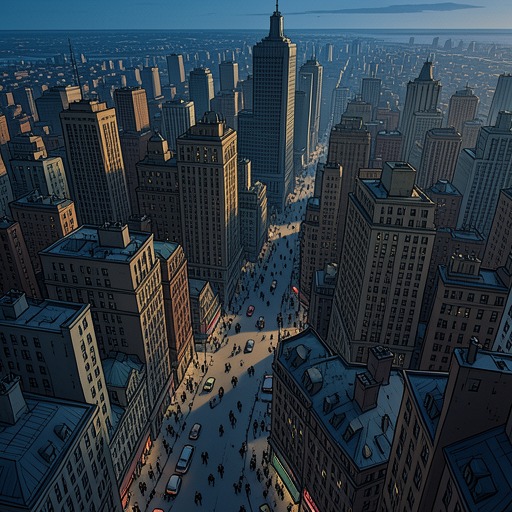
Manhattan
American PsychoManhattan functions as both the social machine that privileges Patrick Bateman and the spatial landscape through which his alienation and violence become visible. Its restaurants, clubs, offices, limousines, luxury apartments, commercial streets, and abandoned doorways form a continuous urban circuit in which wealth and deprivation are separated less by distance than by rules of access, attention, and recognition.
A Stratified Urban Circuit
Manhattan first appears through the movement of Wall Street professionals and the city’s branded surfaces. Leaving Wall Street in a cab, Timothy Price notices blood-red lettering on the side of Chemical Bank near Eleventh and First, but a bus carrying an advertisement for Les Misérables quickly blocks his view. The city’s warnings are therefore both conspicuous and disposable: graffiti, advertising, traffic, and commerce compete for the same field of vision. Price responds not to the writing but to the radio, offering the driver five dollars to turn up WYNN, where Be My Baby is playing, while continuing to describe his career, income, and dissatisfaction.
The same geography supports an evening of elite consumption. At Pastels, the maître d' recognizes Craig McDermott, complimentary Bellinis are expected, and Patrick Bateman displays his new business card from a gazelleskin wallet bought at Barney's for $850. The meal costs $475, a sum divided among the group and charged to Bateman's platinum American Express card, while the men argue over a ten-dollar reimbursement and leave an unopened bottle of champagne behind. Outside, a homeless man asks first for change and then, more hopefully, for food. The proximity of luxury and hunger does not produce solidarity; it turns the homeless man into another object within the party’s economy of appraisal and contempt.
Manhattan also provides a chain of controlled interiors. At Courtney Lawrence's brownstone, Bateman and Price arrive in Armani overcoats, exchange air kisses, and enter a room where new Talking Heads plays softly. Later, in a club, Bateman follows Price past the bar and dance floor, upstairs, and into an empty men's restroom stall. The locked stall becomes a backstage space within the city's social theater: the public performance of status gives way to whispered handling of a small envelope and the inspection of its supposed gram of cocaine.
Streets, Margins, and the Unseen
When Bateman leaves the protected circuit of parties and restaurants, Manhattan changes from a network of reservations into a nearly deserted nocturnal landscape. Below Fourteenth Street, he passes a newsstand, dry cleaners, church, diner, phone booth, and antique stores while taxis move toward Union Square. A torn playbill for Les Misérables tumbles along the cracked, urine-stained sidewalk; steam rises from below the streets; garbage bags line the curbs; and the Chrysler Building hangs above the scene as an emblem of a distant, indifferent skyline. The city is not empty in any literal sense, but its inhabitants appear as isolated fragments, briefly illuminated and then absorbed by darkness.
The doorway of an abandoned antique store on Twelfth Street concentrates this marginal Manhattan. A black homeless man lies on an open grate beside a Gristede's shopping cart loaded with newspapers, bottles, and aluminum cans. The cart bears a hand-painted sign reading I AM HUNGRY AND HOMELESS PLEASE HELP ME. His rail-thin dog, Gizmo, guards him from a pile of newspapers. The scene makes domestic life, possession, and public exposure overlap: the cart is storage, home, and identifying record, while the open grate offers warmth at the cost of visibility. Bateman registers the man's clothing, smell, drunkenness, and physical deterioration with meticulous attention, but that precision does not become compassion.
The city's public rituals reveal another form of exclusion. Gridlock forces Bateman to leave his company car and walk down Fifth Avenue, where he encounters a Gay Pride Parade near Sixteenth Street. The marchers, pink triangles, pastel windbreakers, and singing turn a major commercial avenue into a temporary collective space that he experiences as intolerable. He flees to Sixth Avenue, returns by cab to his apartment, changes into a Cerruti 1881 suit, gives himself a pedicure, and tortures a small dog. His retreat shows how Manhattan’s streets can expose identities and solidarities that the elite interiors attempt to regulate, while his private response converts social discomfort into cruelty.
Luxury, Access, and Violent Opportunity
Manhattan’s privileged interiors do not simply shelter Bateman; they provide the access, anonymity, and procedural gaps through which his violence can develop. At a brownstone party, he rushes Evelyn Richards through an alley and pushes her into a limousine he believes may belong to Paul Owen. The maneuver depends on the city’s abundance of nearly identical cars, its traffic, its servants, and its crowded social occasions. A limousine can appear to be a private refuge while remaining only another interchangeable object in the urban flow.
The same pattern is more explicit in Bateman’s confrontation with Luis Carruthers. Bateman considers whether Courtney would prefer him if Luis were dead and whether killing him would make his own world safer or more manageable. In the deserted men's room, Luis occupies a stall with its door slightly ajar, whistling from Les Misérables. Bateman approaches from behind and places his hands around Luis’s neck. The restaurant’s polished social environment has produced a moment in which privacy, proximity, and surveillance failure converge; the city’s formal civility is suspended inside a stall that no one else enters.
Paul Owen's apartment represents a more elaborate version of the same opportunity structure. Bateman learns through a lawyer that Donald Kimball has heard Owen is in London, that Kimball has traveled there, and that no one is watching the apartment. The keys Bateman stole from Owen still work. He carries a power drill, acid, a nail gun, knives, and a Bic lighter into the apartment, then hires two young escorts using Owen's gold American Express card. The apartment’s security, ownership records, payment systems, and temporary absence of supervision become instruments that help sustain Bateman’s sense of impunity. The girls’ impression that the condominium is a palace only reinforces the environment’s conversion of violence into a private luxury service.
Central Park and the City’s Animal Spectacle
Central Park and its zoo expose a different relation between urban order and violence. Bateman wanders through Central Park Zoo while unable to maintain a credible public persona. The zoo is surrounded by Fifth Avenue apartment buildings, Trump Plaza, the AT&T building, carriage traffic, horse manure, and drug dealers near the gates. Rather than separating nature from the city, the zoo intensifies the city’s artificiality: animals are enclosed within an urban enclosure already surrounded by wealth, commerce, and surveillance.
Inside the zoo, Bateman encounters a black custodian, closed information booths, a blind man eating a pretzel, two drunks, and a mother nursing her baby. He insults the custodian and uses a knife to make him back away. The animals appear stained, drugged, morose, or mindless, while a warning on the seals’ tank states that coins can cause ulcers, infections, and death. Bateman throws change into the tank anyway, insisting that it is not the seals he hates but the audience’s enjoyment of them. The distinction is characteristic of his urban perception: spectatorship itself becomes the object of hatred, even as he repeatedly turns people and animals into spectacles for his own impulses.
The zoo’s proximity to the murdered McCaffrey boy’s location gives Central Park a recurrent and contaminated geography. Later, Bateman returns from Central Park near the children's zoo and describes feeding portions of Ursula's brain to passing dogs. Walking along Fifth Avenue, he sees bodies lying across the pavement, airplanes crossing the sun, pigeons rising, and the gleaming Trump Tower above the avenue. The skyline’s grandeur persists while the street becomes a scene of decay, suggesting that Manhattan’s monuments do not contradict violence and abandonment; they provide the elevated backdrop against which both become ordinary.
The City as Perception and Concealment
Manhattan is also the setting in which Bateman’s account reaches its most unstable form. After a nighttime shooting spree, he returns to what he identifies as his new office, signs in with Gus, the night watchman, and calls Harold Carnes. With shaking hands, he leaves a message confessing dozens or even a hundred murders. Outside, police cars, ambulances, flares, a SWAT team, and a helicopter search the building he has just left. Yet the promised public consequence never solidifies within the scene. Bateman remains on the phone, sobbing, leaving further messages, while sunrise overtakes the city with the speed of an optical illusion.
This sequence makes Manhattan a structure of simultaneous revelation and erasure. Offices, lobbies, elevators, telephones, police vehicles, and surveillance systems seem to promise that actions will be recorded and answered for, but Bateman’s account repeatedly dissolves the boundary between event and fantasy. The city’s anonymity protects him socially even when he claims to expose himself verbally. His message to Harold Carnes becomes less a stable confession than another performance staged through Manhattan’s communication infrastructure.
Across the novel, the island’s routes connect the most expensive forms of consumption to the most exposed forms of homelessness, and the same polished social world that prizes names, clothes, cards, reservations, and professional identity also makes individuals interchangeable. Manhattan’s decisive literary role is therefore spatial and moral: it keeps privilege and abandonment within view of one another while allowing each to remain insulated. Bateman’s movement through the city reveals not a coherent map of modern life but a fractured urban theater in which surfaces are carefully maintained, witnesses fail to recognize one another, and violence can appear either as an unspeakable rupture or as just another image passing through the streets.