Misogyny and the commodification of women
American PsychoMisogyny and the commodification of women names a central structure of the novel’s moral and perceptual world. Women are repeatedly reduced to appearance, sexual availability, social usefulness, or material that can be arranged, consumed, filmed, and destroyed. The pattern is visible both in the polished conversations of the financial elite and in Patrick Bateman’s private fantasies and crimes, where the language of selection and judgment develops into literal control over female bodies. The result is not merely a series of misogynistic acts but a system in which looking, buying, ranking, and harming become disturbingly interchangeable.
Women as Appearance and Status
The social vocabulary surrounding women begins with evaluation. In conversation about Laurie Kennedy, Hamlin insists that she is desirable because she is “a babe,” while dismissing the possibility that interest might arise from any other quality. Reeves goes further, treating a woman’s personality as irrelevant if she is not attractive and suggesting that beauty is the only meaningful criterion. These exchanges make female value a visible surface, measured through the same competitive logic that governs clothes, restaurants, business cards, and professional prestige.
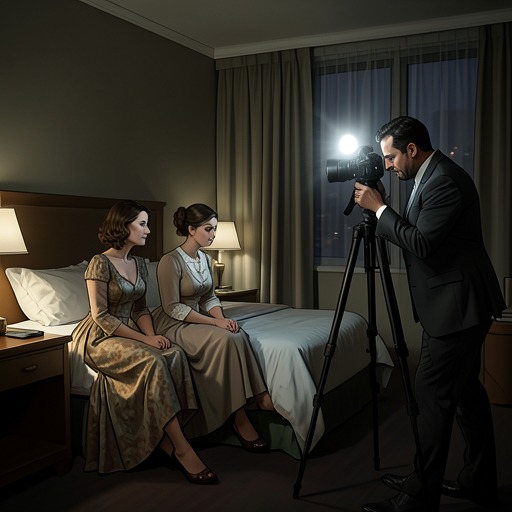
That logic also shapes the narrator’s account of Evelyn Richards. He considers her in terms of sexual availability and imagines whether she would participate in a scene that he could direct, light, and choreograph. The fantasy does not approach her as an independent subject with a desire of her own; it converts her, and the imagined second woman, into performers under his supervision. The women’s bodies become a private stage on which his authority can be displayed, while violence appears as another possible method of securing obedience.
Selection, Purity, and the Marketable Body
The search for a prostitute in the meat-packing district is described as a process of prolonged inspection and acquisition. Patrick Bateman has spent months prowling the area for the “appropriate babe,” and when he finds a young blond woman, he evaluates her age, clothing, skin, and racial identity before approaching her. Her whiteness is treated as a rarity, and therefore as an added value; she seems especially “clean” in contrast with the other women around her. The description borrows the language of scarcity, quality control, and product differentiation, turning a person into a desirable item within a carefully surveyed market.
The setting intensifies that reduction. The woman stands beside an abandoned warehouse marked with the word “MEAT,” a blunt visual emblem that links the commercial vocabulary of the district to Bateman’s perception of the people in it. His limousine, tinted windows, and chauffeur place the encounter within a hierarchy of wealth and mobility. He does not enter the space as an equal participant in an exchange. He arrives as a consumer with the means to select, transport, and dispose of another person.
Violence as Possession and Performance
The commodifying gaze becomes physical domination in the assault on the woman in the apartment. When she tries to escape, Patrick Bateman blocks the door and knocks her unconscious with a nail gun. He then fixes her hands to the floor, repeatedly shoots nails into them, sprays her with Mace, covers her head with a Ralph Lauren coat, and records what follows on a Sony Handycam. The branded coat and camera are not incidental details: luxury consumption and mediated spectacle surround the violence, making the victim’s suffering part of an arranged scene rather than an encounter between two human beings.
His repeated insults further strip her of personhood, while her plea addressing him by name briefly exposes the relationship that his actions are trying to erase. He responds not with recognition but with renewed torture and sexualized control. The camera converts injury into an object for later viewing, and the carefully positioned body becomes both victim and prop. Violence therefore functions as a demonstration of authorship: Bateman directs bodies, controls movement, determines exposure, and treats pain as material that can be staged.
A similar structure appears in the scene involving Elizabeth and Christie. Both women are naked on Bateman’s bed while he watches from a chair and repeatedly repositions them. He instructs their movements, dictates how they touch and kiss, and uses their bodies to produce a tableau that satisfies his gaze. Their sexual activity is not presented as mutual intimacy but as a performance organized by a male spectator whose commands determine its form. The women’s apparent participation cannot obscure the asymmetry of the scene, because the narrator controls the setting, the instructions, and the interpretation of what their bodies mean.
Dehumanization Beyond the Female Body
The novel’s misogyny belongs to a wider practice of dehumanization. In the encounter with Al, a homeless man, Patrick Bateman first adopts the language of personal responsibility, telling him to get a job and accusing him of having a negative attitude. He briefly performs compassion, then withdraws the offered money and calls Al a loser before attacking him with a serrated knife. The sequence shows how moral language can become a prelude to violence: structural vulnerability is recast as individual failure, allowing the aggressor to present cruelty as correction.
The presence of Gizmo, Al’s thin dog, extends the same logic across species. Bateman notices the animal’s hunger and gratitude, pets it, and then kills it while holding it against a streetlamp. Later, he kills another dog and its owner in a rapid scene that combines knife attacks, gunshots, a bloodied BMW, and the routines of shopping afterward. The juxtaposition of spectacular violence with an expired cereal coupon and the tune of “Hip to Be Square” makes harm appear as one more consumable episode in a world of surfaces, brands, and entertainment.
The penguin habitat provides another disturbing version of spectatorship. The penguins are displayed behind glass for a crowd surrounded by artificial sounds, tired animals, and a carefully managed attraction. Bateman identifies one that resembles Craig McDermott, then draws a small child away from the crowd by offering a cookie and stabs him in the neck. He returns to the spectators while the child’s mother initially mistakes the hidden body for a game. Here the vulnerable body becomes invisible within an environment organized around looking, distraction, and public enjoyment. The scene does not make the child a commodity in the literal marketplace, but it places him within the same field of instrumentalized bodies: selected, used, concealed, and converted into part of Bateman’s private spectacle.
Breakdown of the Commodifying Order
The narrator’s treatment of women reaches its most grotesque expression when a murdered woman’s body is converted into food. He attempts to make meat loaf from her remains, smears flesh across the walls, chews strips of skin, and grinds bone, fat, and flesh into patties while a Richard Marx CD plays and a bag from Zabar’s sits nearby. The ordinary markers of domestic consumption remain intact even as the distinction between person and product collapses. His description of the body as “nothing” and “shit” is a verbal technique of moral disengagement: by denying the victim’s human status, he makes the act momentarily bearable to himself.
Yet the scene also reveals the failure of that strategy. The narrator’s grotesque pleasure sours into weeping, and he cries, “I just want to be loved,” while declaring that principles, distinctions, choices, morals, compromises, knowledge, unity, and prayer were all wrong. This breakdown does not redeem him or restore the women he has destroyed. Instead, it exposes the emotional vacuum beneath the system of possession. The women have been treated as objects because the narrator cannot sustain relation to another person; when the objects fail to provide meaning, his violence turns back toward his own vacancy.
The recurring contrast between expensive goods and damaged bodies gives the theme its force. A new business card is displayed from a gazelleskin wallet, while luxury clothing, restaurants, cameras, cars, music, and furniture surround acts of abuse. The world’s surfaces remain polished, but the human beings within it are ranked, exchanged, staged, and discarded. Misogyny and the commodification of women thus operate as both social behavior and narrative method: the male gaze organizes what is seen, consumer language determines what is valuable, and violence reveals the human cost of confusing possession with intimacy.