Murders of two escorts in Owen's apartment
American PsychoThe Murders of two escorts in Owen's apartment are a decisive episode in Patrick Bateman's descent from fantasies of violence into an apparently organized campaign of torture and killing. Conducted in Paul Owen's apartment, the episode combines sexual exploitation, elaborate weapons and recording equipment, theatrical staging, and Bateman's abrupt return to ordinary appointments. Its aftermath offers no clear public confirmation: although Bateman later confesses to Harold Carnes and revisits the apartment, he finds no reported bodies and eventually discovers that his stolen keys no longer work. The event therefore functions both as a horrifying crime narrative and as a test of the novel's unstable boundary between fact, fantasy, and performance.
Causes and Access
Patrick Bateman chooses Owen's apartment because his own residence reeks of the remains of Christie and because the apartment provides a separate, apparently unmonitored setting. He has already arranged a tryst there, checked the premises for surveillance devices, and learned that Donald Kimball has gone to London while investigating Paul Owen's disappearance. Bateman still possesses the keys stolen from Owen on the night he killed him, and he uses them to enter the apartment and transport a power drill, acid, a nail gun, knives, and a Bic lighter inside.
The circumstances also depend on a wider institutional failure. People assume that Paul Owen is in London after reported sightings at Claridge's, a tailor on Savile Row, and a restaurant in Chelsea. That assumption helps Bateman use Owen's gold American Express card to hire two escorts without attracting a trace, even though a trace remains on Owen's platinum card. The apartment becomes a privileged private space in which access, money, mistaken identity, and the absence of surveillance temporarily protect the perpetrator.
The Assault and Killings
At midnight, Bateman's conversation with Torri and Tiffany is brief because he is struggling to contain what he calls his disordered self. The two young blond escorts are impressed by Owen's expensive condominium, but Bateman dismisses their admiration of it as a palace. Sexual activity follows, yet the scene increasingly shifts from erotic display toward fantasies of blood. He describes the encounter as failing to satisfy him and begins biting Tiffany's genitals while the women remain engaged with one another. When Tiffany tries to pull away, he wounds her severely; Torri initially mistakes the screams for sexual excitement until she sees Bateman's blood-covered face.
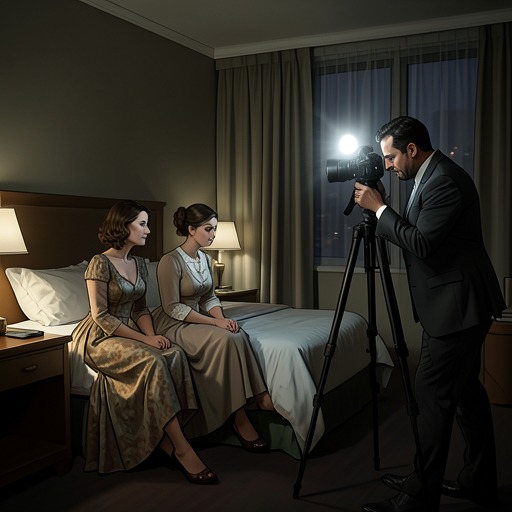
Bateman then uses Mace to blind both women and the butt of the nail gun to render them unconscious. Torri awakens tied over the side of the bed, her lips cut away, while Tiffany is immobilized with six pairs of Owen's suspenders. Bateman positions Tiffany so that she must watch what happens to Torri. He films the deaths with a Minox LX ultra-miniature camera mounted on a tripod, using its 9.5-millimeter film, 15-millimeter lens, exposure meter, and neutral-density filter. A portable CD player plays the Traveling Wilburys over the scene, deliberately muting the victims' screams.
The violence against Torri proceeds through repeated mutilation rather than a single act. Bateman skins parts of her legs and stomach, sprays her with Mace, attempts to cut off her fingers, and pours acid onto her belly and genitals. When these actions do not kill her, he stabs her throat; the knife blade breaks in her neck. He then saws off her head while Tiffany watches. The killing is presented as both torture and spectacle, with the camera, the music, and Bateman's attention to the victim's forced position turning the apartment into a private stage.
The attack on Tiffany is even more methodical. Bateman burns her eyelashes, brows, and eyes with a match and a Bic lighter, drives a dildo into her rectum with the nail gun, removes the flesh around her mouth, and uses a power drill to enlarge the opening. He reaches into her throat and tears out internal tissue before opening her stomach with his bare hands. The account emphasizes not only the brutality of the acts but also their mechanical instruments: the apartment contains, or is made to contain, a drill, acid, nail gun, knives, lighter, camera, restraints, and music, all converted into parts of a procedure.
Staging and Immediate Aftermath
The aftermath is described with the same administrative detachment that governs Bateman's professional and social life. He records no fear or confusion and cannot linger because he has other obligations, including returning videotapes, going to the gym, attending a new British musical on Broadway with Jeanette, and making a dinner reservation. The bodies have entered early rigor mortis, but Bateman has difficulty distinguishing one from the other. One torso has collapsed inward, with broken ribs protruding through what remains of the stomach; a head is nailed to the wall, and fingers are scattered or arranged in a circle around the CD player.
He further contaminates the scene through acts of desecration, including defecation on one body and bite marks across it. With blood taken from a corpse's stomach, he writes I AM BACK above the faux-cowhide paneling and adds a frightening drawing identified in the narrative as a rat. The message turns the apartment into a signature site, but it also resembles a crude theatrical prop: an attempt to give the otherwise confused violence a recognizable author and a continuing identity.
Investigation, Confession, and Uncertainty
The killings remain entangled with the unresolved Paul Owen disappearance. Meredith Powell hires a private investigator to investigate Owen's disappearance, and the investigator later speaks of the case without being affiliated with the FBI. Bateman's conduct is consequently exposed to the pressure of inquiry even though the murders themselves generate no immediate public response. His access to Owen's apartment, Owen's identity, and the missing bodies all belong to the same network of concealment.
During a later night of violence and panic, Bateman calls Harold Carnes and leaves a message admitting everything, including thirty, forty, or a hundred murders. He says he has left a woman in a parking lot near a Dunkin' Donuts somewhere around midtown and describes himself as a sick man. The confession appears to offer a direct revelation, yet it produces no recorded intervention within the episode. Bateman remains protected by anonymity, and the narrative supplies no external confirmation that the call leads to arrest or even recognition.
One hundred and sixty-one days after the killings, Bateman returns to Owen's apartment after working out at Xclusive. He has heard nothing in New York City's newspapers or on local news about two mutilated prostitutes, and he has asked dates and business acquaintances whether anyone knows of such a discovery. The absence of rumor seems impossible to him, but he treats it as evidence that no bodies have been found. At the building, however, his keys no longer fit. A new uniformed doorman opens the lobby and asks whether he is coming in or staying out in the rain; Bateman, carrying a Walkman and a surgical mask intended to deal with the smell, can only give the apartment number, Fourteen-A.
Narrative and Thematic Significance
The episode makes the contrast between Bateman's front-stage identity and his hidden conduct especially stark. Elsewhere he manages appearances through expensive clothes, a prized business card, restaurant reservations, office etiquette, and controlled interactions with secretaries and maître d's. Here those same systems reappear in distorted form: Owen's credit card secures the victims, Owen's apartment supplies the setting, Owen's suspenders restrain Tiffany, and a portable music player manages the soundscape. The instruments of social privilege become instruments of private violence.
The killings also expose the instability of Bateman's narration. The account is highly specific about brands, tools, filming equipment, bodily details, and the written message, yet the outside world supplies no confirming discovery. The later disappearance of the bodies, the changed apartment entrance, and the failure of Bateman's keys complicate every apparent fact. The event therefore cannot be reduced either to a straightforward confession or to a harmless fantasy. Its significance lies in the unresolved pressure between the precise materiality of the description and the absence of consequences that ordinary reality should impose.