Pastels
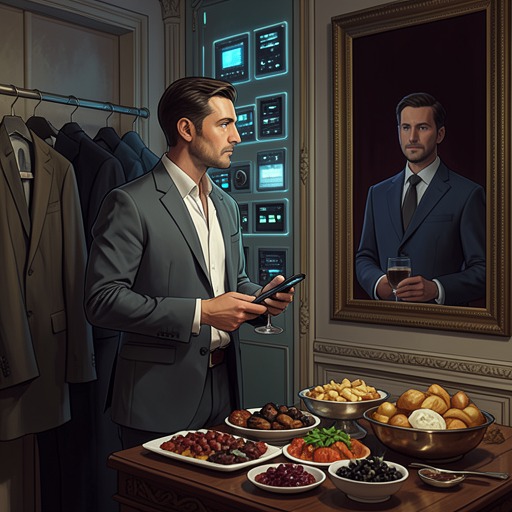
American PsychoPastels is an exclusive Manhattan restaurant where access matters as much as the food. Its difficult reservations, brightly staged interior, attentive maître d', complimentary Bellinis, expensive clientele, and carefully observed clothing make it a social institution rather than a mere place to eat. In the dinner scene involving Patrick Bateman, Timothy Price, David Van Patten, and Craig McDermott, Pastels becomes a compact arena in which privilege is displayed, measured, and defended through connections, money, taste, and composure.
Setting and Reputation
Pastels is presented as a pink, brightly lit restaurant with an overcrowded bar and a main dining room organized around highly desirable tables, including an excellent booth up front. The restaurant's reputation rests on scarcity: obtaining a reservation is described as extremely difficult, so the party's successful entry produces immediate relief and admiration. The setting therefore converts hospitality into a scarce form of social capital. Being seated is evidence that someone possesses the right contacts or the practical knowledge to move through the city's elite institutions.
The party had not secured a table before leaving Water Street. During the taxi ride, the men debate alternative restaurants while anxiety rises to the point that Patrick Bateman nearly tears the Zagat guide in two. Timothy Price objects to the eventual choice but yields after using his portaphone to make the reservation. At Pastels, McDermott knows the maître d' well enough to secure an excellent booth within minutes, despite the restaurant's crowded condition. The maître d' later sends four complimentary Bellinis, confirming that personal familiarity can override the formal scarcity governing everyone else.
The Dinner and Its Social Performance
The restaurant's atmosphere is built from coordinated sensory and status signals. The Ronettes and the Shirelles play over the sound system, the waitress is described through the men's sexualized gaze, and the women at the opposite table are catalogued by designer labels, fabrics, cuts, and shoes. The meal is thus consumed alongside a visible inventory of brands and bodies. Clothing, music, liquor, table position, and service all function as signs through which the diners read one another.
The men perform ease even when the evening has required panic and improvisation. They order drinks despite receiving complimentary Bellinis, and Price, who dislikes the restaurant, appears relaxed once the table and service have been secured. Their jokes about Price's body turn male friendship into another contest of dominance. Patrick's later decision to display his new business card continues the same performance: he removes it from an $850 gazelleskin wallet bought at Barney's and places it on the table while waiting for the others' reactions. Price's response treats the card as though it might be a packet of cocaine, exposing how every object in this environment can be interpreted as a status claim or a commodity.
The bill provides a further test of hierarchy. The total is $475, less than the diners expected, and Patrick charges it to his American Express Platinum Card while collecting the others' mostly fresh fifty-dollar bills because he needs cash. McDermott nevertheless demands ten dollars back, arguing that his scallop-sausage appetizer cost only sixteen dollars. The scene joins conspicuous wealth to petty accounting: substantial spending and minute disputes over reimbursement coexist without contradiction.
Exclusion Beyond the Dining Room
Pastels' polished interior is sharply contrasted with the people left outside it. Before entering, the group passes a homeless man holding a cardboard sign that reads, "I AM HUNGRY AND HOMELESS PLEASE HELP ME." Timothy Price throws at him a napkin containing Van Patten's carefully phrased question for GQ. After the meal, another homeless man asks first for change and then, more hopefully, for food. Patrick responds by commenting on the man's appearance, while Price laughs and suggests that McDermott throw him his tie.
The restaurant therefore produces a boundary between recognized consumers and disregarded bodies. Inside, the maître d' notices missing complimentary drinks and moves quickly to correct the service; outside, hunger is met with ridicule and an object used as a joke. The contrast is not incidental to the location's meaning. Pastels organizes visibility according to status: diners are scrutinized for their labels, reservations, and connections, while homeless people are reduced to obstacles, spectacles, or targets of contempt.
Connections to the Wider Elite Network
Pastels belongs to the same network of institutions through which the characters conduct their professional and social lives. Reservations are arranged through telephones and portaphones; restaurant names circulate as information worth recording; personal access to a maître d' can matter more than advance planning. Elsewhere, Patrick's secretary, Jean, manages reservations and schedules, while office conversations about restaurants turn dining into a routine form of professional and social coordination. Pastels is one node in a larger system of offices, clubs, apartments, and restaurants whose entrances are controlled by staff, lists, names, and informal recognition.
The restaurant's symbolic value also extends beyond the immediate dinner. Craig McDermott later produces a Xeroxed article about Donald Trump and points to its claim about where the best pizza in Manhattan is served. That reference shows how restaurant knowledge circulates as a form of competitive cultural knowledge: the men do not merely eat at places but use opinions about food and venues to challenge one another's authority. Pastels is consequently part of a world in which taste, access, and name recognition are continually converted into social advantage.
Narrative Significance
Pastels concentrates the novel's interest in consumerism, material display, and the interchangeability of elite identities. The diners' personalities are repeatedly expressed through labels, reservations, cards, drinks, and restaurant rankings, yet their apparent confidence depends on fragile arrangements that can fail at any moment. The terror of not being seated, the relief of obtaining the booth, the pride in the business card, and the argument over ten dollars all reveal a culture in which social existence is measured through access and recognition.
The restaurant also exemplifies the contrast between front-stage civility and concealed brutality. Its maître d' performs effortless control, the diners perform sophistication, and the room projects abundance and refinement. Beyond the door, however, the same social order permits casual humiliation of hungry men; within Patrick Bateman's consciousness, polished dining and fantasies of violence occupy adjacent spaces. Pastels thus functions as a miniature of the novel's Manhattan: immaculate in presentation, intensely hierarchical in operation, and sustained by the refusal to recognize the people excluded from its frame.