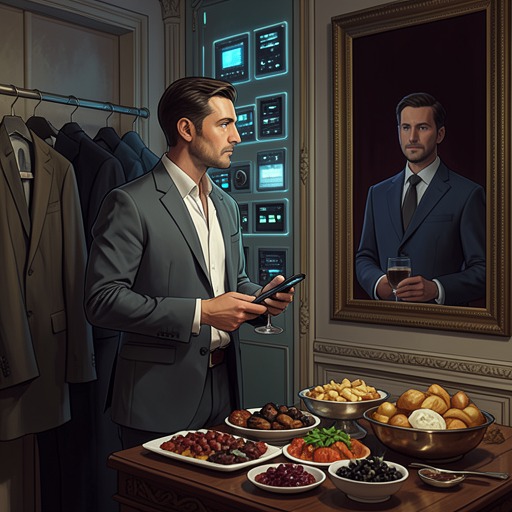
Patrick Bateman's business card
American PsychoPatrick Bateman's business card is a meticulously designed professional accessory whose importance far exceeds its practical function. Presented in a restaurant as an object of admiration and rivalry, it converts a name and occupation into a material performance of rank. Its bone-colored stock and Silian Rail lettering briefly give Patrick Bateman the satisfaction of believing that he has mastered the codes of elite taste, but the card becomes inadequate as soon as David Van Patten and Timothy Price display cards judged more elegant than his. The episode makes the card a decisive emblem of a world in which identity is established through surfaces and recognition depends on competitive consumption.
Design and Material Display
Patrick Bateman introduces the card as a new possession, taking it from a gazelleskin wallet purchased at Barney's for $850 and placing it on the table while waiting for the others to react. He tries to appear casual, yet he is smiling proudly and explains that the printer supplied it only the previous day. Its coloring is not merely described as pale or attractive: Bateman insists that it is “bone,” and he identifies the lettering as “Silian Rail.” The technical vocabulary allows the card to function as a miniature lesson in connoisseurship, distinguishing its owner as someone who knows how luxury should be named as well as displayed.
The card's presentation also belongs to a larger regime of controlled appearance. At another social gathering, Bateman carefully airkisses Courtney Lawrence after removing his black wool Giorgio Armani overcoat, while the new Talking Heads CD plays in the living room. Elsewhere, his private Xclusive health club is defined by expensive amenities, repeated remodeling, specialized machines, personalized programs, and an annual membership fee of five thousand dollars. These details clarify the card's setting: it is one item in a coordinated wardrobe of brands, services, gestures, and spaces through which Bateman's social identity is continually staged.
The Restaurant Competition
The card's meaning changes when Timothy Price, Craig McDermott, and David Van Patten examine it. McDermott handles it with genuine admiration, and Van Patten remarks on its “Cool coloring.” Bateman then identifies the stock and typeface, seeking confirmation that the object has achieved the desired effect. Van Patten offers guarded approval but immediately produces his own card, placing it beside an ashtray. His card is “Eggshell with Romalian type,” and the comparison shifts the scene from appreciation to competition.
Bateman experiences the comparison physically. He notices the elegance of Van Patten's color and type, feels a brief spasm of jealousy, and clenches his fist while attempting to answer that the card is nice. Timothy Price, however, openly prefers Van Patten's card, even while praising Bateman's as very cool. Bateman looks from one card to the other and cannot accept that Price actually likes Van Patten's better. The judgment is devastating precisely because the cards have no meaningful difference as business tools. Their value lies in distinctions visible to this narrow social audience, and a minute difference in shade or typography becomes a public ranking of the men themselves.
Price then produces his own card from an inside coat pocket and turns it over slowly for inspection. The theatrical reveal culminates in his description, “Raised lettering, pale nimbus white…” Even Bateman has to admit that the card is magnificent. The restaurant seems to recede into silence as the men concentrate on the object, and a fresh supply of Bellinis becomes irrelevant beside the card's surface. The scene is therefore not a pause in professional life but a ritual of professional identity, in which the men suspend ordinary conversation to measure one another through paper.
Envy and Social Function
Patrick Bateman's card has an obvious utilitarian purpose: it identifies him in the professional world. Yet the restaurant scene shows that its real function is symbolic and competitive. The card must be seen, handled, compared, and approved. Its effectiveness depends less on transmitting contact information than on producing an impression of refinement before an audience capable of detecting tiny differences. The object operates as a status signal whose meaning is generated relationally: Bateman's card seems impressive until Van Patten's and Price's cards establish a superior scale.
Bateman's response reveals the emotional cost of this system. He does not simply lose a contest over typography; he experiences the other's judgment as an injury to his own position. His attempt to dismiss the matter, handing Price the card as though he does not care, conflicts with the difficulty he has swallowing his jealousy. The card thus exposes the gap between his performed indifference and his actual dependence on recognition. His polished professional persona requires him to appear untouched by comparison, even as comparison governs his attention.
That contradiction recurs throughout his social world. He moves among people who are often mistaken for one another, receives greetings addressed to the wrong names, and encounters figures whose clothing, glasses, ties, and manners make them nearly interchangeable. Luis Carruthers appears at a bar in an unfashionable Chaps suit, striped cotton shirt, silk bow tie, and Oliver Peoples glasses, while the surrounding men treat clothing as evidence of belonging. In this environment, the business card promises stable identity but instead becomes another replaceable surface. It says who Bateman is only within a system where another card can instantly displace his claim.
Limits of Professional Identity
The card's failure anticipates the broader instability of Patrick Bateman's public identity. He remains capable of moving through offices, restaurants, health clubs, parties, and financial circles because he possesses the correct objects and gestures. He wears Ralph Lauren and Polo clothing, uses expensive grooming products, attends Xclusive, and maintains the polished habits expected of his milieu. Yet the same world that rewards his surfaces does not reliably distinguish one man from another. People mistake Bateman for other professionals, and others are mistaken for one another in turn.
The business card is especially revealing because it appears to promise a fixed, legible self. A name printed in distinctive type should stabilize identity, but the card's value is immediately subordinated to aesthetic hierarchy. The more beautiful card wins, and the winner is not determined by work, character, or accomplishment. The object therefore dramatizes the tension between information and ornament: it identifies, but it also disguises; it communicates a profession, but its deeper message is social rank.
Its concentrated symbolism also connects private consumption with the larger city. Bateman can withdraw another hundred dollars from an automated teller simply to make the amount in his wallet an even five hundred, while the same narrative places him among streets marked by hunger, garbage, abandoned social order, and people asking for work or food. The card belongs to the affluent side of that contrast, where paper, clothing, water, club memberships, and restaurant reservations are treated as matters of intense consequence. Its elegance is real as an object, but the surrounding social reality makes the intensity invested in it appear grotesquely disproportionate.
Narrative Significance
Patrick Bateman's business card condenses the novel's concern with consumerism, material display, and the interchangeability of identity into a single scene. The men handle paper as if it possessed an almost sensual power, focusing on color, type, texture, and raised lettering while the restaurant's ordinary world fades into a meaningless hum. The card is not passive decoration: it directs attention, provokes jealousy, organizes social judgment, and turns friendship into rivalry.
The episode also clarifies the relation between Bateman's public composure and the violence of his inner life. Later, he can imagine strangling Luis Carruthers while checking his own perfect teeth in a men's-room mirror, and after a night of shootings he retreats to a new office, signs in, and leaves Harold Carnes a message confessing to “thirty, forty, a hundred murders.” The card scene does not prove that the object causes this violence, but it shows the same structure of mind at work: surfaces are inspected, ranked, and invested with consequences far beyond their practical use. Even the final image of Bateman moving through a city of decay while admiring the gleaming Trump Tower preserves that division between immaculate appearance and collapsing reality. The business card is the polished miniature of that entire order.