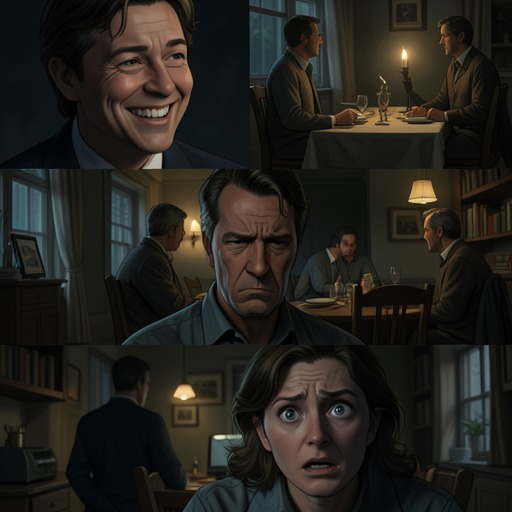
Patrick Bateman–Bethany relationship
American PsychoThe Patrick Bateman–Bethany relationship links Patrick Bateman to a former lover whose reappearance turns an apparently civilized reunion into one of the clearest demonstrations of his destructive intimacy. Bethany is identified as a woman Patrick dated at Harvard who later dumped him; when she encounters him again, her ordinary romantic choices and emotional independence collide with his entitlement, jealousy, and increasingly violent fantasy of possession.
Identity and Earlier History
Bethany belongs to Patrick Bateman’s past rather than his established present. Their relationship began while both were at Harvard, where Patrick says he used to write her long, dark poems quite often before they broke up. The earlier romance therefore carries a trace of an emotional life that Patrick can still imitate in retrospect, even though his current response to Bethany is dominated by calculation and hostility rather than mutual recognition.
Their history resurfaces unexpectedly on a rainy street. Patrick is trying to hail a taxi when Bethany, whom he recognizes as a former Harvard girlfriend who dumped him, appears with an open white umbrella. She is wearing a Christian Lacroix lace-embroidered sweater and viscose-crepe trousers, and the missed taxi leaves Patrick facing her without the practical escape he had been seeking. Their brief exchange of names marks the transition from accidental encounter to deliberate renewed contact.
Reunion and the Performance of Romance
The reunion is arranged as lunch at Vanities, a new Evan Kiley bistro in Tribeca. Patrick is extremely nervous despite having worked out for nearly two hours and lifted weights in his office before noon. He cannot decide whether his anxiety comes from the possibility of rejection or from the sticky Italian mousse in his hair, a revealing fusion of bodily self-surveillance and romantic insecurity. He prepares conversation in advance by trying to read a fashionable short-story collection, then abandons it, drinks J&B followed by two Xanax, and writes Bethany a poem before falling asleep.
The poem recalls the old Harvard relationship, but the preparation also reveals how thoroughly Patrick converts intimacy into presentation. He arrives fifteen minutes late, worries that Bethany may have ended up with Robert Hall, and checks his reflection in a mirror to confirm that his hair looks right. The meeting is thus staged through lateness, grooming, alcohol, medication, clothing, and imagined rivals. Patrick wants the encounter to restore the sexual and emotional access he associates with their earlier relationship, yet he approaches it as an exercise in managing impressions rather than as a reciprocal conversation.
Rejection, Rivalry, and Hostility
Bethany tells Patrick that she is seeing someone. When he presses her to identify the man, she names Dorsia as the restaurant associated with him and asks whether Patrick is all right. Patrick experiences the information as a physical and mental rupture: his perception fills with grotesque images of chef hats, and he immediately asks why she chose Robert Hall. Her relationship has transformed the reunion from a possible reconciliation into a contest he believes he has lost.
Bethany explains that time is running out because her biological clock will not stop and that she wants children. Patrick responds with disbelief and contempt, asking whether she intends to have them with Robert Hall and comparing that prospect derisively with having them with Captain Lou Albano. His reaction turns her reproductive desire into an insult against him. When she asks why she senses hostility, the question identifies the emotional reality Patrick is trying to conceal beneath jokes, restaurant references, and social polish.
Patrick’s hostility also depends on reducing Robert Hall to a sexual category. He blurts out that Hall was gay and insists on the claim after Bethany clearly rejects it. The exchange shows that Patrick cannot accept Bethany’s choice without degrading the chosen man, while Bethany still possesses the power to correct him and to name the hostility he denies. The relationship’s apparent romantic triangle is therefore less a mutual conflict among three lovers than a confrontation between Bethany’s autonomy and Patrick’s demand that her desire validate him.
The Apartment and the Violent Reversal
After the lunch, Bethany accompanies Patrick to his apartment, where the social setting changes from a public restaurant to a controlled private interior. She admires the living room, touches the Wurlitzer 1015 jukebox, and studies the David Onica painting above the fireplace. Patrick locks and bolts the door, pours J&B without ice because his hands are shaking, puts on black leather gloves, and retrieves a new nail gun from an armoire. The apartment’s expensive furnishings and carefully arranged objects become the backdrop and equipment for a concealed change in the relationship.
Patrick’s stated grievance remains Robert Hall, but the violence exceeds any plausible dispute over the rival. When Bethany sees the nail gun and tries to reach the front door, Patrick blocks her and strikes her unconscious four times. He drags her into the living room, nails her fingers to wooden boards, sprays Mace into her eyes, mouth, and nostrils, covers her head with a camel-hair coat to muffle her screams, and continues attacking her when she regains consciousness. He insults her while inflicting the injuries, then sets up a Sony palm-sized Handycam to record what follows.
The scene reverses the expected direction of a romantic reunion. The former girlfriend’s return, Patrick’s poem, and the possibility of renewed sex initially suggest the conventions of reconciliation; the locked door and loaded weapon disclose that Patrick has converted those conventions into a trap. Bethany’s attempt to leave is the final visible assertion of her independence, and Patrick’s blocking of the door turns jealousy into captivity. The relationship consequently ends not through a negotiated breakup but through the collapse of social performance into domination and recorded violence.
Narrative Significance and Uncertainty
Bethany’s relationship with Patrick is important because it concentrates the novel’s conflict between polished appearance and concealed conduct. In public, Patrick is attentive to clothes, restaurants, grooming, and the correct display of composure. In private, the same attention to surfaces supplies a vocabulary and setting for control. The transition from Vanities to the apartment makes the contrast stark: a fashionable lunch permits Bethany to speak about a boyfriend and children, while the apartment allows Patrick to punish her for having a life beyond him.
The broader narrative also makes the aftermath of Bethany’s assault uncertain rather than securely verifiable. Patrick later leaves Harold Carnes a message confessing to numerous murders and says that he left a woman in a parking lot near a Dunkin' Donuts, but Carnes does not respond as though the confession establishes a prosecutable fact. When Patrick insists that he killed Paul Owen and tortured dozens of women, Carnes counters that he had dinner with Paul Owen twice in London only ten days earlier. That contradiction places the Bethany episode within the novel’s unstable first-person account: the violence is described with extreme specificity, while the surrounding world repeatedly fails to confirm Patrick’s version of reality.
This uncertainty does not soften the relationship’s significance. Whether read as literal violence, distorted recollection, or a deliberately unstable fusion of fantasy and action, the Bethany episode shows Patrick treating intimacy as ownership and rejection as provocation. Bethany’s independence, her boyfriend, and her wish to have children are not accepted as facts about another person; they become offenses against Patrick’s self-image. The relationship therefore ends by exposing the failure of romantic reconciliation as a moral framework for him: where ordinary attachment would require recognition of Bethany’s separate will, Patrick answers with concealment, coercion, and destruction.