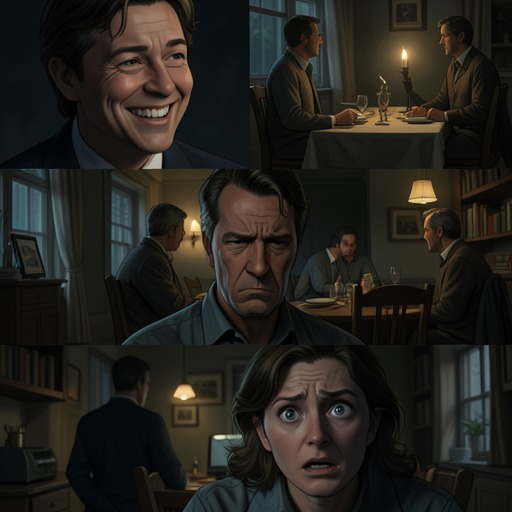
Patrick Bateman's psychopathy
American PsychoPatrick Bateman's psychopathy is the central psychological and narrative condition of his character: it joins homicidal violence to emotional vacancy, social performance, and a corrosive doubt that any stable self exists behind the polished public persona. He privately rejects the image of the harmless "boy next door," identifying himself instead as "a fucking evil psychopath." That split between the agreeable figure recognized by others and the self he acknowledges in isolation becomes the governing contradiction of his conduct.
Identity and Public Persona
Patrick Bateman's psychopathy operates behind an appearance carefully maintained through clothing, manners, professional language, and consumer ritual. In a shop, while presenting himself as an affectionate adult entertaining a child, he waves a platinum American Express card and coos that he is "a total psychopathic murderer" who likes to kill people. The grotesque statement is delivered within an apparently playful exchange, so the social scene converts a confession into a joke and demonstrates how easily his identity can remain hidden in plain sight.
The same performance depends on the indifference and confusion of the people around him. Patrick Bateman is treated as a recognizable, socially acceptable man even while his own narration describes an inner life defined by cruelty. His psychopathy therefore does not merely oppose a normal public identity; it exploits the conventions that make such an identity credible. Politeness, status, expensive objects, and conversational familiarity function as protective surfaces, while the violence beneath them is repeatedly misread as banter, exaggeration, or someone else's problem.
Moral Disengagement and the Dehumanization of Victims
His language before and during violence repeatedly removes moral status from the person being harmed. When confronted with Al's hunger, Patrick Bateman first withholds a five-dollar bill, asks why Al does not get a job, and presents employment as the solution to homelessness. He then offers help in a falsely compassionate manner, telling Al to get his act together and claiming that he will assist him. The performance of charity makes the subsequent assault more disturbing: compassion is not a restraint but another role that can be put on and discarded.
The encounter turns from feigned concern to contempt when Patrick Bateman says that Al reeks and that he has nothing in common with him. He returns the bill to his Luciano Soprani jacket, reaches instead for a serrated knife, and attacks Al while taking care not to kill him immediately. The victim's poverty, smell, hunger, and inability to find shelter are transformed into excuses for disgust. The violence thus reveals a precise pattern of moral disengagement: Patrick Bateman treats Al as an object, frames deprivation as personal failure, and converts the final quarter thrown at him into a mocking substitute for aid. The presence of Gizmo, the dog, does not interrupt the assault; it becomes part of the scene's vulnerable physical spectacle.
The same refusal to recognize another person as fully human appears at the Central Park Zoo. Patrick Bateman lures a child with the offer of a cookie, then abruptly stabs him in the neck. Afterward he hides the child behind a trash can and blends into the crowd, pointing out a penguin to a pretty tourist while the child's feet continue kicking behind him. The mother initially interprets the hiding place as a game, and her delayed recognition of the blood produces a devastating contrast between ordinary parental expectation and the concealed act. Patrick Bateman's ability to resume casual sociability immediately after the attack shows how completely violence and everyday public behavior coexist within his consciousness.
Escalation and the Pleasure of Control
Patrick Bateman's violence is not limited to sudden killing. In the assault on a woman with a nail gun, he blocks her attempt to escape, knocks her unconscious with four blows, drags her into the living room, and nails her fingers to wooden boards. He uses Mace, a camel-hair coat, repeated insults, and a Sony Handycam, turning the attack into a controlled sequence in which restraint, pain, silencing, and recording are all deliberate. The camera makes the act both private and mediated: violence becomes an object to stage, preserve, and revisit.
His psychopathy is consequently marked by an appetite for domination as much as by the fact of murder. He regulates whether a victim can move, speak, see, or breathe freely, and he treats the victim's suffering as material for his own experiment and spectacle. The scene's meticulous attention to tools, surfaces, clothing, and recording equipment places brutality within the same consumerized world as his suits and accessories. The polished environment does not civilize the violence; it gives the violence a setting, a procedure, and an audience of one.
After killing and dismembering a woman, Patrick Bateman attempts to turn her remains into food, abandons the effort as frustrating, and instead smears flesh across the walls, chews pieces of skin, watches Murphy Brown, and later grinds bone, fat, and flesh into patties. A Richard Marx CD, a Zabar's bag of bagels and spices, Xanax taken every half-hour, and the smell of meat and blood that eventually becomes unnoticeable compose a domestic routine around the crime. The banal objects do not soften the scene; they show psychopathy absorbing atrocity into consumption, entertainment, medication, and household activity.
Yet the episode also exposes an unstable emotional residue. His macabre joy sours into weeping, and he cries that he wants to be loved while declaring that principles, morals, prayer, and other inherited distinctions have no final purpose. He reduces existence to the command to die or adapt and imagines a vacant face speaking through him. This distress does not produce remorse or repair. It is another form of self-absorption, in which even the recognition of suffering returns to Patrick Bateman's own pain.
Confession, Evidence, and Unreliable Reality
The disappearance of Paul Owen places Patrick Bateman's psychopathy within an investigative framework that appears to promise external verification. Meredith Powell hires a private investigator to investigate the disappearance, and Donald Kimball reports that an answering-machine message says Paul Owen went to London. Owen's girlfriend doubts the message, while Owen's datebook and secretary place him at dinner with Marcus Halberstam. These records point toward a traceable chronology, but they do not resolve what happened to him.
Patrick Bateman explicitly confesses to Harold Carnes that he killed Paul Owen, chopped off Owen's head, and tortured dozens of women, insisting that the message he left was true. Carnes does not respond as a witness receiving a credible confession. Instead, he treats Patrick Bateman's words as confused or socially inappropriate, and the institutional world around the confession remains unmoved. The collapse of confession into misunderstanding is essential to the psychopathy's narrative form: the acts may be described with absolute certainty by the narrator, yet the world supplies no corresponding acknowledgment.
The contradiction becomes sharper when Carnes says that he had dinner with Paul Owen twice in London only ten days earlier. Patrick Bateman's assertion therefore collides with another person's apparently concrete memory and produces no adjudication. Either the social world is incapable of recognizing him, or the narrative's reality cannot be stabilized through ordinary evidence. The investigation, the datebook, the answering-machine message, and the claimed dinners create competing versions of the same identity rather than a conclusive account.
The Empty Self and the Absence of Catharsis
Patrick Bateman eventually describes himself as an abstraction rather than a real person, an entity that is illusory, fabricated, and without a formed personality. He says that his conscience, pity, and hopes disappeared long ago, perhaps at Harvard, and that no barriers remain. This account does not explain psychopathy as a diagnosis with a recoverable origin; it dramatizes the disappearance of the person who might be expected to answer for the acts. He can describe his heartlessness and the mayhem he has caused while presenting himself as strangely absent from them.
His bleak self-analysis retains one certainty: no one is safe and nothing is redeemed. He admits that he wants his pain inflicted on others, asks whether evil is something a person is or something a person does, and states that repeated acknowledgment of his acts produces no deeper knowledge. The confession has no cleansing effect. It does not lead to punishment, insight, reconciliation, or transformation; it merely repeats the condition it claims to reveal.
That absence of catharsis is the decisive significance of Patrick Bateman's psychopathy. His violence is horrifying in itself, but the surrounding failures of recognition make it socially and narratively larger than individual pathology. He can move between polished sociability, calculated cruelty, self-pity, and explicit confession without crossing into a stable moral reckoning. The result is a portrait of a self whose murderous impulses are enabled by dehumanizing language and protected by a culture of interchangeable identities, while the final revelation remains trapped inside an unreliable consciousness that cannot make its own truth matter.