Paul Owen
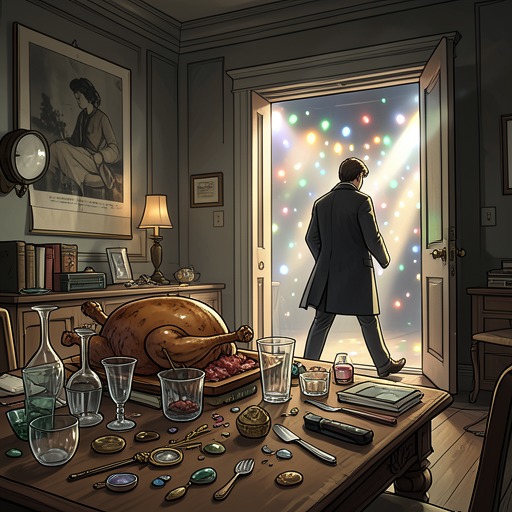
American PsychoPaul Owen is a Wall Street professional whose disappearance becomes the organizing mystery of the investigation conducted by Donald Kimball and the crisis of Patrick Bateman’s narration. He is presented as socially established, professionally connected, and sufficiently recognizable to appear in the same exclusive restaurants, offices, and parties as Bateman’s circle. Yet his apparent solidity is repeatedly undermined: the story offers a missing person, a suspected killing, a carefully prepared crime scene, and finally testimony that places Owen alive in London after the supposed murder. Owen’s importance therefore lies not only in what may have happened to him, but in how his identity becomes unstable within a culture built on interchangeable faces, names, clothes, and financial credentials.
Identity and Social Position
Paul Owen is first identified in conversation as the person shown in a social setting, despite a dispute over whether the man being pointed out is someone else. When Timothy Price insists, "That's Paul Owen," Patrick Bateman immediately contradicts him, saying that Paul Owen is actually on the other side of the bar. The moment establishes Owen as recognizable but also strangely replaceable: even among people who share his social world, a person’s identity can be confused with another man’s appearance.
Owen works on the Fisher account, a professional responsibility that Timothy Price discusses at length during lunch, squash, and drinks at Harry's. His work gives him a definite position inside the financial world, but the narrative does not develop him through biography or private reflection. Instead, it defines him through transactions, appointments, clothes, offices, and the perceptions of other men. When Owen is later seen at the bar, he is wearing a double-breasted wool suit, another carefully legible sign of status in a social environment where appearance functions as evidence of existence.
Disappearance and the Suspected Murder
Owen’s disappearance is connected to a wider atmosphere of elite social violence. A newspaper report describes two people who vanished during a party aboard a yacht belonging to a New York socialite. Blood residue and three smashed champagne glasses are found on the deck, while the police suspect that a machete may have been used. No bodies are recovered, and there are no suspects. Although this report does not identify Owen, it supplies the social and narrative environment in which his own disappearance is understood: wealth, entertainment, unexplained bloodshed, and an absence of reliable physical proof coexist without interrupting the ordinary routines of the privileged.
The account later shifts from rumor to an alleged personal crime. Patrick Bateman arranges to meet Owen for dinner at Texarkana under the name Marcus Halberstam. Bateman chooses the restaurant partly because he expects few acquaintances to be present there. Owen becomes heavily intoxicated during the meal, allowing Bateman to make him pay the $250 check, admit that he is a fool, and accompany him back to Bateman’s apartment. There, Owen opens a bottle of Acacia that Bateman believed he had hidden and sits among newspapers spread across the floor to protect the polished white-stained oak from blood. Bateman retrieves an axe from the shower, takes Valium, puts on a raincoat, and approaches Owen as he looks through Bateman’s CD collection. The scene presents murder as a planned continuation of domestic arrangement: alcohol, drugs, clothing, furniture, music, and newspapers are all incorporated into the preparation.
Investigation and Documentary Contradictions
Meredith Powell hires Donald Kimball, a private investigator, to investigate Owen’s disappearance. Kimball is not with the FBI, but his questions introduce a competing structure of evidence into a narrative otherwise dominated by Bateman’s assertions. One apparent clue is a message on Owen’s answering machine stating that Owen had gone to London. Owen’s girlfriend does not believe that explanation, leaving the message suspended between ordinary travel information and a possible attempt to manufacture a false trail.
Kimball’s reconstruction places Owen at dinner with Marcus Halberstam on the night in question, a detail verified by Owen’s secretary. Kimball has also questioned Halberstam. This evidence seems to draw Bateman directly into the disappearance, because Bateman has arranged his own encounter with Owen under that name. The investigation consequently turns professional aliases, appointment books, secretarial verification, and remembered meetings into competing versions of the same identity. Owen’s disappearance is not merely a missing-person case; it is a conflict between records that appear objective and a narrator whose account continually distorts the status of what has occurred.
Bateman’s Confession and the Uncertain Outcome
Bateman later tells Harold Carnes that he killed Owen, chopped off Owen’s head, and tortured numerous women. He insists that the message left on Carnes’s answering machine was true and demands that Carnes acknowledge the confession. Carnes, however, treats Bateman’s statements as incoherent or absurd rather than as a prosecutable admission. The social setting absorbs the confession as another embarrassing disturbance, and Bateman cannot force his version of Owen’s fate into public recognition.
The decisive contradiction comes when Carnes says that he had dinner with Paul Owen twice in London only ten days earlier. This testimony does not simply deny Bateman’s confession; it attacks the presumed chronology on which the confession depends. If Carnes’s memory is accurate, Owen was alive after the dinner at which Bateman claims to have killed him. If Bateman’s account is accurate, Carnes’s statement is impossible. The narrative offers no stable external resolution, leaving Owen’s death, disappearance, and continued existence suspended between competing testimonies.
Narrative and Thematic Significance
Owen functions as a test of identity in a world where names and faces are routinely exchanged. Bateman’s confusion of social figures, his use of Marcus Halberstam’s name, and the investigation’s reliance on calendars and secretaries all suggest that professional identity is produced by surfaces and administrative traces rather than by intimate knowledge. Owen can be pointed out incorrectly, located through a datebook, reported absent through a machine-recorded message, and then recalled as alive in London without the surrounding society necessarily reaching a secure conclusion.
His role also exposes the difference between confession and proof. Bateman speaks with apparent certainty about Owen’s murder, but the surrounding world supplies no conclusive body, no dependable acknowledgment, and no clear legal consequence. The resulting uncertainty belongs to the novel’s unreliable narration: Owen is central precisely because his fate cannot be separated from the instability of the account that reports it. Whether he is dead, missing, or alive elsewhere, Paul Owen remains the figure through whom the story makes private violence collide with public indifference and shows how easily a human being can become an unresolved entry in a system of names, schedules, and appearances.