Paul Owen's apartment
American PsychoPaul Owen's apartment is the central private space in which Patrick Bateman's polished professional world turns into concealed violence. It first appears as an expensive, controlled interior whose surfaces can be rearranged, protected, and repopulated with almost no visible trace of what occurred there. Its significance lies in that contradiction: the apartment is a place of possession and status, but also a temporary killing ground whose apparent cleanliness allows the surrounding social order to continue undisturbed.
Interior and Social Function
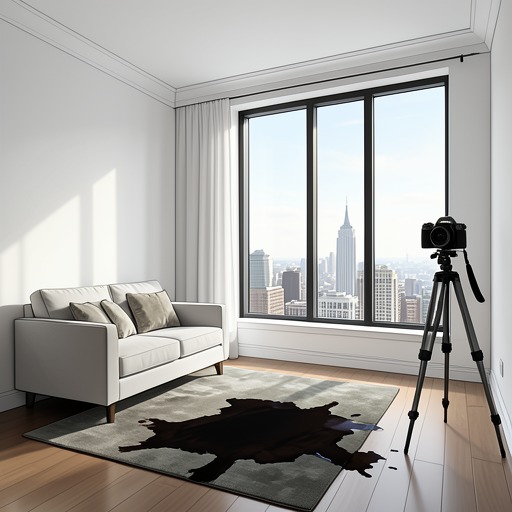
The apartment belongs to Paul Owen and is presented through the consumer goods and design features that define the financial elite's domestic environment. Its polished white-stained oak floor, cowhide paneling, mural, glass coffee table, Thonet chairs, black leather couch, Venetian blinds, and large-screen television make it less a personal refuge than a carefully assembled display of taste. Even the objects surrounding its later transformation retain the logic of luxury consumption: a Conran's folding chair, Ralph Lauren luggage, Brooks Brothers suits, Barney's accessories, and other branded possessions become part of the room's social vocabulary.
The apartment is also connected to a wider Manhattan circuit of offices, restaurants, clubs, taxis, and high-end retail. Patrick moves through these spaces with the same attention to clothing, reservations, business cards, and service rituals that governs the apartment's appearance. The contrast is especially stark because the exterior world contains visible poverty and exposure: a homeless man and his dog sleep beside garbage and a shopping cart, while privileged interiors remain guarded by doormen, locked doors, and conventions of recognition. The apartment therefore participates in the city's spatial separation between those whose belongings and bodies are protected and those whose presence can be ignored.
Murder and Concealment
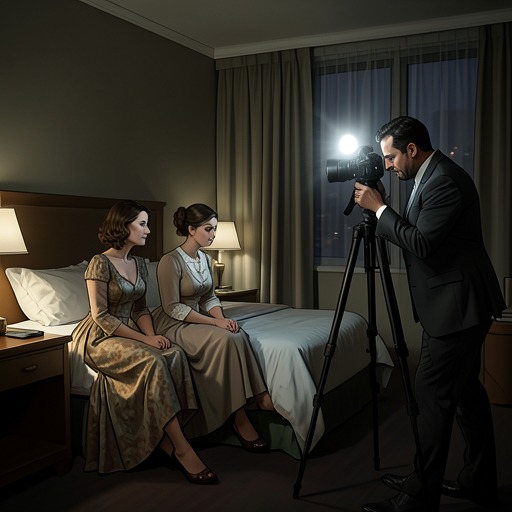
Patrick brings Paul Owen back to the apartment after Owen becomes so drunk that Patrick makes him pay a $250 dinner check and admit how foolish he is. Owen opens a bottle of Acacia that Patrick believed was hidden, using a Mulazoni sterling silver wine opener, while he looks through Patrick's CD collection near the stereo. The domestic setting initially retains the air of an ordinary evening, but Patrick has already prepared it for violence: newspapers, including USA Today, W, and The New York Times, cover the floor to protect the polished oak from blood.
Patrick takes an axe from the shower, swallows two five-milligram Valium with a tumbler of Plax, puts on a cheap raincoat, and approaches Owen as Owen sits in a white aluminum folding chair. The apartment's objects are thus reassigned from decoration and comfort to instruments and safeguards. The raincoat conceals Patrick's clothing, the newspapers anticipate bodily damage, and the chair places Owen in a controlled position. The room becomes a backstage area in which the outward identity maintained in restaurants and offices is replaced by deliberate preparation for murder.
After the killing, Patrick treats Owen's body as a logistical problem rather than as evidence of a human death. He wraps the corpse in four cheap terry-cloth towels, places it fully dressed and headfirst into a Canalino goose-down sleeping bag, and drags it through the elevator and lobby past the night doorman. He then takes it by taxi to the abandoned building in Hell's Kitchen, carries it up four flights of stairs, places it in an oversized porcelain tub, strips off Owen's Abboud suit, wets the body, and pours two bags of lime over it. The apartment is therefore not merely the site of violence; it is the first stage in a process of transport, disposal, and attempted erasure.
Performance, Access, and Invisibility
The apartment's concealment depends on the same social mechanisms that protect Patrick elsewhere. People identify one another through clothing, brands, professional affiliations, reservations, and familiar faces, yet these signals repeatedly produce confusion rather than reliable recognition. Patrick's confidence that his voice resembles Owen's closely enough to sound identical over the telephone allows him to alter Owen's answering-machine message and announce that he will send him to London. He packs Owen's suits, passport, travel equipment, and personal accessories into a Ralph Lauren suitcase, creating the material impression of continued travel rather than disappearance.
This performance is reinforced by the apartment's capacity to absorb disruption. Patrick switches on a Panasonic television, changes the answering-machine message, and appropriates Owen's possessions, while the ordinary media environment continues in the background. The domestic scene is not presented as a place where truth is discovered but as a surface onto which a plausible story can be fitted. Professional identity, travel documentation, clothing, recorded speech, and expensive luggage become interchangeable signs, allowing absence to be managed as if it were merely a change of itinerary.
Return and Apparent Restoration
Patrick later returns to Owen's apartment and finds that the locks have been changed. He remembers that he has never been back since murdering the two women there, yet he approaches the door trembling, conscious that the place may contain the material confirmation of his crimes. A middle-aged real-estate broker emerges and mistakes him for a prospective visitor, asking whether he is her eleven o'clock appointment. Patrick denies being that person, and the broker leaves after regarding him with a strange expression.
Inside, a couple in their late twenties confer in the living room as if the apartment were an ordinary property on the market. The woman holds an Evian bottle and wears expensive clothing; the man carries a carefully specified wardrobe and outer coat. The apartment itself appears spotless. The new Venetian blinds are in place, the cowhide paneling has disappeared, and the television has been moved, but the mural, glass coffee table, Thonet chairs, and black leather couch remain. This combination of alteration and continuity unsettles Patrick's memory: the room has been renovated enough to deny its former state while preserving enough of its recognizable structure to make the disappearance of evidence more disturbing.
The return converts the apartment into a test that yields no stable answer. Patrick's recollection insists that murder occurred there, but the real-estate scene supplies no public acknowledgment, no visible remains, and no consequence that can be verified from the room itself. The apartment's restored marketability does not prove that Patrick's account is true or false; instead, it dramatizes the novel's unreliable relation between confession, memory, and social fact. A space that has absorbed murder can be shown, cleaned, sold, and occupied without its history becoming legible.
Narrative Significance
Paul Owen's apartment condenses the book's contrast between appearance and reality. At restaurants and clubs, Patrick performs elegance through clothes, manners, reservations, credit cards, and professional language; in the apartment, those same signs become tools for concealment. The room's polished surfaces mirror a social world trained to read status but poorly equipped to recognize suffering, disappearance, or guilt.
The apartment also links private violence to the larger urban system. Patrick travels from elite dining rooms and corporate anonymity to a controlled domestic interior, then from that interior to an abandoned building in Hell's Kitchen. His route crosses sharply unequal spaces, but the institutions and people along it fail to produce meaningful scrutiny. Later, when he returns and sees strangers examining the apartment as a clean, valuable commodity, the property market appears capable of converting even a suspected crime scene back into an asset.
Its final force is therefore structural rather than merely Gothic. The apartment does not simply hide a murder; it shows how identity, ownership, wealth, and repetition can make a violent past indistinguishable from ordinary urban continuity. Patrick's later confession to Harold Carnes, in which he claims responsibility for dozens or a hundred murders while police activity unfolds elsewhere, intensifies this uncertainty. The apartment remains an apparently intact room, and that intactness is precisely what makes it one of the clearest symbols of the novel's social numbness and its refusal to provide a secure exit from the contradictions of Patrick's narration.