Rats
American PsychoRats are among the narrative’s most persistent nonhuman presences. They first appear as an urban rumor, then as invasive household pests, experimental victims, and finally participants in Patrick Bateman’s most extreme violence. Their recurrence turns them into more than background vermin: they expose the unstable boundary between animal and human, living creature and commodity, private fantasy and material reality.
Urban Rumor and Manufactured Dread
At a facial appointment, Patrick reads a story in the Post about creatures discovered in Harlem and moving toward midtown. They are described as part bird and part rodent, essentially pigeons with the heads and tails of rats. The newspaper presents the photograph as probably fraudulent, but that explanation does not reassure him. His fear is directed not only at the supposed animals but at the elaborate human process that produced and circulated the hoax: someone invented the image, sent it to the newspaper, editors debated whether to publish it, experts were consulted, and the story reached hundreds of thousands of readers. Rats therefore enter the book through a chain of mediation, publicity, and consumption, where even an alleged creature becomes part of the city’s information economy.
The episode also establishes the characteristic ambiguity surrounding the animals. The photograph may be a crude fake, yet Patrick’s response is genuine enough to leave him exhausted. The possibility of rats is less disturbing than the possibility that people have invested time and institutional energy in fabricating them. This makes the rat an emblem of a wider anxiety: the apparently solid world of newspapers, experts, photographs, and public discussion may be as artificial and unstable as the monstrous animal itself.
Household Invasion and Capture
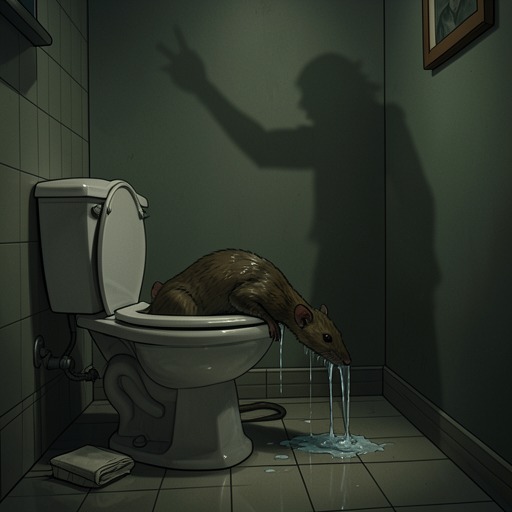
A rat later emerges from the toilet in Patrick’s apartment. The large, wet rodent shakes itself dry on the rim before scrambling across the bathroom floor and into the kitchen, where it attacks a leftover Le Madri pizza bag placed near the garbage. Patrick is taking Halcion and is less disturbed than he believes he should be, a detail that links the animal’s intrusion to his chemically dulled perception. The rat is at once a threat, a nuisance, and another object within the apartment’s carefully managed luxury.
Patrick buys an extra-large mousetrap and baits it with an entire wedge of Brie, a sun-dried tomato, and dill. Because of the rat’s size, the trap fails to kill it. The injured animal lies squeaking and thrashing, its oily pink tail striking the white oak floor, while Patrick spends more than an hour searching for a dustpan. He eventually moves it into a Bergdorf Goodman hatbox, but it claws its way out, forcing him to confine it beneath a board in the sink. The sequence places expensive furnishings, branded goods, and domestic tools beside a wounded animal, making the apartment’s polished order physically vulnerable to something wet, hungry, and uncontrolled.
The captured rat also becomes a repository for Patrick’s violent imagination. While it struggles beneath the board, he thinks of ways to torture girls with it and produces a list of mutilations. The animal has not yet been used in an assault, but its containment converts it into a device for imagining one. Its status changes from intruder to instrument, and the transition reveals how quickly Patrick’s consumer environment becomes a workshop for cruelty.
The Rat as Experimental Victim
Patrick keeps another rat in a glass cage attached to an elaborate Habitrail system on the kitchen table. During a telephone conversation about clothing and restaurant plans, his attention shifts from the voices to the animal. The rat has an acid-ravaged body and struggles halfway across the system toward water that Patrick has poisoned with Evian. He cannot decide whether the scene is too pitiful or not pitiful enough. That uncertainty is crucial: pity has not disappeared entirely, but it has become indistinguishable from detached observation and aesthetic judgment.
The caged rat’s suffering is organized like a consumer display. The Habitrail is a manufactured environment, the water is a branded bottled product, and the animal’s pain unfolds while Patrick conducts ordinary social business. In this setting, cruelty is not an interruption of his lifestyle; it is another activity performed alongside calls, meals, clothing decisions, and preparations for going out. The rat’s body is treated as a controllable object, and its distress becomes something Patrick watches for stimulation rather than something that demands intervention.
The pattern intensifies when Patrick starves the rat for five days and places it beside a murdered girl. The animal hurls itself against the glass, then races through a Habitrail tube toward the scent of cheese. Patrick uses the tube as a conduit into the girl’s body, trapping the rat inside her. After the girl is cut apart, the rat emerges stained with blood; Patrick feeds it more Brie and then stomps it to death. The rat is simultaneously predator, victim, prop, and disposable equipment. Its hunger supplies the mechanism of the assault, while its own death completes the scene’s logic of consumption: the animal is lured, used, fed, and destroyed.
Animalization and Narrative Significance
The book repeatedly places rats within a continuum that includes other animals and human bodies. At a dinner hosted by Evelyn, Stash points accusingly at a piece of sushi and announces that it moved. Timothy responds with contempt, while Patrick compares Stash to a monkey and treats Courtney’s attraction to him as another form of animal appraisal. Although this scene does not contain a rat, it helps establish the narrative’s habit of converting social difference into animal imagery and of judging bodies according to appearance, breeding, clothing, and market value.
The same logic appears in the encounter with the homeless man and his dog, Gizmo. The dog is emaciated, tied to a shopping cart, and initially overlooked before Patrick returns and notices it guarding its owner. Patrick then kills the dog and its owner with a knife and silencer. The scene places animals and socially abandoned people within the same field of dehumanizing perception: both are seen through smell, bodily degradation, poverty, and vulnerability, and both can be converted into targets. Rats make that continuum especially visible because they are conventionally treated as disposable urban matter, yet the narrative gives them repeated, concrete bodily presence.
At the Central Park Zoo, Patrick also sees a penguin that resembles Craig McDermott before approaching a young child. The zoo’s animals appear stained, drugged, bored, or mechanically displayed, while fake penguin noises play for spectators. This setting echoes the rat scenes: animals are enclosed, watched, and consumed as entertainment, and Patrick responds by violating the rules of the exhibit and turning observation toward violence. Across these episodes, nonhuman life is rarely granted an independent position outside human systems of ownership, spectacle, experimentation, and abuse.
Reality, Repetition, and the Unstable Body
Rats recur whenever the distinction between reality and fantasy becomes difficult to maintain. The alleged rat-headed birds may be a hoax; the apartment rat is unmistakably physical; the caged animal is subjected to methodical experiments; and the later rat assault is narrated with such grotesque precision that its materiality competes with the narrator’s emotional emptiness. In each case, the animal’s body interrupts the smooth surface of Patrick’s world. A toilet, a pizza bag, a glass cage, a bottle of Evian, and a luxury apartment become contact points between consumer order and uncontrolled organic matter.
The final image of the apartment’s aftermath gives the motif its most disturbing form. Decay fills the room, and the dead woman’s body is described through colors, food-like textures, and animal associations. Patrick imagines that a brown fluid from her body smells as though the rat had been forced back inside her and digested. The image collapses human and animal anatomies into one contaminated substance. Rats thus function as recurring figures of invasion and appetite, but also as mirrors of the narrative’s larger collapse of categories: person becomes object, object becomes weapon, animal becomes spectacle, and violence becomes another consumable image. Their significance lies precisely in that repetition, which makes the rat less a single creature than a persistent sign of a world unable to preserve meaningful boundaries between life, merchandise, and waste.