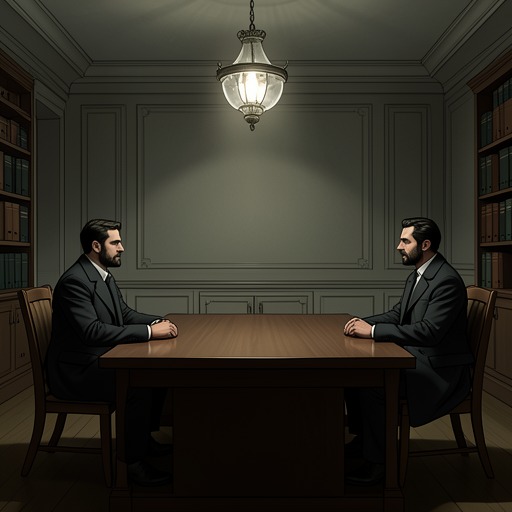
Sean Bateman
American PsychoSean Bateman is Patrick Bateman's brother and one of the clearest figures through whom the novel displays familial hostility without meaningful emotional connection. Their relationship is openly reciprocal in its contempt, yet it is also structured by money, family expectations, fashionable venues, and the rituals of upper-class sociability. Sean's birthday dinner becomes less an act of celebration than a hostile negotiation in which Patrick tries to control the setting, humiliate his brother, and extract information about his life.
Identity and Family Position
Sean is present chiefly through Patrick's resentful, unstable perspective, which makes him less a fully accessible personality than a social rival and familial irritant. Patrick states that he despises Sean and that Sean returns the feeling unambiguously. The birthday occasion nevertheless draws them together because their father's accountant, Charles Conroy, and the trustee of their father's estate, Nicholas Leigh, want to use Sean's presence in New York to ask what he is doing with his life and whether he will go to the Hamptons. Family obligation therefore appears not as affection but as administrative supervision conducted through expensive dinners and inherited connections.
Patrick treats Sean's birthday as an opportunity for coercion rather than goodwill. He and the family representatives lure Sean to dinner by implying that something bad has happened, while Patrick privately considers how to make the evening painful. He rejects Pastels and Dorsia as possibilities for the initial plan for the Quilted Giraffe, deciding that the dinner should be expensive but unpleasant for Sean. The restaurant is selected from a Zagat guide as the most expensive restaurant in Manhattan, an apparently celebratory gesture converted into an instrument of class pressure.
The Birthday Dinner
The arrangements repeatedly reveal how little control Patrick actually has. Sean first calls from the Racquet Club to say that he has spoken with Brin, the owner, and secured a table at Dorsia for nine o'clock. Patrick is left unsure what to think or feel, while the repeated reference to a Patty Winters Show segment about salad bars gives the scene a deliberately banal and dislocated texture. When Sean arrives late, the maître d' refuses to seat Patrick until his brother appears. Patrick waits in a prime booth across from the bar, using Xanax and Absolut to keep his rage under control, while Sean's absence becomes an exaggerated affront.
Sean eventually appears already seated in the booth he reserved, chain-smoking and having ordered Cristal with the expectation that Patrick will pay. He does not drink champagne, a fact Patrick knows, so the order functions as another small act of provocation or entitlement. Sean shakes hands with the maître d' without introducing him to Patrick, and the brothers exchange only a nod. The scene's polished setting cannot produce civility; its luxury instead provides a stage on which indifference and aggression can be performed with impeccable social surfaces.
Their conversation is similarly stripped of intimacy. Patrick asks what Sean did that day, and Sean answers that he played squash with Richard Lindquist and bought a tuxedo. When Patrick raises the questions from Nicholas Leigh and Charles Conroy about the Hamptons, Sean gives no indication that he will submit to their plans. Patrick considers embarrassing him with a birthday cake and candle but does not do so, choosing verbal control and sustained resentment over an openly childish gesture. After the small but very good meal, which Sean touches little, Patrick invents an appointment with Andrea Rothmere at Nell's and then improvises Chernoble when he needs another destination. Sean responds that Nell's is no longer especially fashionable, treating even Patrick's excuse as a matter of club-world status.
Social Performance and Rivalry
Sean's importance lies less in any demonstrated interior development than in the way he participates in the same system of display that Patrick both inhabits and despises. The brothers move through the Racquet Club, the Carlyle, Dorsia, and other elite settings as though restaurants, clothing, cigarettes, and reservations were the available grammar of identity. Sean is staying in their father's suite at the Carlyle, and the family connection gives him access to spaces and symbols that Patrick nevertheless experiences as competitive possessions. His tuxedo, squash game, cigarette, and expensive restaurant reservation establish a recognizable social performance, but none of these details supplies a stable purpose.
Patrick's own performance is equally dependent on objects and settings. He wants to make Sean endure the dinner, prevent him from being distracted by fashionable people going to Nell's, and expose what Patrick assumes is his brother's chronic cocaine use through the ritual of a men's-room attendant. The attempt to dominate Sean through taste and expense mirrors Patrick's conduct elsewhere, including his proud presentation of his new business card at a restaurant. In both cases, status objects are used as tests of superiority, and the audience's reaction matters more than any practical function.
The brothers' hostility also exposes the interchangeability of identities within their circle. Patrick's account repeatedly places names, restaurants, clothes, and professional roles in competition, while people are reduced to appearances, connections, or usefulness. Sean is therefore not simply Patrick's opposite. He is a nearby version of the same privileged world, close enough to threaten Patrick's distinction and distant enough to be treated as disposable. The family relationship intensifies the rivalry because it makes comparison unavoidable while offering no language for care.
Relation to Patrick's Crisis
Sean's presence coincides with Patrick's growing sense that his life contains no coherent motive. While sitting at Dorsia, Patrick keeps thinking of reasons for being there but finds none; an infinitely recurring zero floats into view. This emptiness is not relieved by the birthday, the restaurant, the champagne, or the prospect of nightlife. Sean becomes the immediate target of Patrick's frustration, but the dinner also reveals that Patrick's aggression is directed at a void within the social world itself.
Patrick's thoughts turn from humiliation to disappearance and death. In the men's room, before Sean arrives, he imagines that the world might be better off with certain people gone and treats Sean as one of the people who need not be present. The thought does not produce a meaningful moral decision or a recognizable familial conflict; it is another rapid movement between consumer detail, resentment, fantasy, and nihilistic abstraction. Sean's role in the scene is therefore consequential even when he does little: his presence gives Patrick's diffuse hostility a family target.
The same instability appears in Patrick's conduct toward other people. During an encounter involving Luis Carruthers, Patrick's jealousy turns toward fantasies of strangling or killing Luis, while his thoughts remain entangled with Courtney Lawrence's body, Evelyn Richards's demands, and questions about whether anyone would notice another person's absence. Sean belongs to this same imaginative economy of replacement and removal. Patrick does not experience family, romance, friendship, or professional identity as secure bonds; he experiences them as arrangements that can be interrupted, exchanged, or erased.
Narrative Function and Significance
Sean is also connected to the novel's larger crisis of mistaken identity and unreliable narration. Patrick is later investigated by Donald Kimball regarding Paul Owen's disappearance, although Kimball reports that an answering-machine message placed Owen in London and that Owen's datebook, verified by his secretary, recorded dinner with Marcus Halberstam. Patrick then insists to Harold Carnes that he killed Paul Owen and tortured numerous women, but Carnes replies that he had dinner with Owen twice in London only ten days earlier. These contradictions make every apparently stable identity in Patrick's world suspect.
Within that structure, Sean functions as a familial mirror rather than a clarifying witness. He shares Patrick's access to elite institutions and expensive rituals, yet the account provides no dependable evidence that he understands Patrick's violence or can interpret the disorder beneath the surface. Their birthday dinner seems to promise family knowledge—questions about Sean's life, plans for the Hamptons, and the family's future—but yields only cigarettes, champagne, lateness, evasions, and an invented itinerary. Sean's significance is precisely this failure of the family setting to create recognition. The brothers can occupy the same booth and still remain sealed inside separate performances, while Patrick's narration turns their proximity into another proof that the world contains polished surfaces but no reliable human connection.