Sony Walkman
American PsychoThe Sony Walkman is one of the most persistent objects in Patrick Bateman's world, linking conspicuous consumption to private disorder. It begins as an expensive-looking accessory worn around the neck and ends as an unbearable weight that Patrick throws into a trash can during a breakdown. Across these appearances, the device helps organize the contrast between the immaculate surface of Wall Street life and the unstable consciousness moving beneath it.
Status Object and Social Access
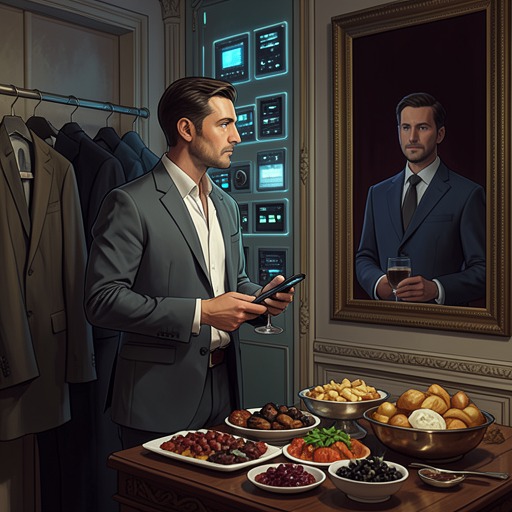
The Sony Walkman first appears in the cab leaving Wall Street with Timothy Price. Price removes the expensive-looking player from around his neck and places it inside a new Tumi calfskin attaché case alongside a Panasonic cordless phone. The gesture places the device within the same inventory as designer luggage, communications technology, and carefully selected clothing: it is not merely something used for listening but part of the visible equipment of professional success.
The device also belongs to a world in which music, consumer electronics, and workplace identity are fused. Price complains that New York City would be tolerable if its taxis contained better Blaupunkt sound systems, naming particular dynamic tuning systems as markers of being “very hip.” The Walkman therefore represents a portable version of the same technological and consumer fantasy. It offers individual control over sound while confirming membership in a culture that treats brand knowledge as social competence.
At Evelyn Richards's brownstone, the new Talking Heads CD plays softly in the living room while Patrick and Price arrive late, dressed in Armani overcoats and other highly specified designer clothes. The Walkman is not foregrounded in that entrance, but its relation to the CD places both objects inside the same carefully staged environment. Music supplies atmosphere, while clothing, manners, and accessories supply identity; together they form the props of a social performance whose precision is repeatedly more memorable than the people conducting it.
Routine, Maintenance, and Controlled Surface
The Walkman is embedded in Patrick's domestic grooming ritual as well as in his nightlife. After an elaborate shower, shaving, moisturizing, hair-styling, and clothing routine, he puts the Talking Heads CD into the player, only to hear it digitally skip. He removes the disc and inserts a CD laser lens cleaner, explaining how dust, smoke, pollutants, moisture, and residue can produce false starts, inaudible passages, speed changes, and distortion. Once the lens has been cleaned, the CD plays smoothly again.
This small episode turns the device into a model of Patrick's preferred world. Malfunction is treated as contamination to be removed through a specialized product and a prescribed procedure. The desired result is not discovery or spontaneity but smooth playback, just as Patrick's grooming seeks a controlled appearance without visible friction. The Walkman and its associated technology make the ideal of surface coherence material: when the mechanism works, disorder disappears into uninterrupted performance.
The object also travels through Patrick's crowded social circuits. At Tunnel, while waiting for drugs, he takes drink tickets from Price, orders an Absolut for him and a J&B for himself, and returns with the vodka. Price drinks it in one gulp and responds with an accusatory look; Patrick shrugs. The Walkman is part of this scene's sensory and social machinery, accompanying a night in which branded alcohol, bodies, drugs, and music are exchanged with the same casual fluency. Its portability allows Patrick to carry a curated soundtrack across spaces that otherwise demand different performances.
Sound, Displacement, and Possession
The device's most consequential appearance comes during Patrick's August crisis. After a confused telephone conversation with Jean, who relays restaurant reservations and messages from other acquaintances, Patrick hangs up and finds that the Walkman around his neck suddenly feels like a boulder strapped to his throat. Early Dizzy Gillespie, once merely recorded sound, becomes intensely irritating. He throws the cheap player into the nearest trash can and clings to the rim while breathing heavily.
The destruction of the Walkman marks a sharp reversal in its function. Earlier, technology helped Patrick regulate his surroundings and display his position; here, it becomes an invasive weight attached to his body. The object is no longer a transparent accessory or useful instrument. Its material presence breaks through the polished routine, and Patrick's inability to tolerate it coincides with sweating, physical pain, hunger, compulsive movement, and a rapid succession of disturbing acts, including buying knives, an axe, hydrochloric acid, a Habitrail, and two white rats before abandoning the package.
Yet even after the player is discarded, music continues to structure Patrick's movement through Manhattan. A Madonna song rises from stores as pedestrians move with its beat, and the words “life is a mystery, everyone must stand alone” accompany his unstable attempt to recover normality. The loss of the Walkman does not free him from mediated sound; it reveals how thoroughly his perception has been organized by commodities, recordings, advertisements, and urban noise.
The Device Within an Unreliable World
The Walkman also participates in the novel's uncertainty about what has happened and what Patrick has merely narrated. It appears beside the three copies of Sports Illustrated on Patrick's desk when Donald Kimball arrives to investigate Paul Owen's disappearance. Patrick closes the magazines and slips them, along with the still-running Walkman, into the desk's top drawer before trying to appear conversational. The device is thus placed beside evidence of distraction and concealment, while Kimball's inquiry introduces the external possibility of verification.
Later, after Patrick describes a night of shootings and escapes, he reaches his new office, signs in with Gus, and uses a cordless phone to call Harold Carnes. He leaves a message confessing to dozens or hundreds of murders, while police vehicles, ambulances, flares, and a SWAT team gather across Manhattan. The Walkman is absent from the immediate action, but its earlier role clarifies the larger pattern: objects can be named with obsessive precision while the events surrounding them remain unstable, unverifiable, or absorbed into Patrick's shifting performance.
Narrative Significance
The Sony Walkman condenses the book's movement between public display and private collapse. It is valuable because it is recognizable as a status object, useful because it supplies controlled sound, and threatening because its physical weight becomes impossible for Patrick to ignore. Its recurring presence beside designer goods, alcohol, music, phones, and business materials shows a life assembled through purchasable signals rather than stable personal relations.
Most importantly, the Walkman exposes the limits of Patrick's control. A device intended to isolate its wearer from the surrounding city cannot prevent the intrusion of traffic, telephone confusion, bodily pain, or violent impulse. When Patrick throws it away, the act is neither a lasting liberation nor a clean symbolic resolution. It is a brief material rupture in the system of surfaces he normally inhabits, after which the city, its music, and its commodities continue to press upon him.