The Hamptons
American PsychoThe Hamptons functions in the novel as a geography of wealth, escape, and moral continuity rather than genuine release. Patrick Bateman first encounters it as a status symbol in Timothy Price’s anxious account of professional life, then turns to it during a period of psychological and homicidal crisis. The retreat ultimately changes the setting without changing the social order or the narrator’s condition: the same luxury, possession, and emotional vacancy follow him out of New York City.
Status and Social Geography
The Hamptons enters the narrative through Timothy Price’s self-presentation. While riding in a cab leaving Wall Street, Price insists that he is young, skilled, motivated, and indispensable, yet complains that his work does not pay enough and that returning to Los Angeles is unacceptable. His claim that he has a cooperative apartment in New York City and a place in The Hamptons turns private property into evidence of personal worth. The Hamptons is not described as a landscape at this point; it is a credential, one more possession through which Price measures his position among his peers.
That claim belongs to the same competitive culture that governs the group’s restaurants, clothing, business cards, and memberships. At Pastels, Patrick Bateman displays his new business card from a gazelleskin wallet bought at Barney's, while David Van Patten produces a card whose eggshell stock and Romalian type briefly eclipse Bateman’s display. Xclusive, the private health club four blocks from Bateman’s apartment on the Upper West Side, similarly converts leisure into a costly public marker, with annual membership running five thousand dollars. Against this background, The Hamptons operates as a portable sign of economic and social capital: its value lies not only in use, but in being possessed and recognized.
The Summer Retreat
After a summer spent in a stupor—in restaurants, cabs, nightclubs, movie theaters, Bateman’s apartment, and the abandoned building in Hell’s Kitchen—Bateman describes life as blank and himself as lethal, close to frenzy. The Patty Winters Show is reduced to repeats, his nightly bloodlust has overflowed into his days, and he concludes that he needs to leave New York City. He proposes The Hamptons to Evelyn Richards, who accepts the suggestion. The journey is therefore prompted less by ordinary recreation than by a need to interrupt an escalating condition that Bateman cannot keep hidden behind his public persona.
The house they occupy belongs to Timothy Price, although Evelyn has the keys for reasons Bateman does not investigate. Even at the moment of retreat, ownership and access remain opaque, exchanged through the same privileged network that makes property appear effortlessly available. Bateman’s refusal to ask how Evelyn obtained the keys is part of his stupor: the house is secured by social entitlement, while the precise relationships behind that entitlement no longer seem worth clarifying.
Architecture of Excess
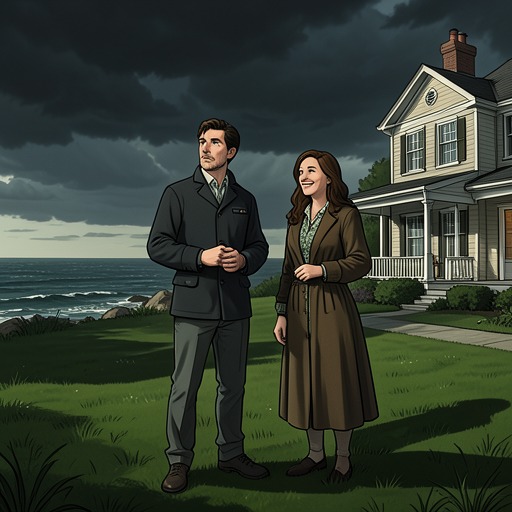
Price’s house stands on the water in East Hampton, rises four stories, and is joined by a galvanized-steel staircase. Its scale makes luxury architectural rather than merely decorative. The kitchen alone covers one thousand square feet and is arranged around enormous ovens, massive cupboards, a walk-in freezer, a three-door refrigerator, and a custom stainless-steel island. Four of the nine bathrooms contain trompe l’oeil paintings, while five display antique lead ram’s heads whose mouths pour water into the sinks. Antique marble fills the sinks, bathtubs, and showers, and the floors are made of tiny marble mosaics.
The house also turns culture into inventory. Every room has a stereo; twelve Frank Lloyd Wright standing lamps and fourteen Josef Heffermann club chairs occupy the interior; two walls are filled with videocassette cases, while another holds thousands of compact discs behind glass. An Eric Schmidt chandelier hangs in the entrance above an Atomic Ironworks steel moose hatrack, and the rooms contain a nineteenth-century Russian dining table without chairs, photographs by Cindy Sherman, an exercise room, eight walk-in closets, five VCRs, a Noguchi glass-and-walnut dining table, a hall table by Marc Schaffer, a fax machine, a topiary tree beside a Louis XVI window bench, and an Eric Fischl painting above one of the marble fireplaces. A tennis court and two saunas extend the house’s promise of total provision.
This accumulation gives The Hamptons a sharply defined contrast with the city’s exposed streets, but not with the novel’s governing values. The house offers space, water, design, equipment, and privacy in abundance; it does not offer emotional clarity. Its objects are arranged as a catalogue of distinction, and its comfort resembles the restaurants, cards, clothing, and clubs through which Bateman’s circle continually confirms its rank. The retreat thus becomes an enlarged domestic version of the same competitive spectacle.
Escape and Continuity
The Hamptons appears to promise distance from the urban scenes through which Bateman moves, yet the narrative repeatedly connects the retreat to the city rather than treating it as an alternative world. Price’s property is an extension of the same network that includes Wall Street, exclusive restaurants, limousines, and private clubs. Bateman’s decision to go there follows a recognition that his mask of sanity is slipping, but the setting does not produce recovery, confession, or moral interruption. It merely supplies a more lavish enclosure for a consciousness already described as stupefied and bloodlustful.
The contrast is especially revealing when set against Bateman’s movement through New York City. He can spend four hundred seventy-five dollars at Pastels, charge the bill to his American Express Platinum Card, and then pass a homeless man asking first for change and then for food. Later, while walking through the antique district below Fourteenth Street, he encounters empty streets, drug offers, party hustlers, garbage, steam, and a homeless man lying beside a thin dog named Gizmo. The Hamptons stands at the opposite end of this economic landscape, but the novel links the two rather than separating them ethically: conspicuous abundance and visible deprivation belong to one metropolitan system.
The same continuity persists in Bateman’s later return to Central Park. At the Central Park Zoo, unable to maintain a credible public persona, he wanders among drug dealers, custodians, animals, spectators, and children, turning the zoo’s display of life into another occasion for hostility and violence. Near the children’s zoo, he later passes the place where he murdered the McCaffrey boy and feeds portions of Ursula’s brain to passing dogs before encountering a blinded homeless veteran on Fifth Avenue. The Hamptons has not displaced the city’s violence; it has only provided a temporary, luxurious pause within the same trajectory.
Narrative Significance
As a location, The Hamptons condenses the novel’s critique of consumerism and materialism. Price’s early reference to his house converts geography into a résumé line, while Bateman’s later visit reveals how a supposedly restorative destination can remain governed by ownership, display, and inherited access. The house’s extreme specifications make wealth visible as an endless sequence of purchasable surfaces, yet Bateman’s mental state grows more unstable precisely as he moves through this abundance.
The location also exposes the limits of escape in Bateman’s unreliable narration. He leaves New York City because his violence is becoming difficult to contain, but no external setting changes his relation to other people or to himself. The Hamptons offers enclosure without transformation, privacy without intimacy, and luxury without relief. Its final importance is therefore structural: it enlarges the novel’s central world rather than opposing it, showing that the polished refuge of the wealthy and the city’s scenes of abandonment are connected expressions of the same social and psychological order.