The Patty Winters Show videotape
American PsychoThe Patty Winters Show videotape is more than a recording that Patrick Bateman watches in passing: it is a recurring object through which the narrative places sensational television beside grooming, shopping, drug use, sexual violence, and murder. Its presence makes the domestic screen a kind of emotional appliance, always available to fill silence yet incapable of producing recognition or moral response. The videotape therefore helps define Bateman's media-saturated consciousness, where atrocities can be replayed, catalogued, or mistaken for programming while ordinary social life continues unchanged.
Appearance and Recurring Use
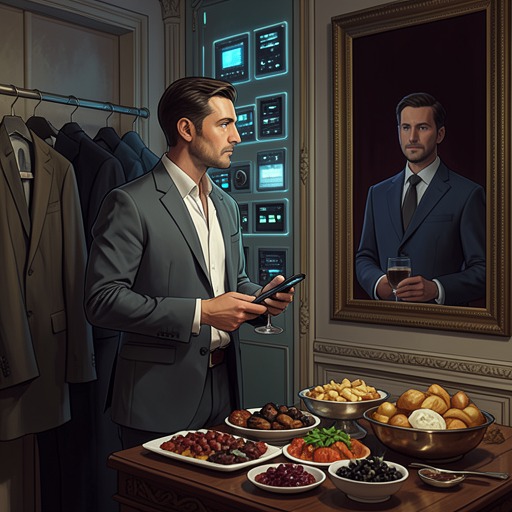
The tape first appears during Bateman's morning dressing ritual. While he wears an elaborate Alan Flusser eighties drape suit, a dotted Valentino Couture silk tie, and crocodile loafers by A. Testoni, the television presents women with multiple personalities. The program's host, Patty Winters, questions an overweight older woman about her condition, and the guest insists that multiple personalities are not schizophrenia and that such people are not dangerous. When asked who she was the previous month and who she is now, she answers that she is Lambchop, mostly Lambchop. The absurd exchange is presented alongside Bateman's precise attention to clothing and appliances, making the television's unstable account of identity echo the larger uncertainty surrounding his own.
The object returns within Bateman's private routines and after-hours activities. Following the killing of Paul Owen, Bateman watches a videotape of that morning's program while listening to messages and taking a call from Evelyn Richards. On this occasion the subject is Deformed People. The tape does not interrupt the aftermath of the crime; it accompanies it, as casually as a television rerun or a telephone message. The juxtaposition makes the recording part of the room's machinery of concealment, helping Bateman maintain a surface of ordinary domestic activity while the consequences of violence remain physically nearby.
The tape also becomes entangled with Bateman's uncertainty about what he has recorded. After spending time with the corpses of Christie and Elizabeth, he watches what he initially believes to be a videotape of the torture and murder of two escort girls from the previous spring. The program turns out to be an episode about tips on how a pet can become a movie star. This misrecognition is one of the object's most revealing functions: it shows a mind in which televised triviality and filmed atrocity have become interchangeable formats, both available for replay and both stripped of stable reality.
Television, Repetition, and Sensationalism
The videotape belongs to a wider culture of mediated repetition. Bateman keeps the television on while dressing, uses a Panasonic pocket television while at work, and repeatedly rents Body Double, a film he has taken out thirty-seven times. The Patty Winters material is similarly encountered as a sequence of compulsively consumed images rather than as meaningful communication. Its subjects are selected for abnormality, spectacle, or shock, and its format converts private suffering into a segment that can be introduced, questioned, replayed, and abandoned.
Near the end of the narrative, Bateman watches another recording while preparing to meet Jeanette. The program is divided into two sections. The first concerns Axl Rose, who is quoted discussing stress, self-harm, and the possibility of damaging a stereo rather than striking another person. The second consists of Patty reading letters Ted Bundy wrote to his fiancée during one of his trials, including the grotesque image of a woman contemplating him like a deranged seagull studying a clam and spreading hot sauce over him. Bateman waits for something to happen, but nothing does. He later remembers the phrase about hot sauce and takes cocaine before going out, carrying the show's language into the rest of his evening without transforming it into reflection or action.
The recording's subjects thus form a catalogue of distorted identity, bodily difference, self-directed violence, criminal violence, and comic or commercial triviality. The program does not supply Bateman with an ethical framework for these matters. Instead, it offers a steady stream of verbal and visual stimuli that he absorbs with the same attention he gives to labels, restaurants, exercise equipment, and consumer electronics. The show's recurrence is important precisely because it is not treated as exceptional: sensationalism has become a normal furnishing of his life.
Object, Image, and Unreliable Reality
As an object, the videotape occupies an unstable position between evidence and entertainment. Bateman repeatedly uses recorded images to organize experience, but the recordings never reliably clarify what has happened. The mistaken identification of the torture tape demonstrates that his categories of reality have collapsed. A program about making a pet into a movie star can be seen as a record of murder because the object is approached through expectation, obsession, and visual association rather than through secure evidence.
This instability extends beyond the tape itself. Bateman's narrative repeatedly places polished social performances beside violent fantasies and uncertain memories. At a restaurant, he presents a new business card from a gazelleskin wallet and waits proudly for his peers' reactions; in another setting, he considers killing Luis Carruthers because of Courtney Lawrence's relationship with him. The same social world that depends on names, clothes, reservations, and professional recognition also permits mistaken identities and unacknowledged brutality. The videotape mirrors that system by offering images that appear concrete while remaining radically open to misreading.
The tape's mechanical reproducibility also changes the status of violence. Bateman owns increasingly elaborate recording and playback equipment, including a Sony CCD-V200 8mm camcorder with time-lapse recording that could record a decomposing body at fifteen-second intervals or a poisoned small dog in convulsions. Within this environment, the camera and the videotape are not neutral conveniences. They make suffering recordable, repeatable, and technically manageable. The possibility of replay turns experience into footage, while the polished apparatus keeps the physical world at a distance.
Relation to Violence and Emotional Numbness
The most disturbing effect of The Patty Winters Show videotape is its adjacency to acts that should be morally and emotionally incomparable. Bateman can watch the program while hung over from a cocaine binge, after disposing of Paul Owen's body, or while surrounded by the remains of women he has killed. During the assault on Bethany, he sets up a Sony palm-sized Handycam to film what follows. The act of recording does not preserve a human encounter; it extends the logic of the television program, converting another person's pain into material for viewing and later repetition.
The tape also appears after violence as a means of maintaining routine. Following Owen's death, Bateman changes Owen's answering-machine message, packs his possessions into a Ralph Lauren suitcase, transports the body to an abandoned building in Hell's Kitchen, and treats it with lime. Later, while unable to sleep, he watches the program about Deformed People. The sequence places consumer objects, broadcast voices, and practical concealment in one continuous rhythm. Nothing in the television's flow acknowledges the crime, and Bateman does not experience the screen as a source of interruption. Its indifference becomes an external version of his own emotional vacancy.
By the time the narrative reaches its closing period, Bateman's dreams are filled with fires, volcanic eruptions, car wrecks, electric chairs, grisly suicides, syringes, mutilated pinup girls, and other disaster images. He wakes in a cold sweat and turns on the wide-screen television to block construction noise. The television is therefore both stimulus and anesthetic: it feeds the visual catalogue that invades his dreams, then serves as the device he uses to suppress the world around him. The videotape belongs to this cycle of saturation and avoidance.
Narrative Significance
The Patty Winters Show videotape gives material form to the narrative's concern with appearance versus reality and the interchangeability of identity. The multiple-personality guest's repeated answers, the sensational interview format, and Bateman's later confusion between programming and murder all make identity a performative and unstable product. The tape is a domestic prop, but it also behaves like a structural refrain, returning whenever the narrative needs to place public spectacle beside private derangement.
Its significance lies in the way it collapses distinctions that should remain firm: fact and fantasy, witness and consumer, confession and entertainment, suffering and content. Bateman's world is crowded with objects that promise control, from business cards and designer clothes to cameras and playback systems. The videotape reveals the limit of that control. Images can be selected and replayed, but they cannot guarantee understanding. Even when Bateman watches a program about violence or abnormality, the screen does not bring him closer to other people; it merely supplies another polished surface in which his own fractured perceptions can circulate.
The object consequently embodies the book's media archaeology of the late twentieth-century consumer environment. Its television segments, answering machines, pocket screens, videotapes, and recording devices create a culture in which reality is continually mediated yet never made more intelligible. The Patty Winters Show videotape is memorable because it does not stand apart from Bateman's violence. It is one of the forms through which that violence becomes thinkable, repeatable, and terrifyingly ordinary.