Timothy Price disappearance at the Tunnel club
American PsychoThe Timothy Price disappearance at the Tunnel club begins as a night of drugs, alcohol, professional display, and restless movement among Wall Street associates. It culminates when Timothy Price abandons the club’s elevated social space, leaps onto the tracks, and disappears into the tunnel. Because the scene is narrated through Patrick Bateman’s impaired and uncertain perception, and because Timothy Price later reappears at the office apparently unharmed, the event never settles into a single stable meaning: it may be an actual disappearance, a reckless performance, or another episode in the novel’s deliberately unreliable narration.
Causes and Background
The episode develops within the controlled but feverish environment of Tunnel. The club is crowded beyond capacity with Wall Street professionals in tuxedos, flashing laser lights, a strobe, a smoke machine, and an earsplitting mixture of music and businessmen’s voices. Patrick Bateman follows Timothy Price into an empty men’s-room stall, where Price bolts the door and hands him a small envelope containing what is supposed to be a gram of cocaine. Price says he is shaking and makes Patrick open the package, establishing the immediate link between the night’s stimulation, disorientation, and escalating behavior.
Price’s earlier self-presentation helps explain the pressure behind the performance. In a cab leaving Wall Street, he describes himself as resourceful, creative, young, unscrupulous, highly motivated, and highly skilled, insisting that society cannot afford to lose him because he is an asset. He complains that everyone hates their job and that they are not making enough money, while pointing to his co-op and his place in the Hamptons as evidence of the status he expects to possess. The social world surrounding the disappearance therefore joins anxiety to privilege: professional ambition, expensive leisure, drugs, and competitive masculine display coexist without producing any dependable sense of purpose.
What Happens at Tunnel
After Patrick returns to the club, Timothy Price is found near the railing above the tracks. McDermott grabs Patrick’s arm and asks what Price is doing. Patrick sees Price balancing on the rails with a champagne glass in one hand, both arms extended, his eyes half closed as though blessing the crowd. The strobe flashes, gray smoke billows around him, and the overfilled room turns his precarious position into a theatrical image rather than an emergency.
Price shouts, but the noise initially swallows his words. Patrick pushes forward through the dense crowd, passing Madison and several other Wall Street men, yet he cannot reach him. The narration emphasizes Patrick’s reaction as much as Price’s danger: Patrick is embarrassed and, while trapped among the spectators, suddenly relieved that he cannot save Price from humiliation. The crowd’s attention arrives only during a brief break in the noise, when Price can be heard shouting, "Goodbye!" and then, "Fuckheads!"
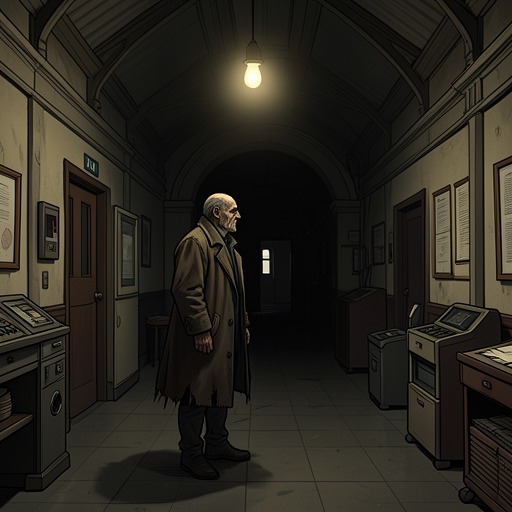
Price twists around, hops over the railing, and leaps onto the tracks. He runs into the tunnel with the champagne flute still held out to his side, stumbles twice under the strobe light, regains his balance, and disappears into the blackness. A security guard remains idly beside the railing and merely shakes his head. Patrick calls, "Price! Come back!" but the crowd applauds what it understands as a performance. Madison extends a hand as if congratulating Patrick and remarks, "That guy's a riot." The applause converts a potentially fatal act into nightlife spectacle, while the indifference of the guard and the spectators leaves Price’s life secondary to the scene’s entertainment value.
Immediate Consequences and Uncertainty
Once outside Tunnel, Patrick is high and exhausted, with a strangely sweet taste in his mouth after more vodka and whiskey. He, David Van Patten, and Craig McDermott discuss finding another club, Nekenieh, rather than organizing a search for Price. McDermott does ask whether Price knows about a VIP room that they do not, but the question remains tied to club access and status rather than to Price’s safety. The group’s attention moves on with the same speed as the limousines trying to turn onto the West Side Highway.
The episode’s uncertainty is reinforced by Patrick’s wider condition. Elsewhere, he loses track of where he has been, what he has eaten, and whom he has met, suffers an anxiety attack, and calls Jean from a phone booth without knowing where he is. His perceptions repeatedly blend precise consumer details with gaps in memory and abrupt distortions. The Tunnel episode uses that same unstable viewpoint: the account is vivid in its lighting, music, smoke, gestures, and crowd behavior, yet it cannot establish whether the apparent disappearance has the ordinary consequences that such an act should produce.
Return and Narrative Reversal
Much later, Timothy Price resurfaces at Pierce & Pierce, or Patrick is at least fairly sure that he does. Jean announces that Price wants to talk, and Patrick responds fearfully before allowing him into the office. Price enters wearing another carefully specified business outfit and appears remarkably fit, aside from what Patrick thinks may be a smudge on his forehead. Patrick asks where he has been; Price replies that he has merely been making the rounds and is back.
The return reverses the apparent value of the Tunnel scene. The leap seemed to move Price from public visibility toward disappearance, perhaps even death, but the later office meeting restores him to the corporate world without explanation, investigation, injury, or acknowledgment of the tracks. Patrick’s conversation with him is brief and oddly insubstantial, and Patrick remains both curious and unconcerned about what has happened in Price’s world. The disappearance thus becomes neither a solved mystery nor a confirmed death. It is absorbed into the ordinary continuity of offices, clothes, handshakes, and business talk.
Significance
The incident compresses the novel’s recurring conflict between spectacle and consequence. Tunnel provides an elaborate apparatus for seeing—rails, strobes, smoke, music, and a crowd—yet the apparatus does not produce knowledge. Everyone watches Price, but almost nobody responds to the danger; when the act becomes legible as entertainment, applause replaces intervention. The event’s social order is therefore one in which visibility does not guarantee recognition and proximity does not produce responsibility.
Price’s movement from the cab’s talk of professional indispensability to the club’s theatrical exit also exposes the emptiness of the identity he claims. He presents himself as an indispensable asset, but in the club he becomes a body balanced above tracks, a temporary image consumed by spectators. His later return makes even that image interchangeable with another office appearance. The same man can be a high-status colleague, a drug user, a performer, a possible suicide, and an apparently intact executive without the surrounding society demanding a coherent account.
As an event, the Timothy Price disappearance at the Tunnel club is therefore both a reckless escape and a structural test of the book’s unreliable narration. Its dramatic charge comes from the apparent shift from social belonging to isolation and possible death; its deeper effect comes from the refusal of the plot to confirm what that shift means. Price vanishes into darkness, the crowd applauds, Patrick leaves, and Price later walks back into the office. The unresolved return leaves the reader with the novel’s governing question of appearance versus reality: in a world organized by status, surfaces, and repeated performances, even disappearance may be only another way of appearing.