Tunnel
American PsychoTunnel is presented as a high-status Manhattan nightclub whose social world concentrates the values of Wall Street yuppie culture: expensive clothes, controlled access, conspicuous consumption, cocaine, and the effortless conversion of danger into spectacle. Its most consequential episode occurs when Timothy Price leaves the club's crowded interior by leaping onto the underground tracks, an act the surrounding crowd treats less as an emergency than as another performance.
Setting and Social Architecture
Tunnel is surrounded by a tuxedoed crowd, while a middle-aged homeless man sits beside a Dumpster near the entrance, extending a Styrofoam cup to anyone willing to notice him. The spatial contrast is immediate: the homeless man is only a few feet from the ropes, yet the club's threshold protects the guests from his claims on their attention. David Van Patten briefly waves a crisp one-dollar bill in front of the man's face, allowing hope to appear before pocketing the money and entering the club with the others. The gesture turns exclusion into a small public game and makes the entrance itself a diagram of class power.
Inside, the men receive a dozen drink tickets and two VIP Basement passes, while two doormen in long wool coats and ponytails question why the group is not wearing tuxedos. Timothy Price handles the challenge through presumed influence or tipping, demonstrating that formal dress rules are less decisive than wealth, confidence, and access to institutional privilege. Tunnel therefore operates through both visible regulations and informal exemptions: the door filters bodies, but status can override the filter.
Interior Atmosphere and Its Occupants
Patrick Bateman follows Price through a narrow corridor parallel to the dance floor, past the bar and into the Chandelier Room. The room is packed with professionals from Drexel Burnham Lambert, Lehman's, Kidder Peabody, First Boston, Morgan Stanley, Rothschild & Co, Goldman Sachs, and Citibank. They wear tuxedos, hold champagne flutes, and occupy the room as a nearly interchangeable financial class. Music shifts seamlessly from "New Sensation" into "The Devil Inside," reinforcing the sense that the club's environment is engineered as a continuous, frictionless surface.
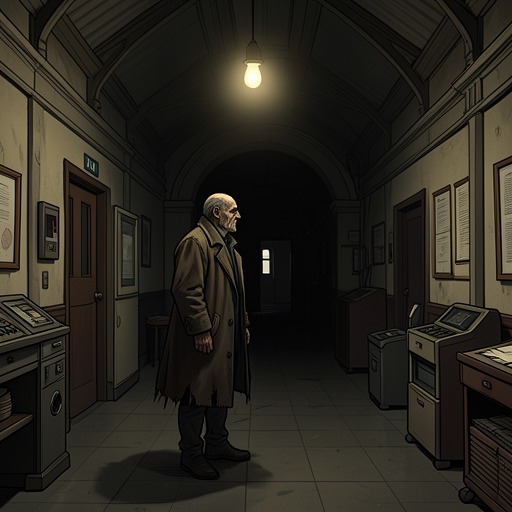
Ted Madison stands near the rear railing in an elaborate tuxedo, while the twin train tracks beyond him disappear into darkness. The tracks are garishly lit in preppy greens and pinks, an artificial coloration that makes an infrastructural hazard resemble a designed attraction. Price stares toward them as though they embody freedom or an escape he has been seeking. The image briefly opens a gap in the club's polished order: behind the champagne and clothing, a route into darkness is visible, but it can be perceived only as fantasy until Price turns that fantasy into action.
The club is also marked by absence. Bateman notices no women except one woman dancing alone in a corner, while the room is otherwise occupied by an army of male Wall Street professionals. The concentration of men, financial affiliations, designer clothing, and drug anticipation gives Tunnel the character of a closed professional fraternity rather than a socially open dance venue. Its pleasures are organized around recognition, ranking, consumption, and the display of belonging.
Cocaine, Performance, and the Tracks
After Madison returns from an unexplained absence, Price leads Bateman upstairs to an empty men's room and locks them together in a stall. Price says he is shaking and hands Bateman a small envelope containing what is supposed to be a gram of cocaine. The drug is visibly less than expected in the dim fluorescent light, but the uncertainty does not interrupt the ritual. Tunnel's private spaces support the same economy as its public rooms: access, anticipation, and consumption matter more than reliability.
Later, Price climbs onto the railing while holding a champagne glass. With the strobe flashing and the smoke machine filling the room with gray mist, he extends both arms and closes his eyes as though blessing the crowd. Bateman struggles through the overcapacity room but is unable to reach him. The club's noise—music combined with the din of businessmen—makes Price's words almost inaudible, and this failure of communication allows the scene to become a visual performance before it becomes a crisis.
During a precisely timed silence, Price shouts, "Goodbye!" and then, "Fuckheads!" He twists over the railing, leaps onto the tracks, and begins running into the darkness with the champagne flute still held out at his side. He stumbles twice but regains his balance before disappearing. A security guard remains idle near the railing and merely shakes his head, while the crowd applauds what it interprets as a performance. Bateman calls after Price, but the applause overwhelms the warning. Madison offers Bateman a congratulatory hand and calls Price a riot; McDermott, more worried, asks whether Price knows about a VIP room that the others do not.
The value shift is stark. Price's earlier longing for freedom becomes a literal movement toward danger, while the crowd's response converts possible death into entertainment. Tunnel does not simply contain the event; its lighting, music, crowd density, security failure, and status-conscious spectators shape the event's meaning. The club's social machinery absorbs a desperate act and returns it as applause.
Connections to the City Outside
Tunnel's entrance links the nightclub to a wider urban route running from Wall Street and expensive restaurants to streets where poverty is visible but disregarded. Earlier, after a costly meal at Pastels, Bateman and his companions encounter a different homeless man asking first for change and then, more hopefully, for food. The expensive bill, charged to Bateman's American Express Platinum Card, and the undrunk champagne left at the table establish the consumption pattern that Tunnel intensifies. Wealth is counted precisely, while need is treated as an irritation or joke.
After leaving the social circuit, Bateman walks through an empty antique district below Fourteenth Street, past a newsstand, dry cleaners, church, diner, and phone booth, with frozen garbage lining the curbs. He later finds a homeless black man lying in the doorway of an abandoned antique store on Twelfth Street beside a shopping cart marked "I AM HUNGRY AND HOMELESS PLEASE HELP ME." His dog, Gizmo, lies beside him on newspapers, guarding the cart. The movement from Tunnel's VIP passes to this doorway is not a change of city but a change in visibility: the same urban system that grants effortless entry to financiers leaves other bodies exposed on the pavement.
The pattern recurs across Manhattan. Bateman passes through Central Park and the Central Park Zoo, where the surrounding skyscrapers and Fifth Avenue apartments enclose a space he experiences as unnatural; later, near the children's zoo, he returns close to the place where he murdered the McCaffrey boy. On Fifth Avenue he encounters another beggar, a blinded Vietnam veteran, and sees a dog protecting him. These scenes extend Tunnel's threshold logic into the city: privilege moves through protected interiors, while homeless people, animals, and victims remain exposed in doorways, streets, parks, and other weakly supervised spaces.
Narrative Significance
Tunnel functions as a concentrated model of appearance versus reality. Its tuxedos, designer labels, champagne, music, and VIP access project order and refinement, yet the club's underlying structure is unstable: a drug transaction is uncertain, identities and social perceptions blur, security fails, and a man can vanish onto the tracks while spectators applaud. The polished surface does not suppress violence; it supplies violence with lighting, rhythm, and an audience.
The club also embodies the social homogeneity and identity interchangeability that dominate Bateman's world. Financial firms, clothing brands, and male professionals blur into a single class spectacle, while even prominent men are repeatedly mistaken for one another. Price's leap exposes the cost of that sameness. His desire to escape the crowd is expressed through the most public gesture available, but the crowd immediately reclassifies it as entertainment, leaving the system intact.
For Bateman, Tunnel is simultaneously a site of appetite, threat, and emotional vacancy. He carries a serrated knife in his jacket and imagines attacking McDermott in the entranceway, yet the impulse is displaced by anticipation of champagne, flirtation, cocaine, and music. The club's ability to turn murderous pressure into recreational expectation mirrors Bateman's own depersonalization. Tunnel is therefore significant not merely as a nightlife setting but as a social machine in which exclusion, consumption, danger, and spectacle operate seamlessly together.